


The Myth of the Water Bank
For decades, Nepali textbooks and political rhetoric have perpetuated the belief that Nepal is the second richest country in water resources globally, trailing only Brazil. However, verified hydrological data confirms this claim is a myth. In terms of total renewable water resources, Nepal actually ranks approximately 43rd in the world, behind nations such as Russia, Canada, and India. Despite this ranking correction, the country remains a formidable "Water Bank" for South Asia. Holding a "deposit" of roughly 6,000 rivers and rivulets, Nepal generates an annual surface runoff of 225 billion cubic meters. The strategic significance of this volume is disproportionate to Nepal's size; while the country occupies only 13-14% of the Ganges catchment area, it contributes a staggering 47% of the river's total annual flow and up to 75% of its dry-season flow, serving as a critical lifeline for hundreds of millions downstream.
From Darkness to Export
Nepal’s journey to harness this "White Gold" began as early as 1911 with the commissioning of the Pharping Hydropower Plant, yet the sector languished for a century due to political instability and lack of investment. By the 1990s, development partners like the World Bank identified hydropower as the nation's path to prosperity, leading to the 1992 Hydropower Development Policy which opened the sector to private investment. However, the country suffered through a "dark age" of up to 18 hours of daily load shedding until 2016. The appointment of Kulman Ghising as Managing Director of the Nepal Electricity Authority (NEA) marked a pivotal turnaround, eliminating power cuts through management efficiency rather than immediate infrastructure spikes. As of January 2026, the country has expanded its installed capacity to approximately 3,800 MW, transitioning from a net importer to a net exporter of electricity during the wet season.
The Geopolitical Stranglehold
The monetization of Nepal's water is inextricably linked to its complex relationship with India. Historic agreements, specifically the Koshi (1954) and Gandak (1959) treaties, remain sources of deep national grievance; critics and local populations argue these treaties favored India with irrigation and flood control benefits while leaving Nepal to deal with inundation and displacement. This asymmetry complicates modern trade. While a Power Trade Agreement was signed in 2014, India’s "Procedure for Approval and Facilitating Import/Export" effectively bars the purchase of power from projects involving Chinese investment or contractors. This policy forces Nepal into a geopolitical "sandwich," compelling it to sideline Chinese capital to access the Indian market. Despite these tensions, a trilateral breakthrough occurred in November 2024, when Nepal began exporting 40 MW of electricity to Bangladesh via the Indian grid, marking its first step as a true regional energy provider.
A Climate Time Bomb
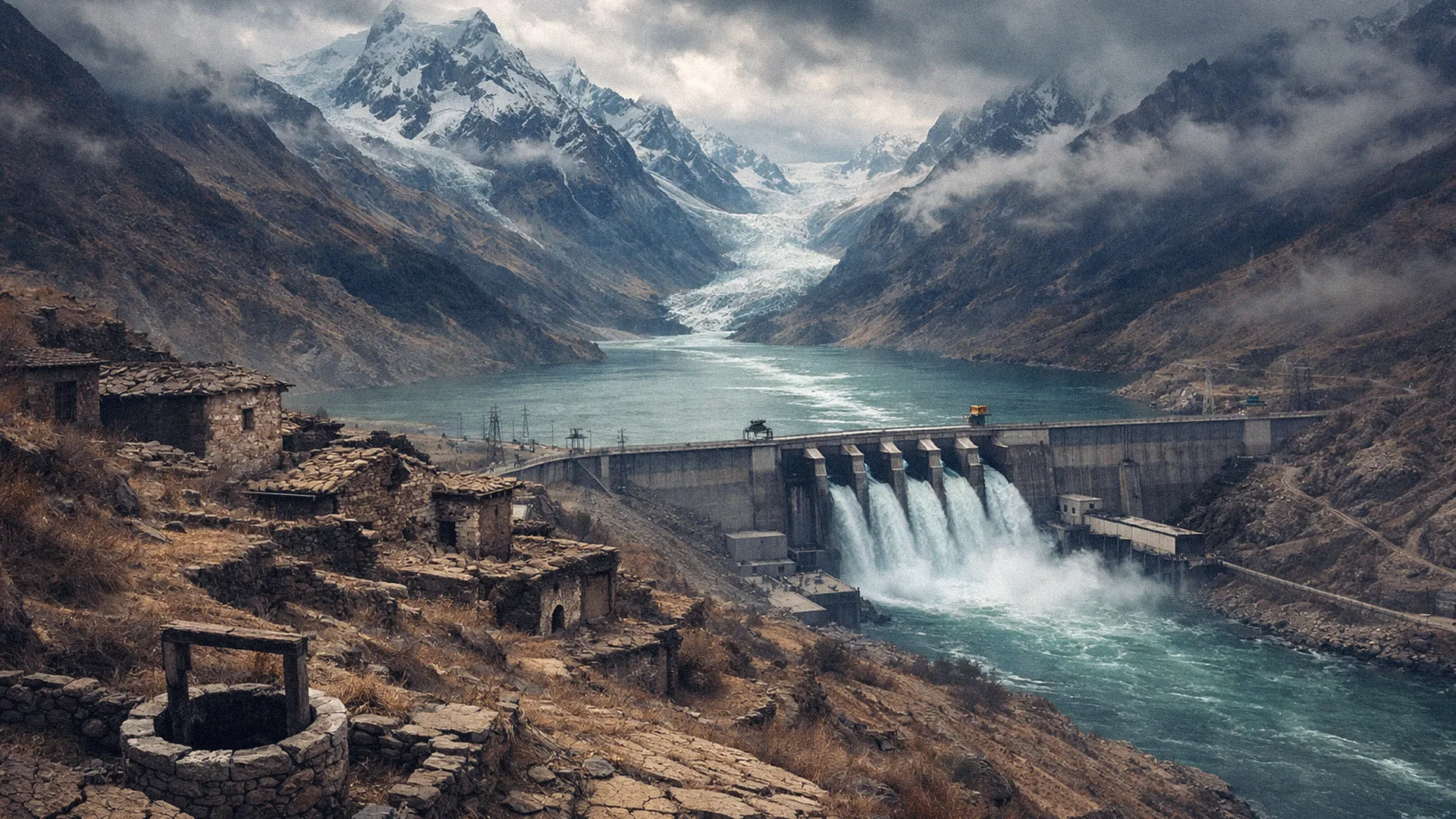
While politicians focus on megawatts, environmental reports highlight a growing ecological crisis that threatens the bank's solvency. The Himalayan region is warming, leading to the rapid melting of glaciers and the formation of unstable lakes. Current verified assessments identify 47 glacial lakes at dangerous risk of bursting, a phenomenon known as Glacial Lake Outburst Floods (GLOFs), which threatens downstream infrastructure. The vulnerability of this sector was tragically underscored by the 2021 Melamchi disaster, where a massive debris flow destroyed the headworks of a flagship water project shortly after its completion. Furthermore, a cruel paradox has emerged in the mid-hills: while major rivers roar with snowmelt, thousands of local springs are drying up due to haphazard road construction and climate change, leaving river-rich villages thirsty.
The Shift to Storage
Recognizing the limitations of Run-of-River projects, which see generation plummet during the dry winter months, Nepal is pivoting its strategy toward storage projects like Budhi Gandaki. This shift aims to transform the nation into a true "Blue Battery" capable of regulating flow and providing peak power when the region needs it most. By early 2026, electricity had established itself as a top export commodity, narrowing the trade deficit with India. Ultimately, Nepal’s ability to capitalize on its resources depends on whether it can navigate the treacherous waters of regional geopolitics while racing against the ticking clock of climate-induced ecological collapse.