


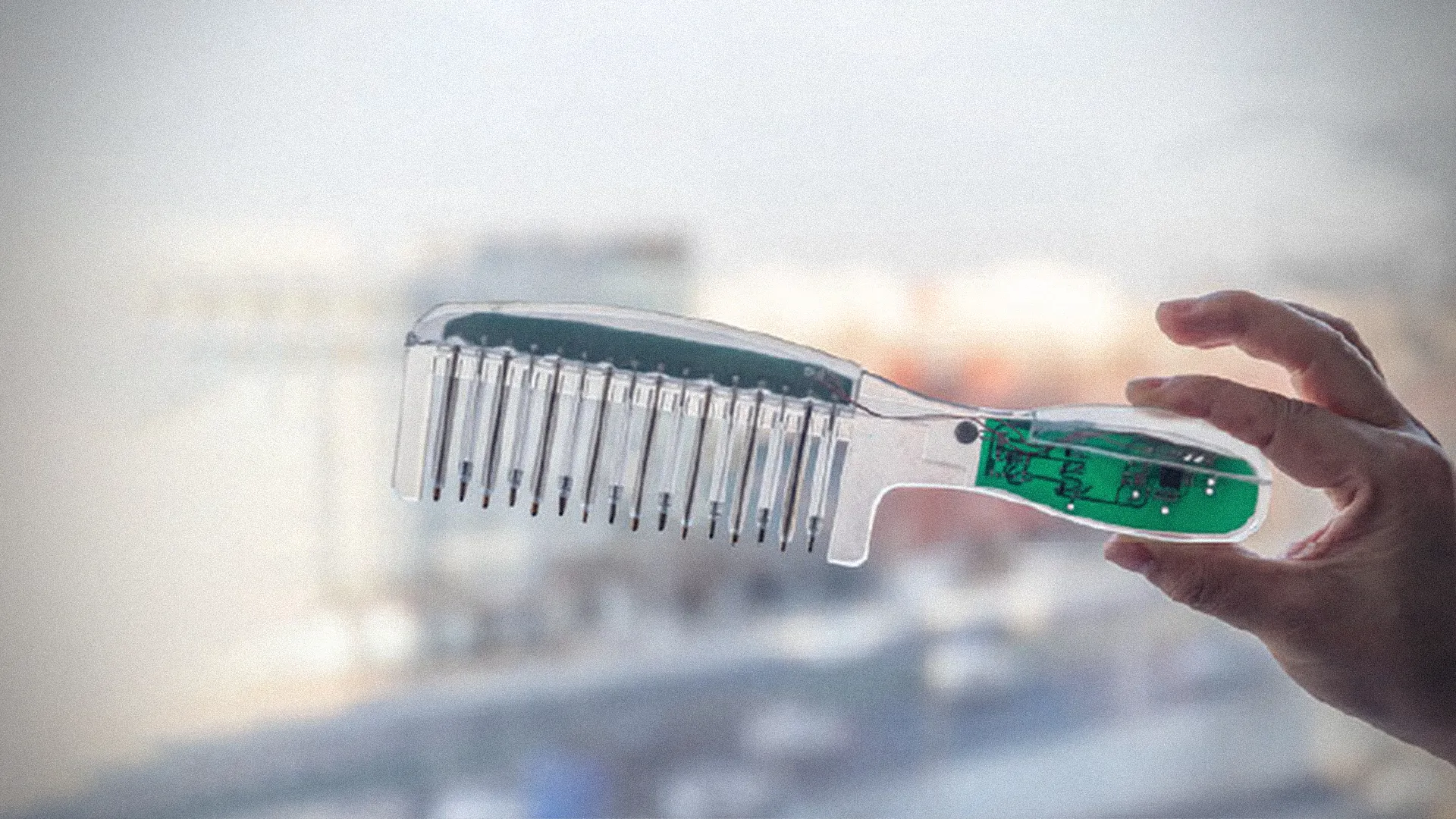
A breakthrough bioelectronic comb engineered by scientists in Beijing, China, could soon offer a powerful new treatment for pattern hair loss affecting over one billion people worldwide. In recent laboratory trials, the specialized device restored nearly 98 percent of lost hair in mice within just 28 days, outperforming conventional medications.
According to a study led by Liu and colleagues at Beihang University and published in the journal Nature Communications in 2026, the device is named Detangle. Unlike ordinary combs, it features alternating teeth of varying lengths embedded with electrodes and drug-delivery modules.
Researchers note that this staggered tooth design generates pulsed electric fields 2.63 times stronger than uniform rows, penetrating roughly nine times deeper into hair follicle regions. These pulses stimulate follicles directly while triggering electroporation, a process that temporarily increases cell membrane permeability to push therapeutic molecules deep beneath the skin.
During the experiments, the team paired electrical stimulation with two targeted genetic therapies. They utilized VEGFA plasmid to encourage blood vessel growth around follicles and SRD5A2 siRNA to block the hormone responsible for follicle shrinkage.
In a 28-day trial involving male mice with testosterone-induced androgenetic alopecia, untreated animals regrew only about 1 percent of shaved back hair. Mice treated solely with Detangle's electrical pulses saw roughly 40 percent regrowth, trailing standard drugs like finasteride at 50 percent and minoxidil at 70 percent.
However, combining electrical stimulation with the genetic therapies yielded dramatic improvements, achieving about 85 percent regrowth with SRD5A2 siRNA and 90 percent with VEGFA plasmid. When mice received the complete Detangle regimen combining electrostimulation with both genetic treatments, hair recovery reached approximately 97.85 percent, surpassing existing oral and topical options.
While the study serves as a compelling proof of concept, scientists emphasize that further clinical trials are necessary to confirm the system's safety and effectiveness in humans. If future testing validates these results, everyday hair care tools could soon play a central role in treating baldness.