


A series of protests across multiple regions in China has brought renewed scrutiny to the country’s internal stability, as citizens clash with authorities over environmental concerns, land disputes, and local governance issues. From central provinces to the industrial south, these demonstrations—though local in origin—have collectively signalled a broader undercurrent of discontent.
In the city of Wuhan, tensions have centred on a controversial battery manufacturing project. Residents have opposed the development since early February, citing fears over environmental degradation and potential health risks. On March 8, thousands of homeowners gathered in protest, only for the demonstration to be dispersed by police, with several participants detained. The unrest did not subside. On March 28, hundreds of residents again took to the streets, calling for the project’s cancellation. Witness accounts and circulating footage suggested that police intervened late at night, forcibly dispersing crowds and detaining multiple individuals. Reports indicated that security forces maintained a visible presence in the area in the following days.
Southern resistance over crematorium plans
Further south, in Guangdong Province, protests have emerged in Shuikou over plans to construct a crematorium near residential neighbourhoods, a primary school, and a local water source. Residents have argued that the location raises serious public health and environmental concerns. On March 25, hundreds of demonstrators marched through the town, with some estimates placing turnout at around 3,000. Eyewitnesses reported that police detained several protesters and that clashes resulted in injuries, though precise figures remain unconfirmed. Authorities subsequently intensified control measures in surrounding areas, including movement restrictions and identity checks for commuters. Earlier demonstrations between March 17 and 19 had already escalated into confrontations outside government offices, suggesting a sustained pattern of resistance rather than isolated incidents.
Disputes escalate beyond environmental concerns
Elsewhere, protests have arisen from a range of grievances. In Inner Mongolia, villagers gathered on March 25 to demand unpaid land lease fees from a private company. The demonstration was quickly dispersed by police, underscoring the limited tolerance for prolonged public gatherings. On the same day, a dispute in Sichuan Province over parking regulations escalated into a broader protest. Residents accused property developers and management firms of imposing unauthorised charges and restricting access to residential areas. Police intervention again resulted in reported injuries and arrests. While these incidents vary in scale and cause, they share a common pattern: local grievances escalating into confrontations with authorities, followed by swift enforcement measures to restore order.
Rising frustration and shifting public sentiment

Interested in this ad?
Would you like to continue to the link or provide your information for more details?
Please provide your information
To continue, please fill in your details
Analysts have linked the protests to deeper social and economic pressures, suggesting that frustration among residents is no longer confined to isolated issues. Observers note that when citizens perceive limited avenues for redress, local disputes can quickly evolve into broader expressions of dissatisfaction. In some cases, individuals have begun articulating more direct criticism of the state. In late March, entrepreneur and rights activist Shen Qijia posted a video alleging mistreatment by authorities, including detention and the confiscation of significant assets. His public remarks, in which he declared personal defiance against the system, gained attention online before being subject to censorship. Such expressions, though relatively rare in China’s tightly controlled information environment, have been interpreted by some observers as indicative of a shifting public mood.
Security presence intensifies in the capital
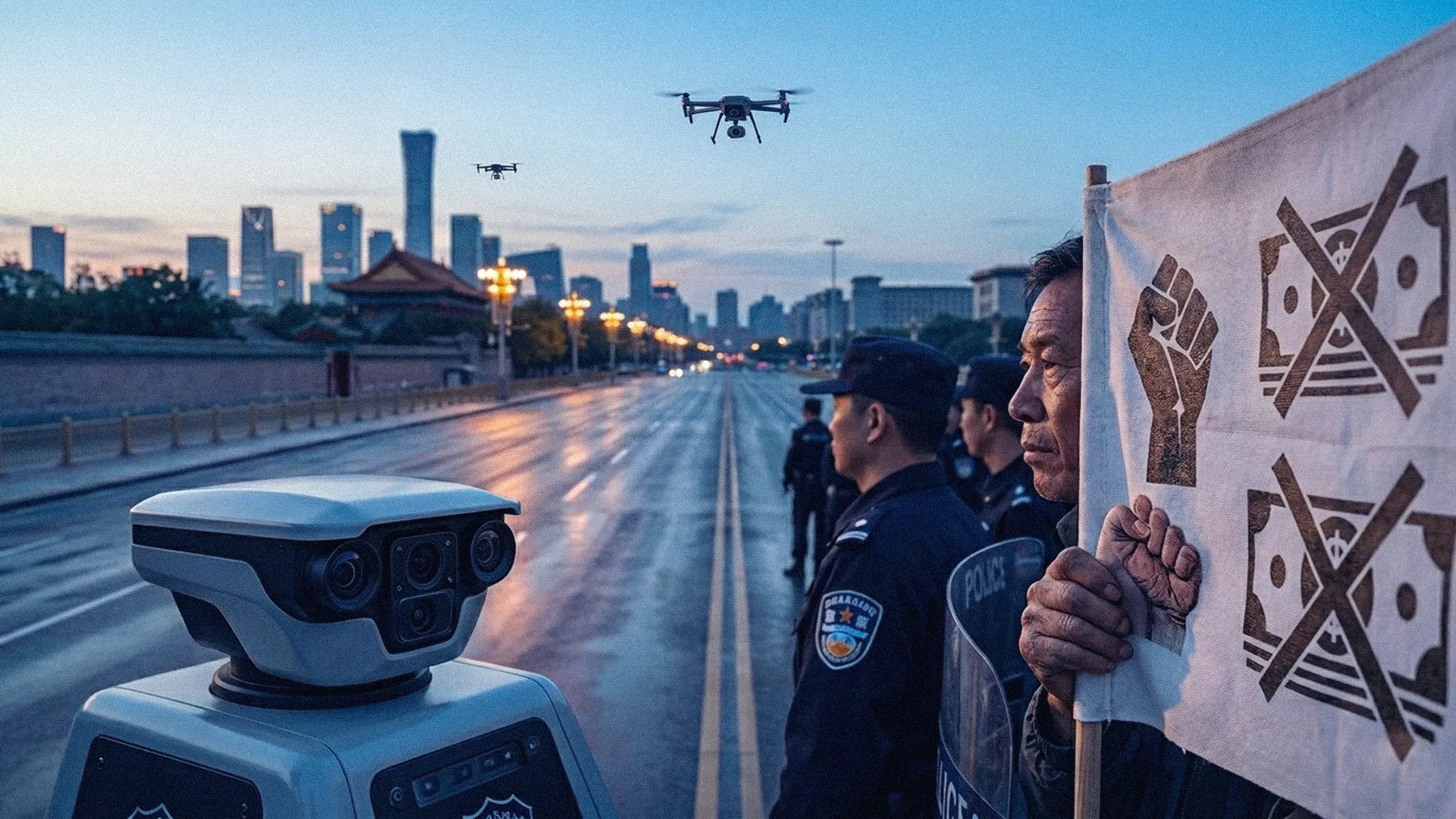
Amid these developments, authorities have moved to reinforce security in the capital, Beijing. Video footage circulating on March 29 showed a heightened police presence along Chang’an Avenue, one of the city’s main thoroughfares that runs past politically sensitive landmarks, including Tiananmen Square and the Forbidden City. The visible deployment of security forces has been interpreted as a precautionary measure aimed at preventing potential unrest in politically symbolic locations. Analysts have suggested that such steps reflect broader concerns about maintaining stability, particularly during periods of heightened social tension.
Sweeping drone restrictions
Alongside increased physical security, authorities have introduced sweeping new regulations governing the use of unmanned aerial vehicles in Beijing. Announced in late March and set to take effect on May 1, the rules place the entire city under controlled airspace. Under the new framework, all outdoor drone flights require prior approval. The regulations extend beyond usage, encompassing the manufacturing, modification, transportation, and storage of drones. Individuals must register their devices by April 30, with real-name identification required for buyers and operators. State media has framed the measures as necessary to address “low-altitude security challenges.” However, analysts have noted that the scope of the controls—covering the entire supply chain—goes beyond typical aviation safety regulations seen in other countries. The restrictions have been linked to concerns that drones could be used for surveillance, unauthorised documentation of protests, or even potential attacks targeting political figures. The comprehensive nature of the policy suggests an effort to limit both technological and informational risks in an increasingly digital environment.
A broader pattern of control and containment
Taken together, the protests and subsequent security measures point to a broader pattern of control and containment. While each demonstration has been rooted in local issues, the uniform response—rapid police intervention, detentions, and tightened surveillance—reflects a consistent approach by authorities. The expansion of drone regulations adds a new dimension to this strategy, extending oversight into the airspace and digital domains. By regulating both physical gatherings and technological tools, authorities appear to be reinforcing multiple layers of control. At the same time, the recurrence of protests across geographically dispersed regions suggests that underlying grievances remain unresolved. Environmental concerns, land disputes, and governance issues continue to generate friction between residents and local administrations. The recent wave of protests across China, coupled with intensified security measures and sweeping drone restrictions, underscores a complex and evolving domestic landscape. While authorities have acted swiftly to contain unrest and tighten oversight, the persistence of demonstrations across multiple regions indicates that localised grievances are continuing to surface in ways that challenge existing mechanisms of control.