


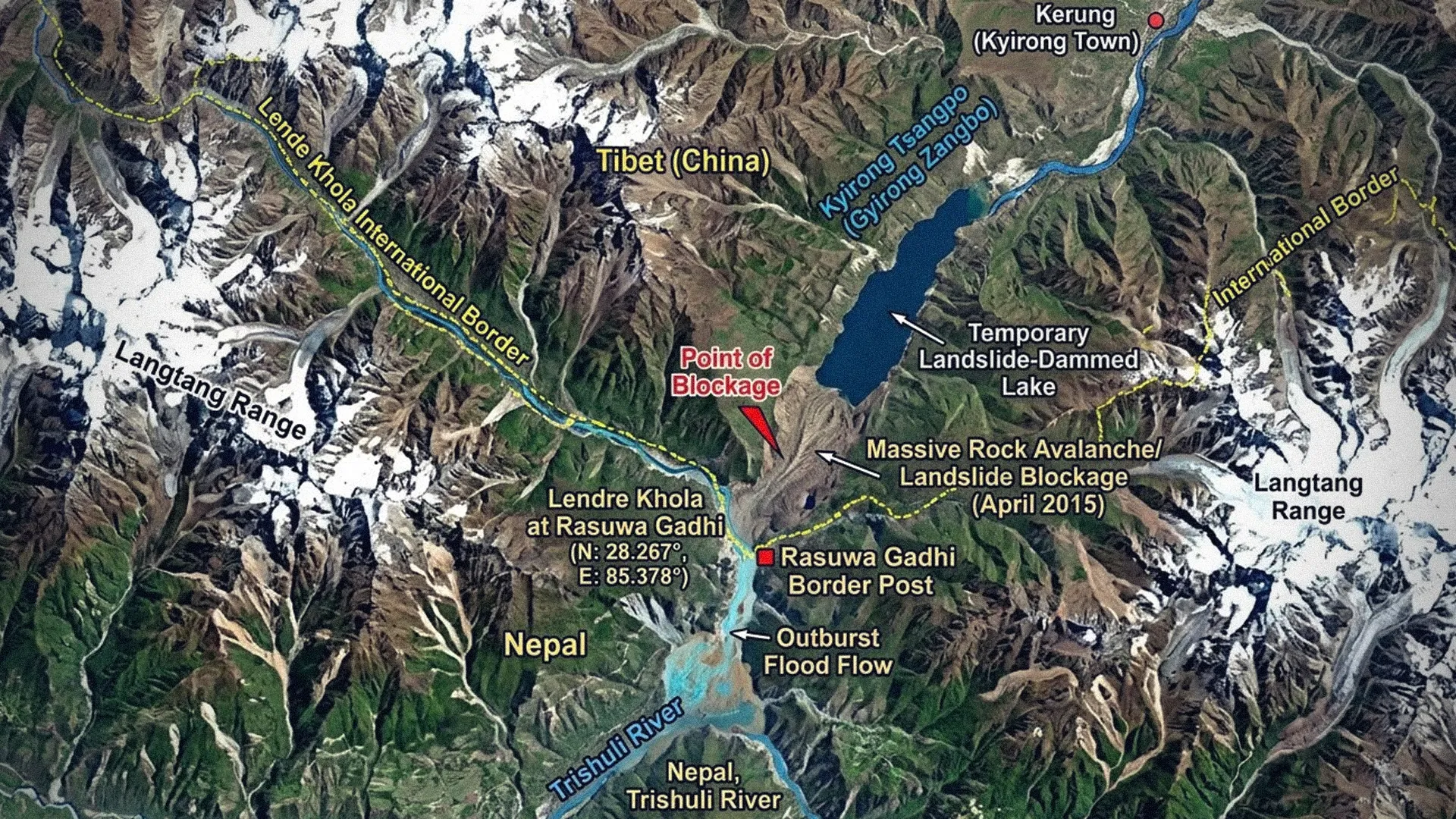
A catastrophic flood triggered by the sudden failure of a landslide dam in Tibet has devastated central Nepal, causing hundreds of deaths and widespread destruction along the Trishuli River basin. The outburst flow funneled across the Rasuwa Gadhi border crossing with immense force, severing critical trade infrastructure and paralyzing key energy projects.
Authorities have confirmed at least 270 deaths in Nepal and 3 in China, while over 1,384 individuals, including numerous foreign tourists, remain unaccounted for in Nepal. High-velocity floodwaters displaced river channels and surged into nearby settlements at elevations up to 80 meters above the normal river level.
According to reconstruction efforts by geological and disaster management experts, the catastrophe began on the morning of August 26, 2026. The United States Geological Survey reported a major landslide or rock avalanche in the upper catchment of the Kyirong Tsangpo in Tibet, generating long-period seismic waves estimated at magnitude 5.2. Researchers at the Chinese Academy of Sciences suggested that a combined ice and rock avalanche choked the narrow gorge, forming a massive temporary landslide-dammed lake just upstream of the international border.
When the temporary natural barrier breached due to overtopping or internal collapse, a massive surge laden with water, mud, ice, and geological debris rushed downstream. Upon entering Nepal at Rasuwa Gadhi, the deluge merged with the Lende Khola and surged into the main Trishuli River system.

Interested in this ad?
Would you like to continue to the link or provide your information for more details?
Please provide your information
To continue, please fill in your details
The surge completely destroyed the Rasuwa Gadhi customs office and primary border facilities, severing the vital overland trade corridor between Kathmandu and Lhasa. Power and communication lines to China's Gyirong Port were entirely cut off.
The Nepal Electricity Authority reported extensive damage to six major hydroelectric plants and transmission facilities, including the Rasuwagadhi, Chilime, and Trishuli 3A projects. Additionally, flooding reportedly destroyed over 90 percent of the upper dam and base camp of the 647 million dollar Korean-led Upper Trishuli-1 project, leaving at least 9 Korean workers missing.
Nepal's Roads Department stated that 19 bridges and 40 kilometers of roads, including the key Syafrubesi-Rasuwagadhi highway, have been damaged. Initial assessments estimate total infrastructure destruction at 15 billion rupees.
This calamity highlights the heightened disaster risks in the Himalayan region, where climate change accelerates slope instability across transboundary river basins. Strengthening regional monitoring and disaster preparedness remains critical as high-altitude geological hazards pose continuous threats to downstream communities.