


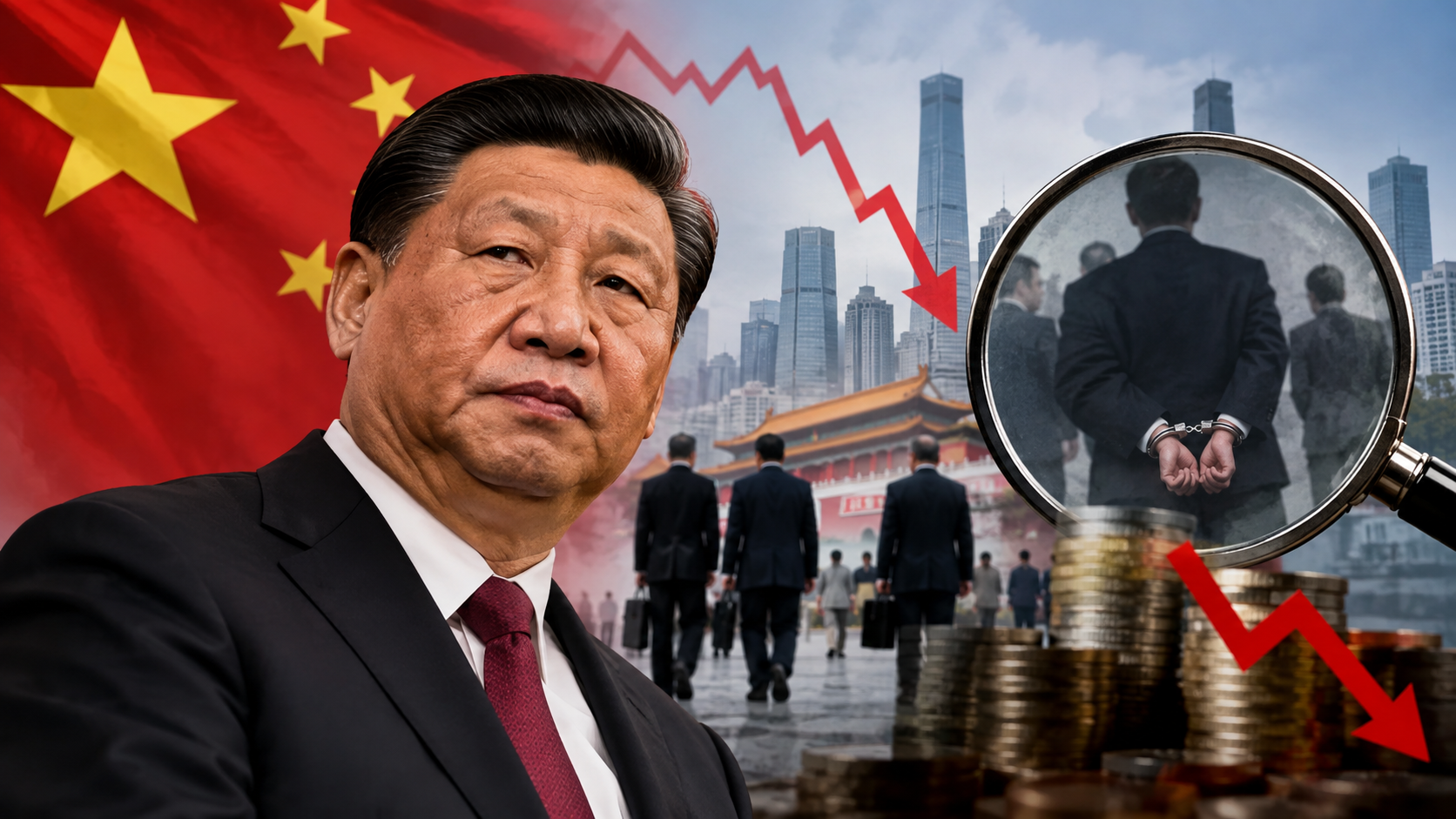
China’s anti-corruption campaign has become one of the defining features of Xi Jinping’s rule. What began in 2012 as a drive against the “tigers and flies” of the Communist Party has developed into a permanent system of political and administrative discipline. Its scale is difficult to ignore. In 2025, Chinese disciplinary authorities opened 1.012 million cases and punished 983,000 people. Among those investigated were 115 officials at the provincial or ministerial level and more than 5,000 at the bureau level. Another 68,600 people from enterprises, rural organizations and other non-governmental entities were disciplined.
The numbers demonstrate the reach of the campaign, but they do not by themselves establish its economic effect. There is considerable evidence that the crackdown has reduced rent-seeking and weakened the value of political connections. One study of Chinese firms found that the campaign increased total factor productivity by 1.7 percent, while other research found that the market value of politically connected firms fell by 7.5 percent during the first two years of the campaign. The latter suggests that much of the economic advantage previously generated through political connections had disappeared.
The economic cost of anti-corruption does not necessarily come from punishing corruption. It comes when the fear of investigation begins to influence legitimate economic decisions. As enforcement has expanded beyond bribery and embezzlement into political discipline, corporate governance and official conduct, the distinction between preventing corruption and encouraging excessive caution has become increasingly important.
The first cost appears within the bureaucracy itself. Chinese officials have traditionally operated in a system where promotion is closely connected to economic performance, local investment and the implementation of central policy. Anti-corruption enforcement changes that calculation. When the consequences of a policy mistake can include disciplinary scrutiny, while the political reward for taking an unconventional risk is uncertain, officials have an incentive to choose the safer option.
A study of Chinese cities found that anti-corruption investigations could reduce the effort local officials devoted to economic activity. The effect was particularly visible where administrative reforms had not reduced officials’ dependence on discretionary approvals. At the same time, the research found improvements in some welfare indicators, including environmental outcomes.
An official approving a major infrastructure project, restructuring a state-owned enterprise or supporting a struggling company may have legitimate reasons for doing so. But if that decision later fails, it can be examined retrospectively through the lens of misconduct. In such an environment, postponing a decision may become less costly than making one.
That creates a contradiction for China’s current economic policy. Beijing wants local governments to attract private investment, support technological innovation, revive consumption and manage the property downturn. Those objectives require officials to exercise discretion. Yet an increasingly expansive enforcement environment can encourage precisely the caution that makes these objectives harder to achieve.
The campaign’s effects are even more consequential when they reach corporate executives. Political connections were once an important feature of China’s business environment. Companies with strong government relationships could obtain easier access to credit, regulatory approvals, land and public contracts. The anti-corruption campaign has substantially reduced the value of such relationships. That has potentially improved competition by reducing the advantages enjoyed by politically connected firms.
But the same campaign has created another source of uncertainty. A review of Chinese stock-exchange disclosures found that senior figures at more than 80 publicly listed companies were detained by authorities in 2024. In roughly half of the cases examined, investigations were conducted by authorities outside the executives’ primary region of operation or by authorities whose jurisdiction was unclear. The pattern prompted concerns over the use of administrative and anti-corruption powers by financially pressured local governments. Premier Li Qiang subsequently called for greater oversight of regional enforcement practices.
The issue matters because private companies remain central to employment, innovation and business formation. Beijing is simultaneously asking private firms to invest more while attempting to reassure them that the regulatory environment is becoming more predictable. Expansive enforcement can complicate that message.

Interested in this ad?
Would you like to continue to the link or provide your information for more details?
Please provide your information
To continue, please fill in your details
The campaign has also affected consumption, although this effect should not be exaggerated. The crackdown on official extravagance sharply reduced spending on government banquets, luxury goods, entertainment and high-end hospitality. The renewed austerity drive has continued this approach. In 2025 alone, authorities recorded 290,752 violations of the rules governing official conduct, with 375,604 people receiving criticism or administrative handling and 261,788 receiving disciplinary punishment. More than 94 percent of the recorded cases involved officials at the township level or below.
This does not mean anti-corruption explains China’s broader consumption weakness. The property downturn, weak household confidence, employment concerns and demographic pressures are much larger factors. But the campaign adds another constraint to an economy that is already trying to persuade households and businesses to spend more.
There is another paradox. The campaign’s success in weakening political connections has been one of its clearest economic effects. Research examining Chinese firms found that the value of political connections declined sharply following the launch of the campaign. For firms that had benefited from such relationships, the reduction was costly. Yet for the broader market, the removal of preferential access can improve competition and redirect resources towards firms that are more productive rather than better connected.
Other research has found that anti-corruption can increase corporate innovation and investment efficiency. Studies of Chinese firms have reported higher research and development spending, stronger innovation outcomes and improvements in productivity following intensified enforcement. The implication is not that political connections should be restored. It is that informal relationships need to be replaced by predictable formal institutions.
If companies no longer benefit from political access but still face opaque regulation, they are not necessarily operating in a more competitive market. They may simply be operating in a more uncertain one.
The sharp decline in the value of political connections suggests that the campaign has reduced the economic advantages associated with political privilege. Greater investment efficiency and reduced rent-seeking can improve the functioning of markets.
The problem, however, has emerged when enforcement has moved beyond eliminating corruption and began to shape the behavior of officials, executives and professionals who did not necessarily engage in corrupt activities.
Beijing does not need to choose between fighting corruption and supporting growth. The larger challenge is nonetheless institutional: creating rules sufficiently clear that officials can make legitimate decisions, companies can invest without excessive political uncertainty and professionals can remain internationally connected without becoming politically vulnerable.
The cost of an anti-corruption campaign is therefore not measured simply by how many people it investigates. It is measured by whether people who are not corrupt begin behaving as though they have something to fear. That is the economic boundary Beijing will increasingly have to manage.