


SB Shah - Nepal’s Tarai Madhesh has historically represented a unique example of cultural, religious and social diversity. Despite historical grievances related to representation, inclusion and development, communities in the Tarai have largely maintained coexistence through shared traditions, local interactions and economic interdependence.
Violence, Public Anxiety and the Question of Trust
The recent violence in Kaptangunj of Sunsari has become a reference point for wider concerns among local communities. The impacts of violent conflict of Kaptangunj has been spread to the most of the area of Tarai and Madhesh Districts, including Saptari, Siraha, Dhanusha, Sarlahi, Rautahat and Parsa. Following incidents of violence, societies naturally seek answers regarding the causes, actors involved and possible institutional failures.
The people of Kaptangunj, and in the most of the districts of Madhesh Provinces have raised about madrassas, and their management systems. Local residents have questioned issues such as student enrollment procedures, institutional accountability and sources of financial support. These questions represent a demand for transparency and clarity.
The fundamental issue is whether Nepal has a fair and uniform regulatory framework that applies equally to all religious institutions, including Islamic organizations, Hindu religious groups, Christian organizations, Buddhist institutions and other faith-based entities.
External Religious Funding and the Debate Over Transparency
One of the most sensitive aspects of the current debate concerns foreign-linked religious funding and the expansion of religious infrastructure supported by external organizations.
In several parts of the Tarai, questions have emerged regarding foreign-supported construction of religious facilities, including madrassas and mosques. IHH, Turkiye had supported the construction of Madrassa several districts of Nepal, while the reported lastly was the involvement of organizations such as the Alhaj Shamshul Hoda (ASH) Foundation of Bangladesh in supporting religious infrastructure projects, including the Abdul E Razzak Madrassa project in Bhokraha Narsing Rural Municipality- Sunsari, has contributed to public discussion regarding approval procedures, funding transparency and government oversight.
The central question raised is whether foreign-funded religious projects follow appropriate legal procedures, whether financial sources are transparent and whether local governments are informed and involved.
A democratic government must avoid policies based on religious identity.
Humanitarian Assistance or Expansion of External Influence?
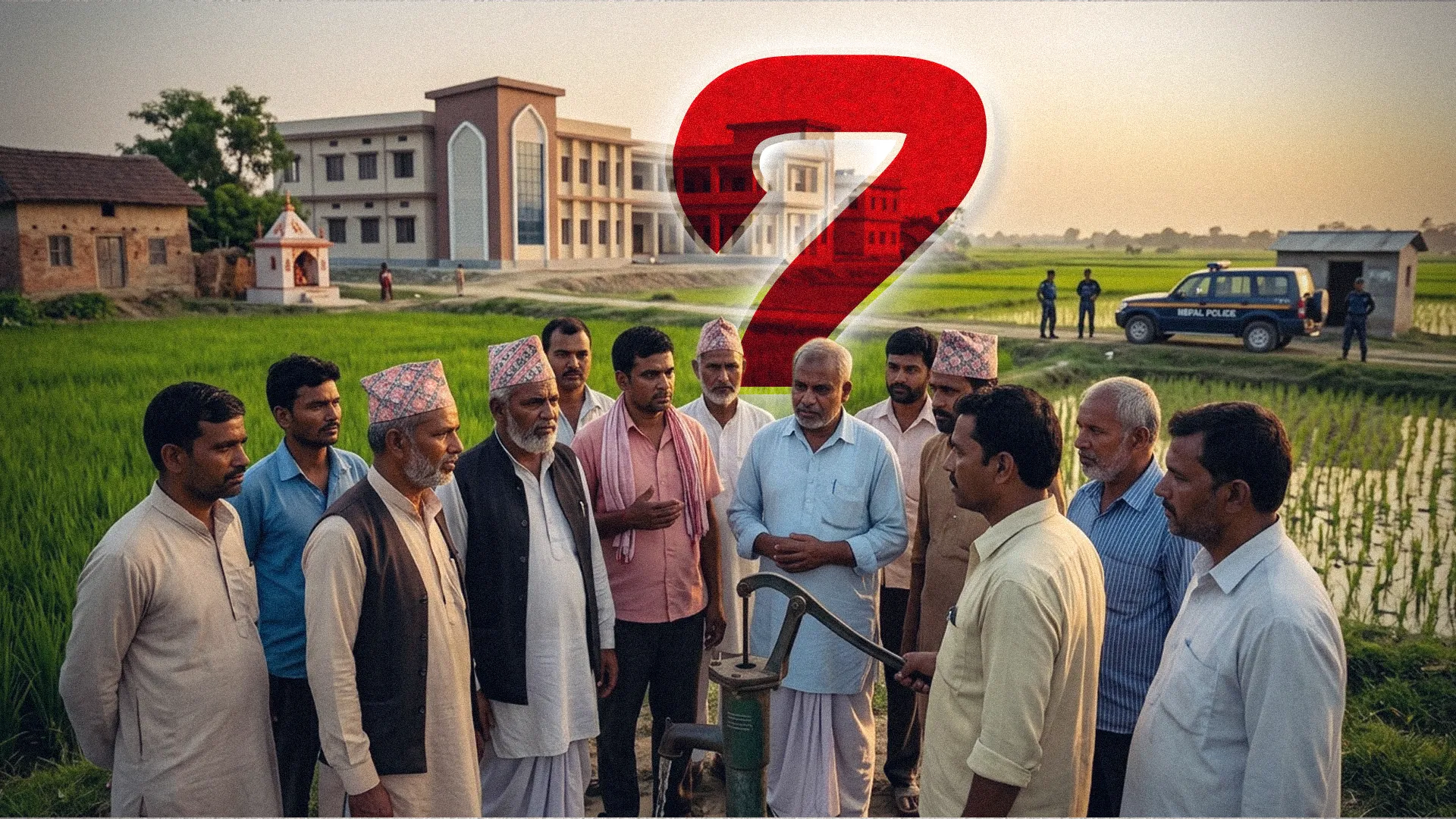
Another important debate concerns the role of international charities and foreign-supported humanitarian organizations involved in community assistance activities. In rural areas of the Tarai, some international organizations IHH-Turkiye and Arab Funds have provided support through drinking water projects, hand pumps, food assistance, educational programs and charitable activities.
The locals argue that such assistance helps communities where government services have not been sufficient. Many rural areas continue to face challenges related to poverty, clean water access and basic infrastructure, and humanitarian organizations can provide immediate relief.
However, critics question whether such activities are always coordinated with government institutions. Concerns have been raised that direct involvement of foreign organizations in local communities without sufficient government oversight may create dependency or allow external actors to develop influence beyond humanitarian objectives.
The presence of foreign Islamic charities, including organizations associated with countries such as Turkey and Arab nations, has generated debate among sections of society regarding the relationship between humanitarian assistance and religious influence. Some critics argue that repeated physical presence, charitable activities and religious outreach may create perceptions of competition among communities and threat.
The state must ensure that charitable activities do not become a mechanism for coercive religious influence. At the same time, accusations against organizations should be based on verified evidence rather than assumptions or political narratives.
Migration, Rohingya Concerns and National Security Debate

Interested in this ad?
Would you like to continue to the link or provide your information for more details?
Please provide your information
To continue, please fill in your details
Migration has added another complex dimension to discussions in Nepal’s Tarai region. Concerns regarding undocumented migration, including the movement of Rohingya refugees from Myanmar and Bangladesh through regional routes, have created debates about humanitarian responsibility and national security.
Nepal has historically demonstrated humanitarian consideration toward displaced populations, and international organizations have supported refugee-related programs. However, governments have a responsibility to maintain proper documentation, identity verification and border management.
Some security discussions have raised concerns that undocumented populations could potentially be exploited by criminal networks or extremist groups. Others argue that vulnerable refugees should not automatically be viewed as security threats without evidence.
The appropriate approach requires balance. Nepal must protect humanitarian values while ensuring effective security mechanisms. Every individual entering Nepal should be properly documented, and every security assessment should be based on evidence and intelligence.
The relationship between migration, madrassas and international organizations requires careful government assessment rather than emotional public debate.
The Danger of Extremism and Political Exploitation
Extremism develops when social divisions, weak governance and identity-based fears combine. Nepal’s challenge is not limited to religious extremism. Any ideology that promotes hatred, violence or intolerance threatens democratic stability.
The greatest danger is when genuine community concerns become tools for political manipulation. Identity-based conflicts can easily be intensified by individuals seeking political influence or social control.
Political actors may attempt to present themselves as protectors of one community against another, creating unnecessary divisions. Such politics damages national unity and diverts attention from real issues such as unemployment, education, poverty and governance weaknesses.
Nepal must therefore adopt a balanced approach: protect minorities from discrimination while ensuring that no organization operates outside the law.
The Need for Comprehensive Government Policy
The current debate demonstrates the need for a clear national framework governing religious organizations, foreign funding and religious education.
Nepal requires policies that ensure registration, financial transparency, institutional accountability and government coordination for all religious and charitable organizations receiving external support.
Financial institutions and government agencies should develop clear mechanisms to monitor foreign donations and ensure that funds entering Nepal are used for declared purposes.
Local governments should also be strengthened because they are closest to communities. Rural municipalities should have information about organizations operating within their areas and should participate in development coordination.
Transparency creates trust. When governments provide clear information and enforce equal standards, communities are less vulnerable to rumours and fear.