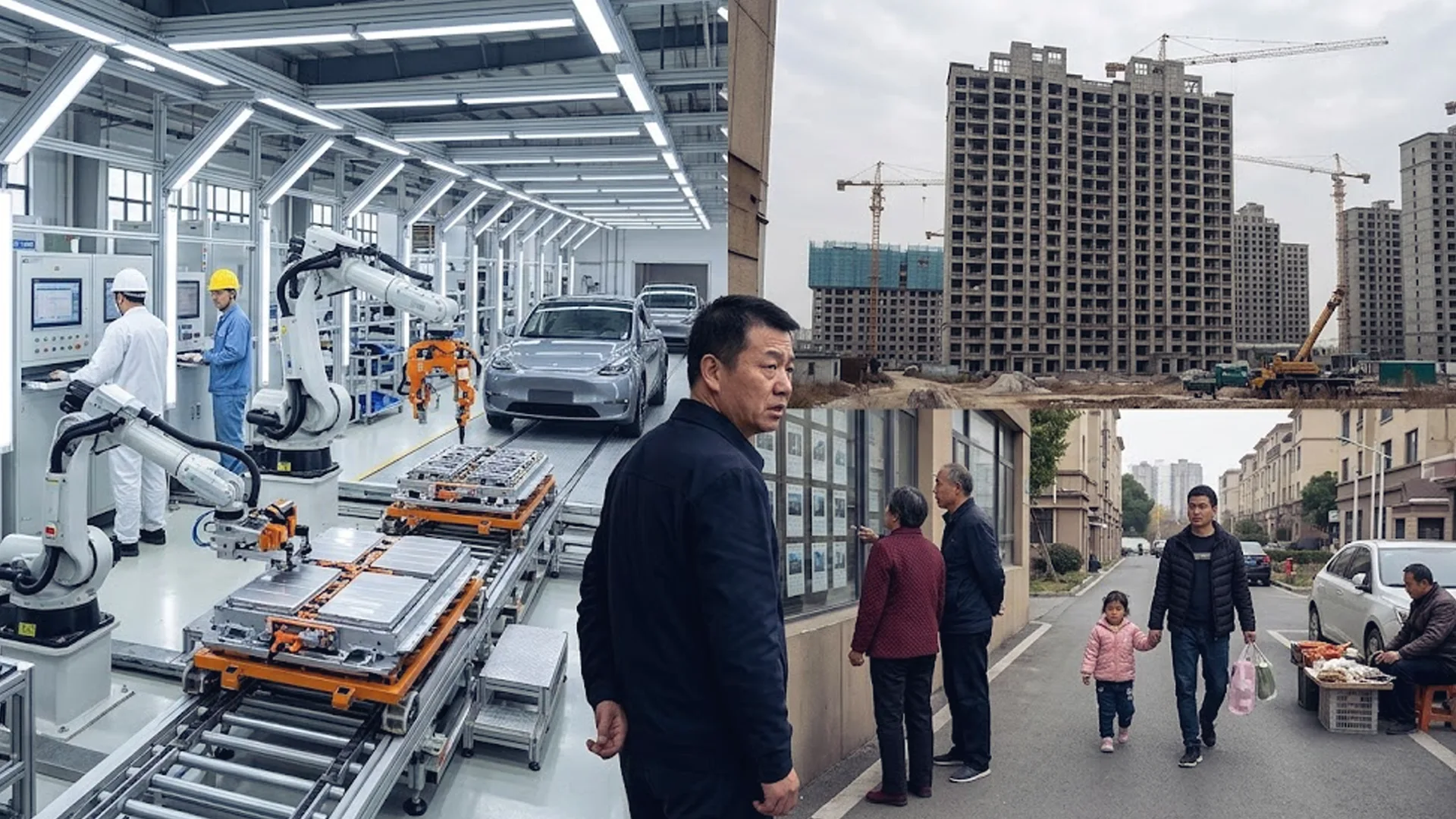




China’s economic difficulties are exposing a contradiction at the heart of Xi Jinping’s development strategy. The country continues to expand its capabilities in advanced manufacturing and strategic technologies, yet the wider economy is struggling to generate the kind of domestic demand that can sustain growth over the long term. In the first nine months of 2026, China’s economy grew by 4.6 per cent, but fixed-asset investment contracted by 7.2 per cent, property investment fell by 20.6 per cent, and retail sales grew by just 1.1 per cent in September. The problem, then, is that the sectors Beijing is determined to strengthen are not necessarily addressing the insecurities holding back households, private businesses and local economies.
This is an awkward problem for a leadership that has placed increasing faith in central direction, political discipline and the mobilisation of state resources. Beijing has not abandoned economic development. It has, however, become more selective about the kind of development it wants, placing technological self-reliance and strategic industries at the centre of its priorities. That approach has produced tangible gains, particularly in sectors such as electric vehicles and batteries. But a country cannot rely indefinitely on manufacturing strength to compensate for weak household consumption, a troubled property market and subdued private investment. These problems require changes in economic incentives and public confidence, neither of which can be secured simply by issuing directives from the centre.
The Communist Party’s Fifth Plenum, held from 26 to 29 October, offers a useful lens through which to examine this tension. The meeting’s emphasis on Party governance and discipline comes as the leadership faces growing pressure to make its economic priorities deliver more broadly. Stronger oversight may help Beijing enforce decisions and curb waste, but it also raises a question that has become increasingly relevant under Xi.
An economy pulling in different directions
China’s headline growth figures can obscure the unevenness of its recovery. Investment remains concentrated in areas that serve national industrial and technological priorities, while property and much of the wider domestic economy continue to struggle. This is not to suggest that investment in advanced manufacturing is misplaced. China has legitimate reasons to strengthen its technological capabilities, particularly as competition with the United States and restrictions on access to critical technologies make external dependence a strategic vulnerability. The difficulty is that industrial expansion and domestic economic recovery are not the same thing.
The property downturn illustrates the difference. For years, real estate supported household wealth, local government revenue and a broad network of industries connected to construction and housing. Its prolonged weakness has therefore affected more than developers and homebuyers. Households that feel less secure about their assets have reasons to save rather than spend, while local governments facing financial pressure have less room to support services and stimulate economic activity. Even when the state directs investment towards new industries, it cannot quickly replace the confidence and spending that a healthier property market once helped sustain.
Beijing’s response has largely focused on supporting production, advancing strategic sectors and encouraging consumption through targeted measures. Yet the reluctance of households to spend is not simply a matter of needing another incentive to buy a car or a household appliance. It reflects deeper concerns about employment, income security, healthcare, retirement and the future value of household assets. Unless these concerns are addressed, efforts to boost consumption risk treating the symptoms of weak demand without changing the conditions that produce it.
The same uncertainty affects private businesses. Firms are more likely to invest when they can anticipate demand and make reasonably reliable calculations about future returns. When the economic outlook is uncertain and regulatory priorities can shift, holding back becomes a rational decision. This creates a difficult cycle for Beijing. The government wants private capital to contribute more to growth, but investment will remain subdued if businesses see greater risks in expanding than in waiting.
Why discipline cannot solve everything
Xi’s emphasis on Party discipline is partly a response to the challenges of governing such a large and complex system. Local officials do not always implement central policies as intended, and the pursuit of growth targets has sometimes encouraged wasteful investment, excessive borrowing and projects with questionable returns. Stronger oversight can help address these problems. It can also reassure the leadership that officials are not quietly working against its priorities.
But there is a difference between ensuring compliance and encouraging sound economic decisions. Officials who fear the consequences of a failed initiative may become reluctant to experiment, even when local conditions call for a different approach. Private businesses face a related problem when policy uncertainty makes it difficult to judge which activities will remain commercially viable. A system that rewards political reliability above all else can be effective at mobilising resources towards clearly defined goals, but it may struggle when recovery depends on initiative, adaptability and confidence among millions of independent economic actors.
China’s economic challenge is therefore not a choice between political control and economic development. The question is whether the Party can recognise the limits of control as a tool of economic management. Discipline may prevent officials from ignoring central directives, but it cannot make households more confident about their finances or persuade businesses to invest when expected returns remain uncertain. Those outcomes depend on the credibility of economic policy and the incentives facing people and institutions outside the immediate machinery of the Party.
This difference will grow as Beijing tries to sustain growth while rebalancing the economy. China has already demonstrated its ability to build globally competitive industries through sustained state support. What remains less certain is whether the same model can generate stronger domestic demand and give private enterprise the confidence to invest beyond sectors favoured by national policy. If the leadership interprets economic underperformance primarily as a failure of implementation, it may strengthen supervision without addressing the reasons households and businesses remain cautious.
For Xi, the challenge is to make the system deliver not only on the priorities the Party can direct, but also on the economic conditions it cannot simply command into existence. China’s industrial capabilities remain considerable. The harder task is to ensure that these capabilities translate into a more secure economic outlook for the people and businesses expected to sustain the next phase of growth.