

The expansion of artificial intelligence is creating a new demand for electricity, cooling systems, batteries, optical networks and specialized materials. A data center may be built to run the world's most advanced AI models, but its operations depend on an extensive industrial ecosystem that receives far less attention than the chips inside its servers. China has spent years building a commanding position across many of these supporting industries, and that advantage is becoming increasingly difficult for other countries to ignore.
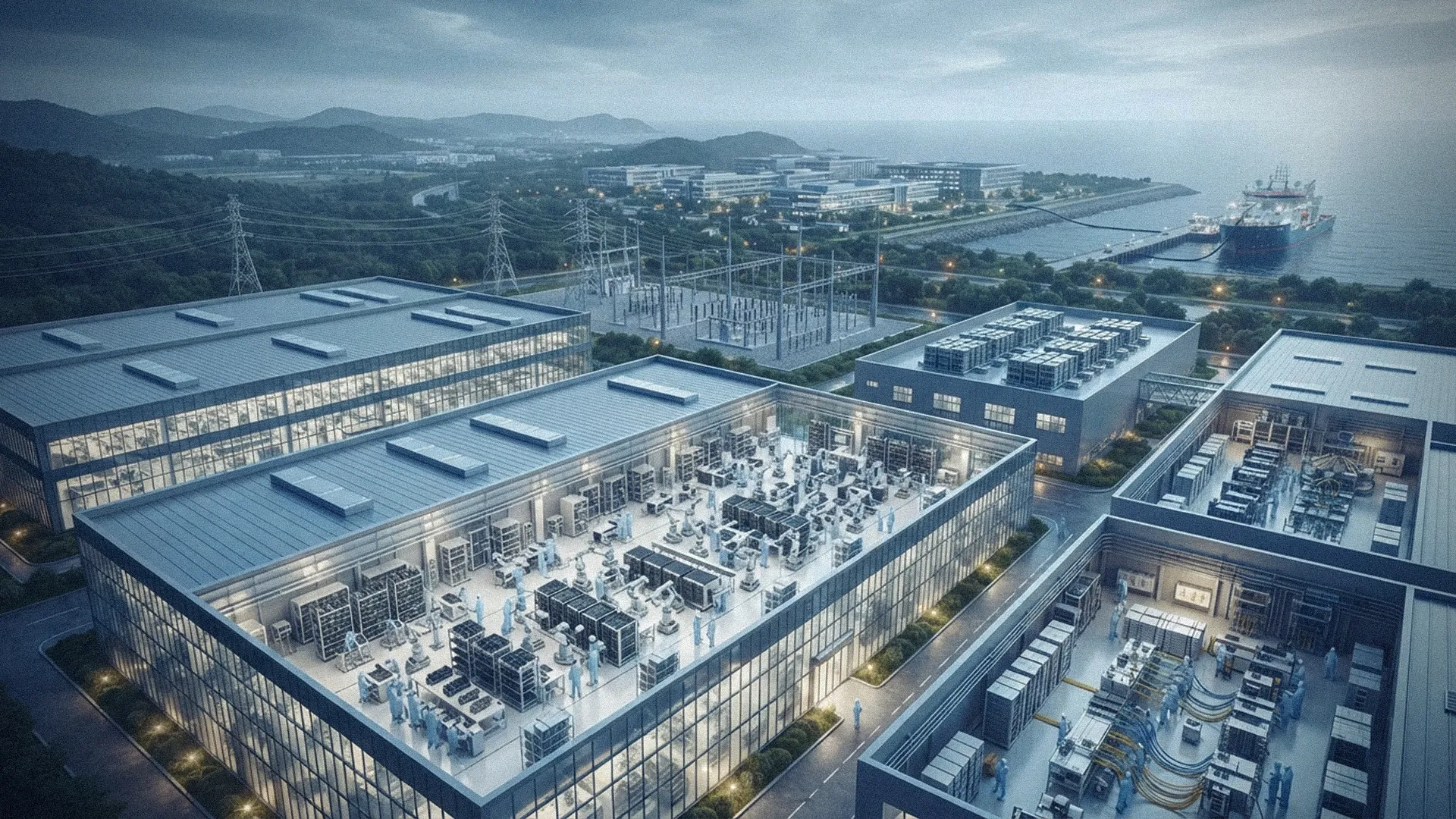
A November 2026 study reported that Chinese companies and institutions account for around 80 percent of the world's patents related to underwater data centers. The research examined 168 core patents filed between 2006 and June 2026, covering technologies such as underwater cooling, modular construction and maintenance. The figure does not represent China's share of operational facilities, but it does illustrate how quickly Chinese research has advanced in an emerging area of computing infrastructure.
The development deserves attention for a reason beyond underwater computing. China is increasingly present across the technologies that allow the digital economy to function. Its companies manufacture batteries, optical fiber, power equipment and components used in data centers, while Chinese firms also occupy important positions in the processing of critical minerals. Beijing may still face constraints in producing the world's most advanced semiconductors, but it is building influence around the systems that make those semiconductors useful. The strategic concern is that the next phase of the AI race could create dependencies that are less visible than reliance on advanced chips, but just as difficult to reverse.
The infrastructure that makes AI possible
The global debate around technological competition has largely centered on semiconductors. US export controls, China's domestic chipmaking ambitions and the competition between major AI companies have reinforced the impression that control over advanced processors will determine who leads the next phase of technological development. Yet the expansion of computing capacity requires much more than chips.
Data centers consume enormous quantities of electricity and require sophisticated cooling systems, backup power, electrical equipment and high-speed connections between servers. The International Energy Agency has repeatedly highlighted the growing importance of these supporting supply chains. China already accounts for approximately 85 percent of global solar manufacturing capacity and around 80 percent of lithium-ion battery supply-chain production capacity. Its share reaches approximately 95 percent in photovoltaic wafers and 97 percent in battery anode materials.
Its influence also extends to the materials needed for electrical and digital infrastructure. The IEA's analysis identifies China's dominant position in the processing of several critical minerals, including graphite, rare earths, lithium and cobalt. It also accounts for substantial shares of refined high-purity silicon and gallium, materials used in servers, optical fiber and advanced power electronics.
These are not unrelated industrial achievements. They reinforce one another. Battery production supports energy storage, power equipment enables large computing facilities to operate, and access to processed materials helps sustain the manufacturing ecosystem. China has developed an industrial base in which several parts of the AI infrastructure supply chain are located within the same manufacturing economy.
Beijing's advantage lies in the less visible parts of the supply chain
Optical fiber offers a useful example of how this dependence is developing. AI computing increasingly relies on high-speed connections between processors and servers, particularly as facilities become larger and more complex. Optical networks are essential to moving the enormous volumes of data generated by these systems.
China has become a major manufacturing center for this industry. Figures cited by Huatai Securities in 2025 placed China's share of global optical preform output at 59 percent, optical fiber production at 57 percent and optical cable production at 47 percent. These figures demonstrate that Chinese manufacturers are not simply supplying low-cost components. They have become important participants in the production chain supporting global telecommunications and computing infrastructure.
Power equipment is another area where China's manufacturing advantage is becoming commercially significant. Exports of Chinese power equipment reached $37.4 billion in 2025, a 26 percent increase over the previous year, according to Caixin Global. Transformers, turbines and other electrical systems are becoming increasingly important as countries expand their data-center capacity and attempt to secure reliable electricity supplies.
The significance of these sectors is easy to underestimate because they do not attract the same attention as advanced processors. But a shortage of transformers, batteries or specialized network equipment can delay the construction of a data center just as effectively as a shortage of chips. China is positioning its manufacturers in precisely these areas.
The security implications extend to the networks themselves
The concern becomes more pronounced when the discussion moves from manufacturing to digital infrastructure. Undersea cables carry the overwhelming majority of international data traffic, connecting financial markets, governments, cloud platforms and telecommunications networks. Their construction and maintenance are therefore matters of strategic importance, not simply commercial telecommunications.
China's HMN Technologies has become an increasingly significant participant in this industry. Between 2020 and 2024, it supplied approximately 10 percent of newly built subsea cable systems, according to research by the Carnegie Endowment for International Peace. Although it remains behind established suppliers such as Alcatel Submarine Networks and SubCom, its involvement has attracted scrutiny from Western governments.
The concern is not that a Chinese-built cable automatically compromises the information passing through it. Rather, the construction, repair and maintenance of critical networks can create opportunities for access to strategically sensitive infrastructure. Countries therefore have to consider not only the cost and technical quality of a cable, but also who builds it, who maintains it and what access that company might retain.
That said, the strategic consequences of concentration do not depend entirely on Beijing's intentions. When a single country becomes difficult to bypass across several essential supply chains, it acquires economic leverage. China's restrictions on exports of gallium, germanium, graphite and other strategic materials have already demonstrated how control over critical inputs can become part of wider geopolitical disputes.
The same vulnerability could emerge in the infrastructure supporting AI. Countries may find themselves dependent on Chinese suppliers not because they have chosen to rely on Beijing, but because alternatives are too expensive, insufficiently developed or unable to meet demand. The more rapidly computing infrastructure expands, the harder it becomes to replace those suppliers without disrupting investment and deployment.
This is why the debate over China's technological rise needs to move beyond the familiar competition over semiconductors. The next phase of digital competition will also be shaped by who manufactures the equipment, processes the materials and maintains the networks that keep computing systems running.
China has recognized the importance of these foundations and built substantial advantages across them. Other countries are now discovering that catching up in AI may require more than developing better chips or models. It will require rebuilding parts of the industrial base on which the digital economy depends. The risk for Beijing's competitors is that by the time this dependence becomes a pressing security concern, the cost of reversing it may already be considerable.