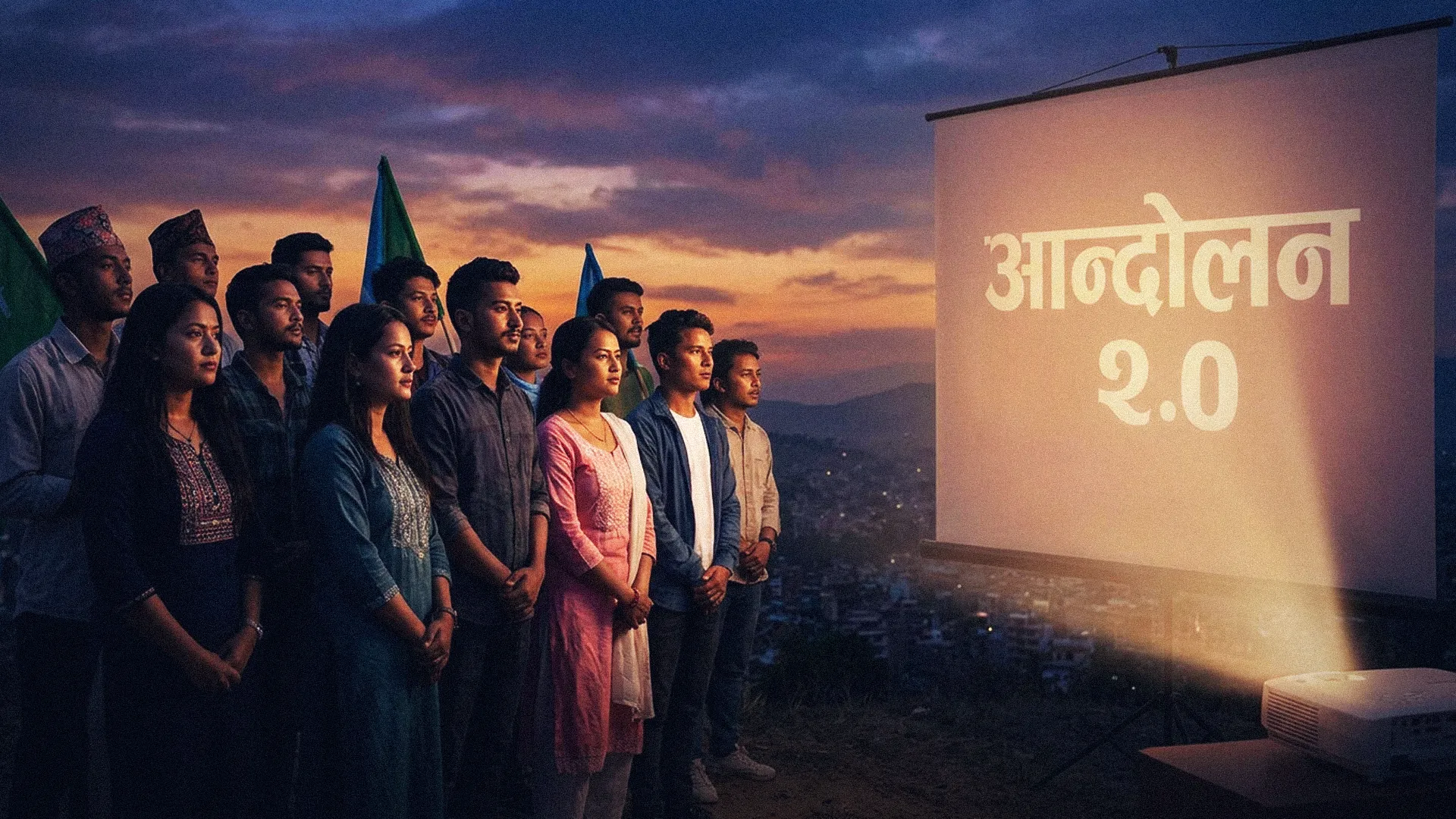



On 12 September, a motley gathering of elderly people (probably over 60+ years) took place at Nepal Bhasa Academy, Kirtipur, under the banner of Kipu Intellectuals Movement (KipuBudhijibiAbhiyan) to deliberate on socio, economic and geo-political impacts of the incidents following Gen-Z movement. Going by their age and get-ups, the majority of the participants seem to be drawn from retired teachers and head masters, coming from the outskirts of Kathmandu, leaning towards the left or the Maoist camp in particular. No wonder, Kirtipur has been their citadel.
Besides geo-political, economic and social impacts, they were worried by a massive erosion in communist movement post general elections in March.
Three papers were presented in the gathering, namely, (1) Gen-Z Movement, Government Response and the General Direction of the Revolution (by Moti Lal Nepali), (2) The Political Landscape post Gen-Z Revolt in Nepal (by Yug Pathak) and (3) The Political Economy of Gen-Z Rebel and Future of Nepal’s Communist Movement (by Tulasi Das Maharjan). These were all in Nepali language. There were three commentators and floor was also briefly opened to the audience. The closing remarks came from Mr Shyam Shrestha, political analyst and Prof. Krishna Khanal from the political science department, Tribhuvan University.
This scribe got primarily interested in knowing Nepali budhijibi’s take on Gen-Z movement plus, as one organizer commented, “Kirtipurian having this type of exercise for the first time”. Must be a quantum leap post attack by PN Shah in 18th Century. It is interesting to listen a bunch of old buddies talking about Gen-Zs.
Of the three papers, one can read one paper labelling Gen-Z as “a movement”, second, “a revolt” and the third, “a rebel”. There is no consensus on Gen-Z. The electoral government of Sushila Karki, before her departure, agreed to call it “People’s Movement”. This is similar to first people’s movement we had in 1990s and second in 2006/7. However, these movements have specific goal to attain. Gen-Z did not have other than cursing or swearing on past governments under multiparty dispensation and FDR Nepal. Sounds like its only goal is to kick out Oli from the power. It is not even a revolution, there is no change in the regime. The FDR Constitution 2015 is very much intact, and is functioning or rather being mal-functioned. We have seen change in actors, not the characters. The new comers detest the Constitution; that is their problem.
Mr Shrestha cautioned the participants saying Gen-Z movement is only the consequence, not the cause. To borrow his phrase, “a failed coup”. Definitely, it was a coup to do away with FDR Nepal, but in the absence of coherent thinking within the army, reluctance of the monarchy to return, and the scale of mayhem and destruction, the chief actors, whoever may be, shied away from making visible presence. One can see appearance, only after two days, of dozen of Gen-Z groups claiming the movement to be their initiative.
The paper presentations and the commentators focused blaming the past for the present mishaps situation – the greed for power, corruption and mismanagement that fueled Gen-Z fire. Mr Tulsi Das Maharjan compared Nepali society as sukekochaur (dried field) waiting for a spark to start a rapid fire. This is what happened with Gen-Z.
There is also a line of thinking that a peaceful street agitation by students against government banning of social media erupted into a violence after it being hijacked by outside elements, after evening riot of 8 September. Many agreed that the scale of violence, a selective arson are basically, an organized crime in action. When something very much similar happen everywhere, at the same time, in the country, one cannot assume it to be an accident, or a random incident. Definitely, it must be an organized activity. When Karki Commission keeps silent on 9 September incidents and the government shy away from making the reports public, it is even clearer, what unfolded post Gen-Z has nothing to do with Gen-Z issues. The present government is not a Gen-Z government, it will be a gross mistake. Some factions of Gen-Z are still out their demonstrating in the streets. Definitely, this government is laid on the foundation of Gen-Z. As Gen-Z itself is a vague ambiguous, if not fragile, even with two-third majority, the it looks so meek and weak. The Mother of Gen-Z has already commented in public, “two-third majority is simply a numerical strength and carries no meaning without good governance”.
Ever since I read the news that, ahead of his oath taking during last KMC mayoral elections, he had an audience with the army chief, I got suspicious with this character. Next day, the social media carried the news that it was arranged to recharge rain water from Tundikhel to traditional stone water taps at Sundhara! You just can’t fool everybody all the time, that too, hiding in black shades.
Talks were also on MCC, SPP and uranium mines in Mustang, forget about Barbara Foundation, US Youth Council. We Nepalese have a high degree of propensity to churn out and consume conspiracy theories.
It is amusing to see a young lady, may be to represent Gen-Zs, uncomfortably sitting beside oldies, in the podium. She turned out to be a Maoist leader with a good oratory skills.
The organizers promised to come out with a proceedings. Hopefully, the material will feed into literature on Gen-Z movement in Nepal.