


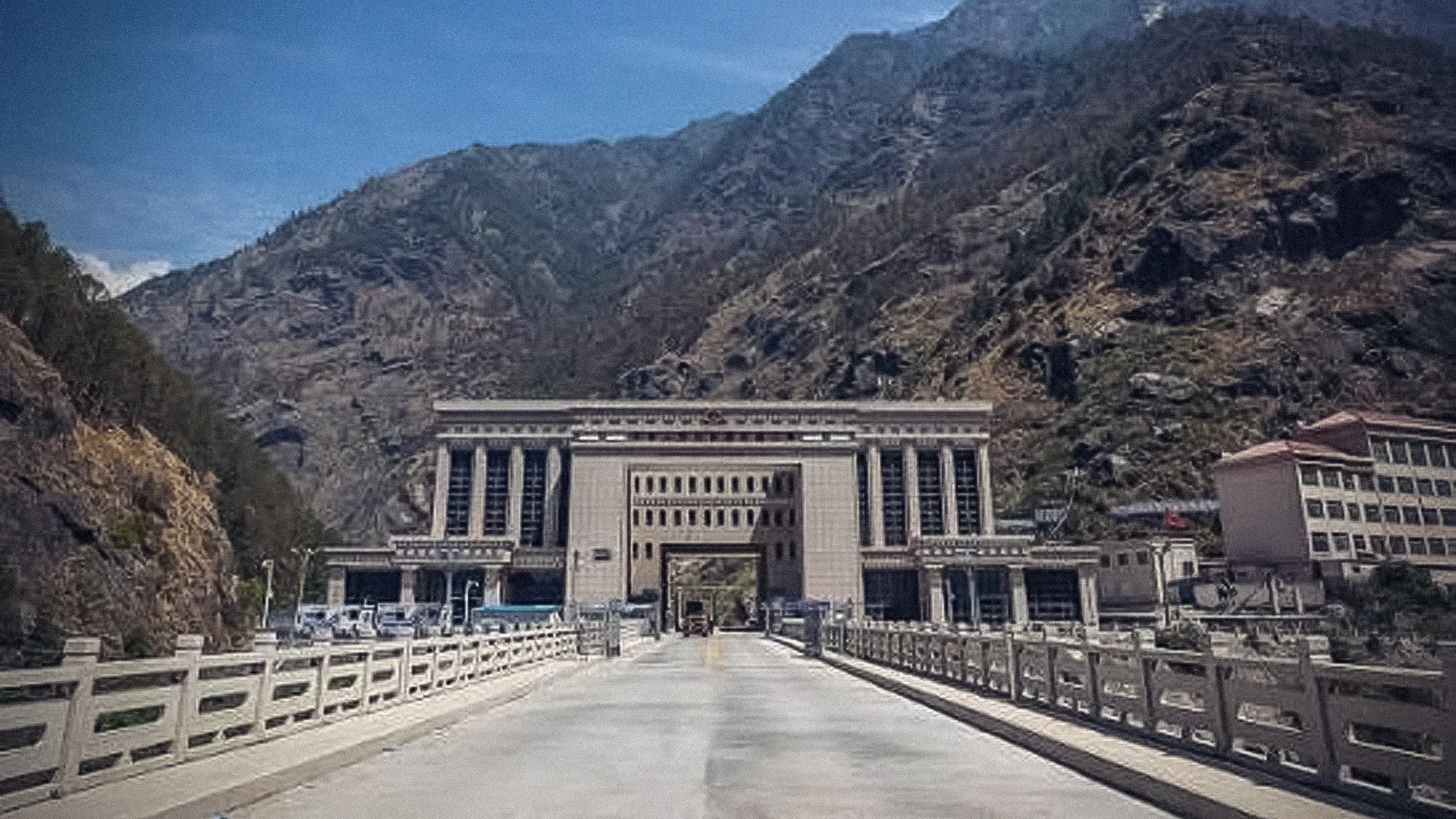
I have traveled to the northern border regions repeatedly. Not only to Timure and Syaphrubesi in Rasuwa, but I also have experience reporting on the hardships and risks faced by local citizens at the Himalayan border points of Mustang, Sindhupalchok, and Humla. From all those visits, I realized a harsh truth—the geography of our northern border is extremely fragile and sensitive. The Timure-Syaphrubesi road section is geographically so risky that a major accident could happen at any moment.
A strategic road where international trade operates should have strong, safe, and sustainable infrastructure. However, the Chinese side held onto the responsibility of construction without pushing the work forward. Once the work stopped, local residents and business owners were forced for years to suffer from landslides, soil erosion, dust pollution, and hours of traffic jams. Taking advantage of the fragile geography, the Chinese attitude of occupying infrastructure without working put the entire settlement into a trap of risk.
Government Letter Revealed via RTI and Chinese Delays
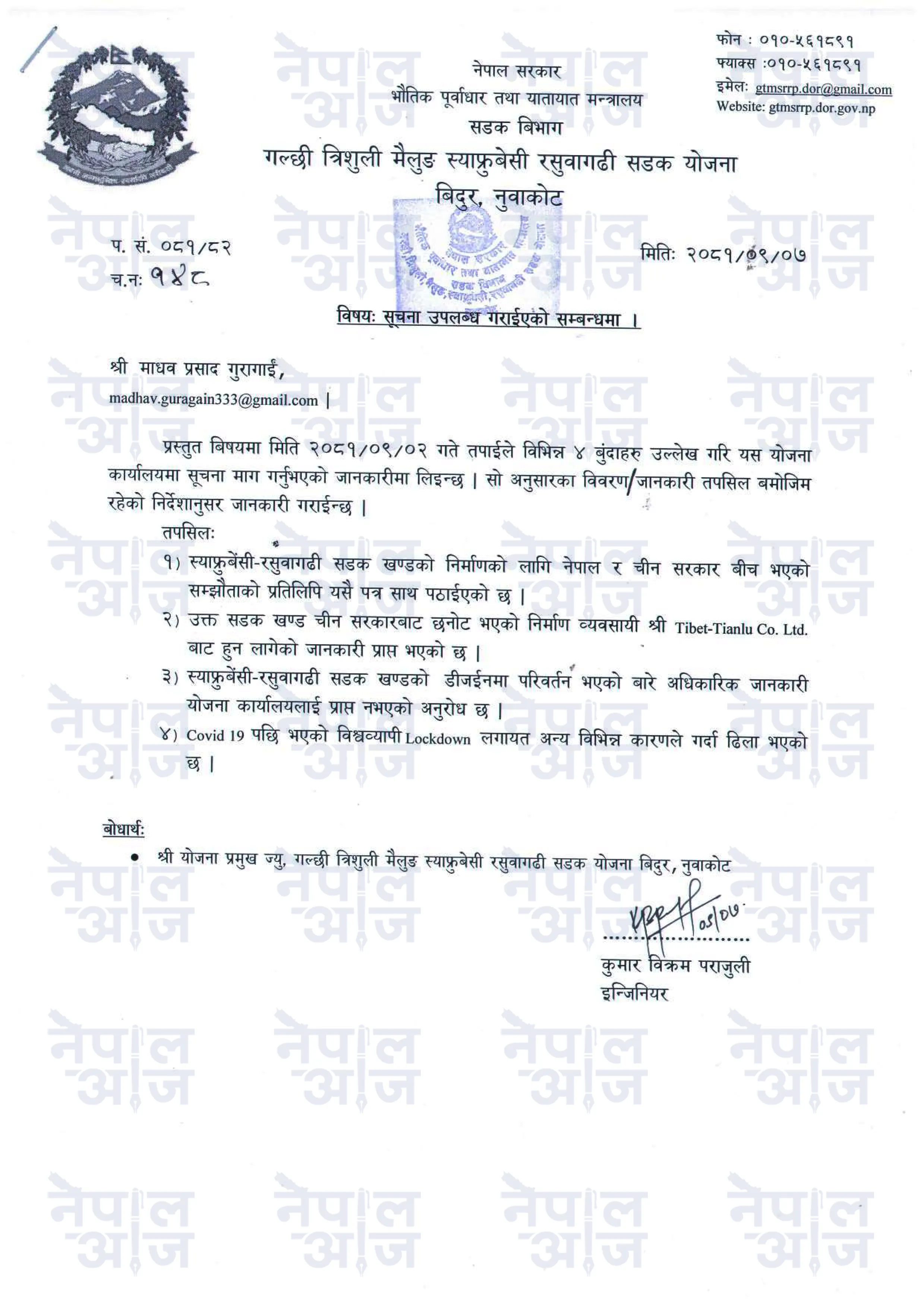
To get information regarding the actual status of the Syaphrubesi-Rasuwagadhi road section, I registered an application under the Right to Information (RTI) at the 'Galchhi-Trishuli-Mailung-Syaphrubesi-Rasuwagadhi Road Project' office on 2081/09/02 BS. In response, official documents provided by project engineer Kumar Bikram Parajuli (Ref. No. 081/82, Dispatch No. 148, Date 2081/09/07 BS) clearly reveal a massive gap between Chinese commitments and reality.
The documents provided by the project office clearly state the following:
-
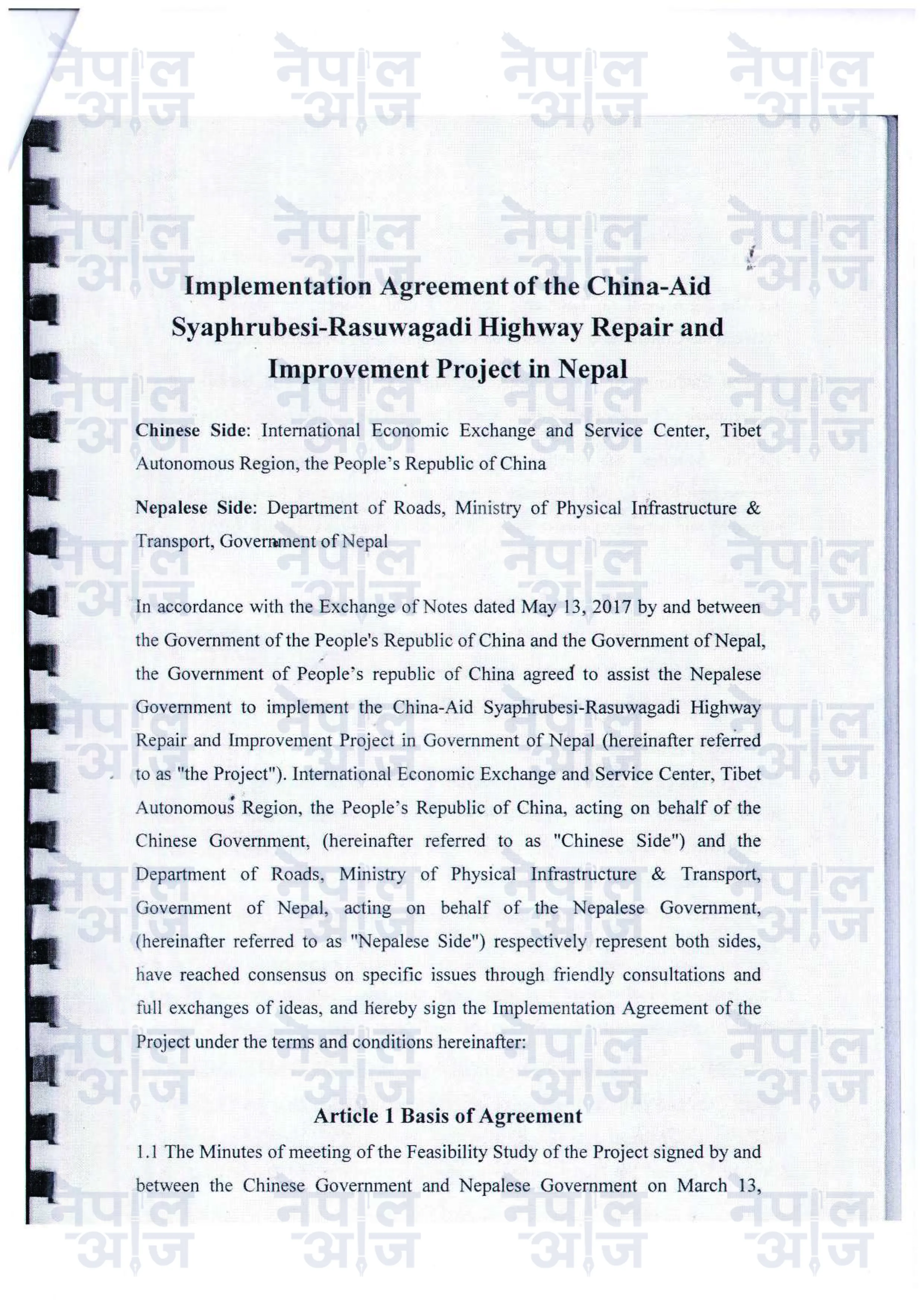
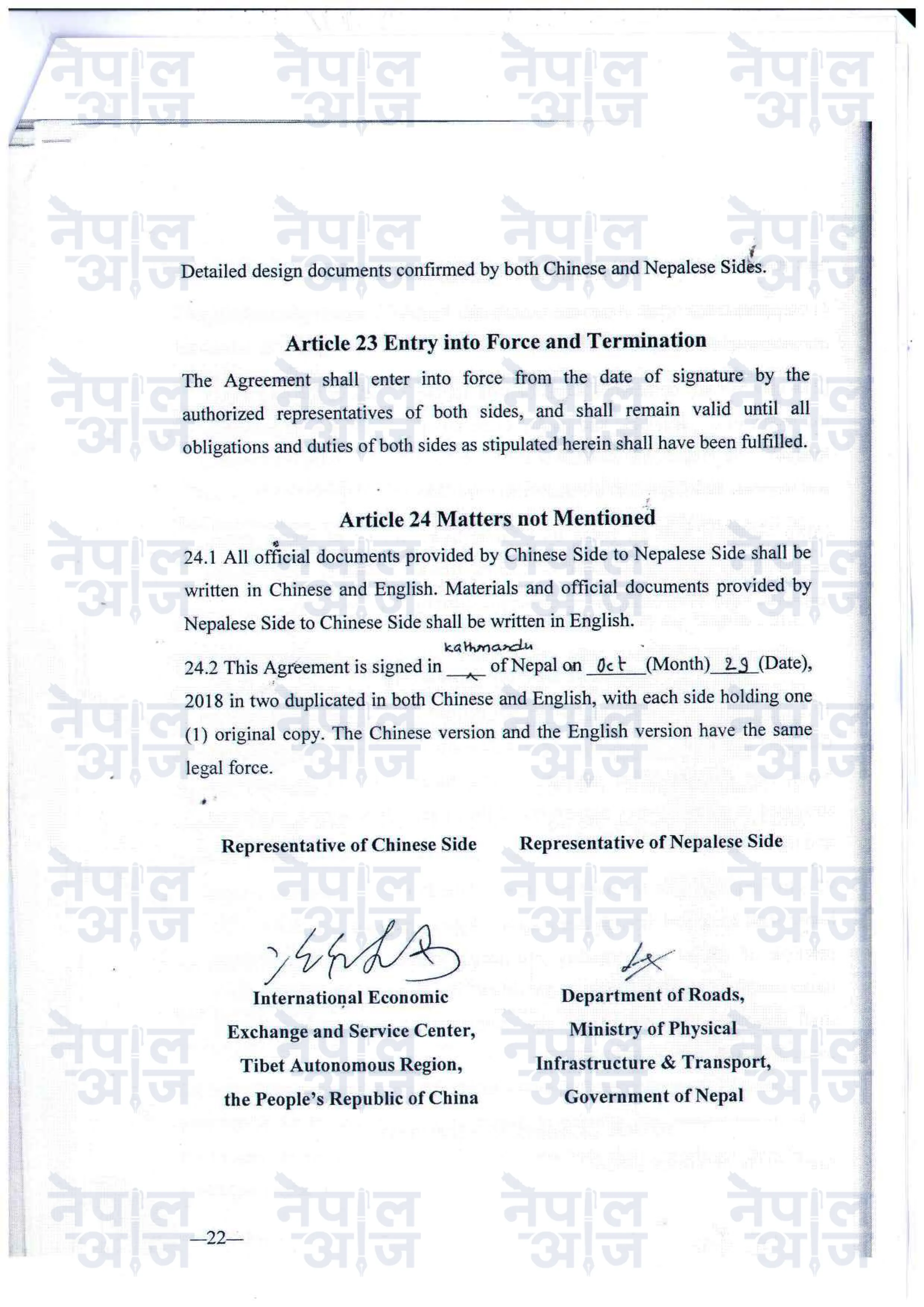
G2G Agreement and Key Dates: As per the 'Exchange of Notes' signed between the Government of Nepal and the Government of China on May 13, 2017, the Chinese government agreed to assist in upgrading this road. Subsequently, on October 29, 2018, the 'Implementation Agreement of the China-Aid Syaphrubesi-Rasuwagadi Highway Repair and Improvement Project in Nepal' was signed in Kathmandu. It was signed by the Department of Roads on behalf of Nepal and the International Economic Exchange and Service Center of Tibet Autonomous Region on behalf of China.
-
Selection of Contractor: The Chinese government selected its own construction company, Tibet-Tianlu Co. Ltd., for the construction of this road.
-
False Claims of Design Change: Although rumors were spread that the design was changed without official information, the project office clarified that no official information regarding a design change was received.
-
Excuse for Delay: In response to the question regarding construction delays, the office replied that 'delays occurred due to the global lockdown following COVID-19 among other various reasons.'
Leaving such a strategic border crossing stranded for years after signing paper agreements, under the pretext of COVID-19, was extreme negligence by China.
Sudden Disaster and Satellite Evidence
Recently in August 2026 (Bhadra 2083 BS), a massive and destructive flash flood suddenly struck the Bhote Koshi and Syaphrubesi region of Rasuwa. The flood devastated Timure Bazaar, the customs yard, police posts, and even the administrative buildings of Uttargaya Rural Municipality.
Even though the Chinese side attempted to shift the blame for the flood onto Nepal, scientific facts and satellite images from Planet Labs have brought a different truth to light. According to satellite imagery, the origin of the flood was located in the Himalayan region of Tibet, approximately 20 kilometers north of the Rasuwagadhi border. Studies clearly show that an ice-rock avalanche fell in the high Himalayan region, blocking the river, which then suddenly burst and sent a massive debris-laden flood toward Nepal.

Interested in this ad?
Would you like to continue to the link or provide your information for more details?
Please provide your information
To continue, please fill in your details
Red-Blue Stamps and the Rampage of 'Wolf Warrior' Diplomacy
As an upstream nation, by international rules and basic human relations, China should have provided prior notice and warnings to the downstream nation, Nepal. However, allowing a sudden debris-laden flood to crash into Nepali settlements without any prior notification is equivalent to dropping a bomb directly on Nepali citizens.
Instead of assisting in rescue and relief for victims during a disaster, the aggressive 'Wolf Warrior' style exhibited by the Chinese Embassy in Kathmandu is deeply regrettable. Rather than awaiting findings from a joint bilateral technical team, the Chinese Embassy posted red and blue stamped posters (graphics labeled 'Fake News' and 'Truth') on social media, directly attacking the claims of Nepali media and locals. For China, which claims to be the world's second-largest economy and a superpower, displaying such 'drama' with red and blue stamps and exercising 'sharp power' to control information is in no way compatible with diplomatic decorum.
Mandatory Demand for Intervention, Penalty, and Compensation
Nepali citizens will no longer tolerate China's highhanded behavior of occupying construction work on fragile terrain for years and then pouring down massive floods without warning, causing loss of life and property while ignoring international rules and neighborly duties.
The precious lives of innocent Nepali citizens lost in the flood and disaster cannot be brought back under any pretext. Therefore, mere verbal protests or formal objections are no longer enough. A full accounting of all losses of life and property caused by unleashing an unannounced flood from Himalayan glaciers to the plains of Terai must be conducted. China must be penalized on international platforms for this extreme negligence and irresponsible behavior, and the Chinese government must bear full compensation for all physical and human losses caused from the Himalayan region down to the lower riparian plains of Terai.