Balen Shah vs Gagan Thapa: Who Will Be the Next Prime Minister of Nepal?
Nepal’s Political Bifurcation: The Populist Surge vs. The Reformed Establishment

Nepal’s contemporary political landscape is defined by an unsettling quietude and a profound structural tension. In the wake of the visceral "Gen-Z" movement, Kathmandu Mayor Balendra Shah (Balen) has emerged as a central figure in the discourse surrounding the next Prime Ministerial candidacy, with the Rastriya Swatantra Party (RSP) reportedly endorsing him for the top executive role. The perceived consolidation of figures like Ravi Lamichhane, Kulman Ghising, and Balendra Shah has cast a strange silence over Nepali politics. Within the traditional establishment and the "Old Guard," there exists a palpable existential anxiety—a fear that should this new bloc seize state power, they might weaponize the legal system to exact retribution under various pretexts. Yet, while the exterior of this "alternative force" appears luminous, its internal reality is marred by legal entanglements and significant governance deficits.
The very leaders viewed by the public as beacons of hope are now displaying a glaring deficit of political acumen. Ravi Lamichhane has only recently been released on bail regarding a cooperative fraud investigation. Kulman Ghising faces a barrage of complaints filed at the Commission for the Investigation of Abuse of Authority (CIAA). Mayor Balendra Shah is not immune to this legal scrutiny; he too faces complaints at the CIAA, alongside serious allegations of employing incendiary rhetoric—specifically threats to burn down the administrative heart of the nation, Singh Durbar—and inciting public unrest during the Gen-Z protests. Despite enjoying international backing and robust popularity, Shah exhibits a peculiar trait for a statesman: the absence of the metaphorical "rhino skin" essential for politics—the capacity to absorb criticism, engage in dialogue, and withstand adversity. Shah neither tolerates dissent nor engages with the public or the press, cultivating instead an opaque, mysterious persona that has led detractors to pejoratively label him "Lucifer."
Mayor Shah’s administrative style appears to deride the very concept of democratic accountability. He has shown a marked aversion to direct engagement with the electorate, rarely meeting the public at municipal offices. Instead, he is known to conduct affairs from the shadows—at private venues like Sas in Kirtipur, the Chhaimale Resort, or exclusive restaurants and residences in Lalitpur. His intolerance was displayed early in his tenure through the mistreatment of a Himalayan TV journalist. Further eroding his claim to transparency was the controversy surrounding his visit to France, where he reportedly included an unofficial advisor, Kumar Byanjankar, at municipal expense in violation of protocol. This erratic pressure has made the working environment untenable for civil servants; Chief Administrative Officers, such as Saroj Guragain, were reportedly forced to seek transfers or preemptively approach anti-corruption bodies to protect themselves from the Mayor’s "bulldozer" tactics. Consequently, Shah’s political horizon appears increasingly dim.
Amidst this bleak panorama of populist volatility, a glimmer of hope persists: the potential reformation of the Nepali Congress. This aspiration is tethered to General Secretary Gagan Thapa, who is orchestrating a strategy to seize party leadership through a special general convention. Commanding the loyalty of over 50% of the convention delegates, Thapa’s move is likely to receive legitimacy from the Election Commission. Once recognized, he would control the distribution of parliamentary tickets, positioning himself as the parliamentary party leader and the presumptive Prime Minister. This procedural legitimacy would bypass protracted judicial interventions; even if potential detractors approach the courts, a verdict would likely take years—by which time Thapa would already be established in executive office.
To be sure, Gagan Thapa is not devoid of controversy; in a society where even deities are scrutinized, no politician is immune. However, Thapa remains quintessentially "political." He engages the media, faces the public, and possesses a balance of organizational muscle and intellectual prudence ("Buddha and Vivek"). Furthermore, the aging leadership of the Nepali Congress, wary of facing the physical and political wrath of a radicalized youth movement, may view handing the baton to Thapa as a necessary strategy for a safe landing. Thus, the upcoming election presents a high probability of Gagan Thapa emerging as the Prime Minister. The nation now stands at a historical crossroad: choosing between the opaque, unpredictable path of Balen Shah’s insurgency, or the systemic, rationalized democratic reform represented by Gagan Thapa.
Gagan Thapa Balendra Shah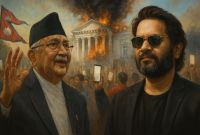
![From Kathmandu to the World: How Excel Students Are Winning Big [Admission Open]](https://nepalaaja.com/img/70194/medium/excel-college-info-eng-nep-2342.jpg)