Election-Selection
Narayan Manandhar -
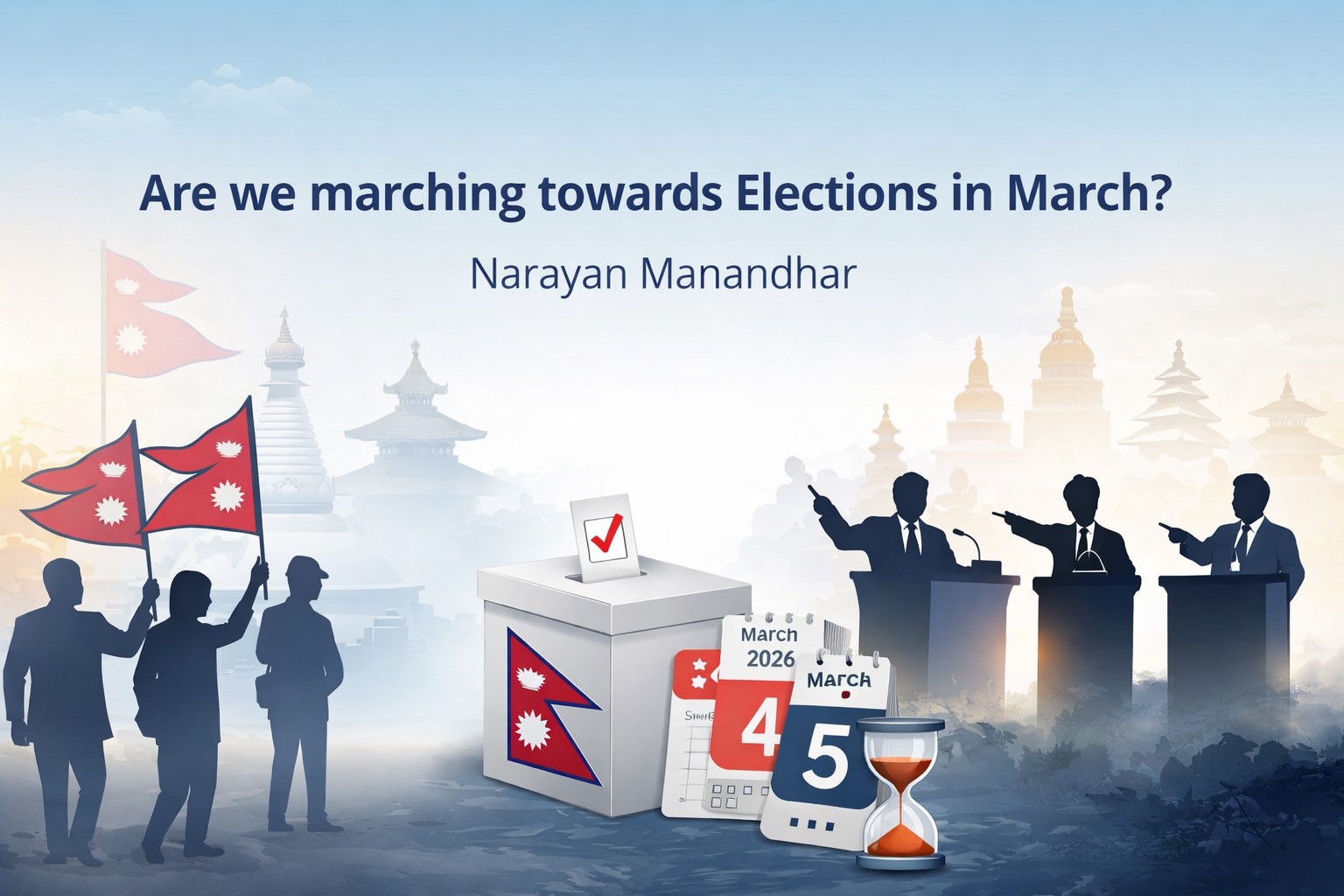
First, a disclaimer: This scribe is of view that (a) there won’t be upcoming elections on 5 March (time pressure, lack of preparedness, pending court cases), (b) there should not be elections because it is not going to solve Nepal’s political problem (cost factor, ambiguous stand of main political parties, will not affect coalition culture), (c) given the intensity of political configurations and polarization, the elections will be marred by violence and insecurity feeling, leading to low turnout and poor quality, (d) though the Karki Government is vocal in saying that she is eager to handover power to an elected government asap, she is not interested in holding elections. Her real interest is in prolonging the elections and holding on to the power as long as possible. I do have certain indicators and back up these claims. But the incidence and events are rapidly unfolding in such a way that this scribe is forced to make an U-turn: There must be elections on 5th March. This is not because that our mitra rastra has donated thousands of vehicles for holding elections. In spite of skepticism, before delving into reasons, let me first outline why elections are happening on 5th March.
Can we stop this electoral train?
First, I do see a definite election wave taking place in the country. This is indicated by taam-jhaam or razzmatazz brought about by nomination and filing of candidates. One can compare elections as a fast-moving big train on roll; it is near impossible to put a brake. Trying to stop this train will either derailment or a major accident. Literally, no one can now stop this train without getting into some kind of big, fatal accident.
Second, the way, some ministers of the Karki Government, including some public office holders like Mayors, resigned at the last hour, to join electoral bandwagon, indicates that they are now sure of the up-coming elections. Forget about others, even Mr Mahabir Pun saying it is because of “anger with the system”, he is forced to contest elections in his home district Myagdi. There is even a joke going around in circle: Mrs Sushila Karki may resign to contest elections on behalf of a political party. She may call her government to be civilian, but is pure villain or rather evil-ian. She might be in a shocked to see her minister joining election fray at the last hour from a particular political party.
Third, old guards of Nepali Congress seems to have given up the leadership mantle, particularly, after the Court declined to issue stay order in favour of their writ petition filed against Thapa and Sharma duo organizing blitzkrieg against Deuba. Deuba may be down but he is not out. Soon, I will have a take on this. Media also reported Gagan working from NC HQ at Sanepa. Forget about NC conundrum, even CPN-UML, is now poised for a big fight with Balen.
Fourth, the Karki Investigation Commission, whose tenure is coming to an end from January 24, is going to be extended. The official reason is that it has 20% of writing to be done. Unofficially, the content of the report may derail elections. Sushila Karki Government cannot even postpone elections by a day or two, forget about two months.
Fifth, Nepal’s Supreme Court, which can pull a brake on polls, seems to be content with its “normal proceedings”. They invested lots of jargon to educate us like herda herdai, herna na milne, herna nabhyayeko, misil jhikaune (please don’t confuse with missile). Though media reported the court preparing for next round of hearing on parliament reinstatement, I doubt on the sense of seriousness or urgency, as one can observe inside the Election Commission. Remember, the Commission refusing to extend nomination deadline plus implementing code of conduct?
Why elections?
I don’t argue on the basis of principles like democratic values, voices and choices to the people. Nor give stupid economic argument like the elections will ‘lubricate’ our economy, with increased flow of money feeding “masu-bhat”. We need this election to test the water of these up-coming, aspiring new political outfits, gangs, thugs or parties whatever you like to call them. Their real strength can be measured only after elections and their boisterous stand can be tested. Remember some parties declaring their PM and Cabinet ministers?
The up-coming elections is like a referendum, albeit at an indirect level, on contentious issues at fray. These included ethnicity, regionalism, federalism, secularism or Hinduism, monarchism, electoral system, power of geo-politics etc.
Change seekers and makers
As about change seekers, let me borrow here a line from American election campaign: I suppose, this famous line comes from Bill Clinton’s first election campaign. I really don’t remember who responded this but I read in the media something like this: These people are talking of change; definitely, after elections, they will have change, but it will all be inside their trouser pockets.” In Nepali we talk much about hastantaran-pustantaran. This sounds foul words to me, for the sake of decency, I cannot spell it here.
Election
![From Kathmandu to the World: How Excel Students Are Winning Big [Admission Open]](https://nepalaaja.com/img/70194/medium/excel-college-info-eng-nep-2342.jpg)