Hong Kong fire puts a question mark on urban planning in China
“With the rapid urbanization, China may seem impressive from the outside. A little digging into these newly transformed cities proves otherwise,” Harryson Hu wrote in his blog titled ‘Ghettos of China’ on November 10, 2013. “Rural life in China is disappearing, countryside farmers are under heavy pressure from the communist government to move into these newly urbanized cities. Farmers resist the move, because the majority of these new cities have dozens of internal issues. The apartments are poorly constructed, unemployment rates are high and living costs are much higher compared to the countryside. I believe the government is implementing these changes too rapidly without thinking of the consequences. At this point, they only care about portraying an image of modernization to boast about on the world stage,” he wrote.
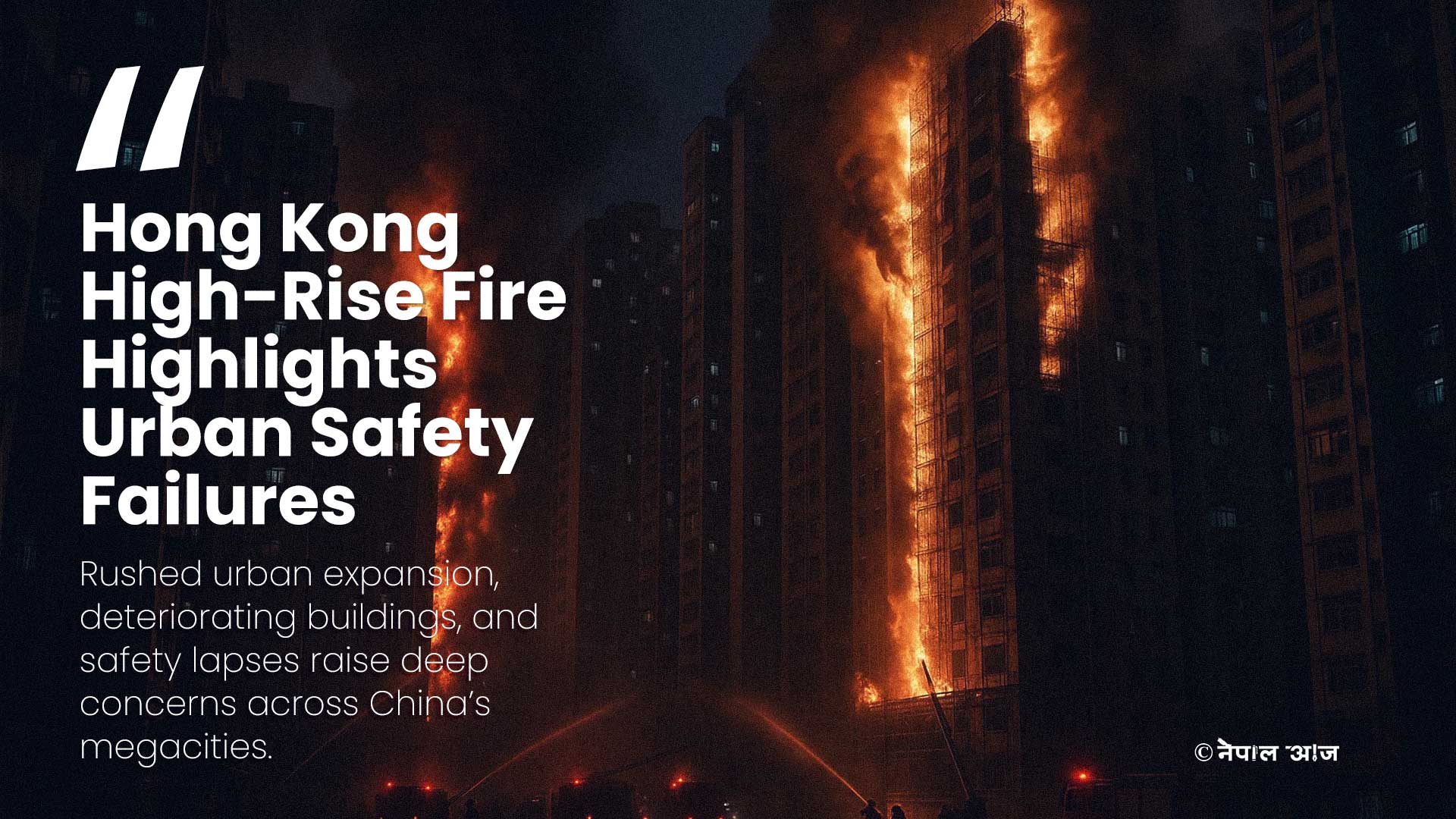
The fire in the Hong Kong high-rise last week, the Wang Fuk Court complex in the Tai Po district, was one of the deadliest fires of the world in recent history. More than 150 people are confirmed dead and the number of missing may be as high as 100. It has drawn attention to the pitfalls associated with the policy of rapid urbanization which the communist leaders of China are pursuing.
The scale of urbanization that Hu referred to in 2013 was only the tip of the iceberg. In that year, China was pushing ahead with a sweeping plan to move 250 million rural residents in newly constructed towns and cities by 2025. To house these millions, megacities in China have witnessed an explosion in the development of towering apartment blocks.
Now these constructions are revealing structural flaws, with costs of maintenance skyrocketing. Many buildings are deteriorating rapidly, losing market value and consigning residents in declining neighbourhoods. The house owners are trapped in an unsafe and decaying milieu. The way the fire in the Hong Kong high-rise, originating from bamboo scaffoldings attached to one of the towers, could quickly spread to engulf seven of the eight towers in the complex shows that the towers had been built too closely, without any thought about fire safety or of enough sunlight and fresh air for residents. In the hurry to construct them, the structural integrity of many of these high-rises could have been compromised. In Chinese slang, they are called “tofu-like constructions.”
Corruption and graft have played a role in this, with project funds skimmed off by officials; leaving no funds for quality materials and workmanship. Projects have often been granted to companies that have more political ties than qualification. In the Hong Kong high-rise, the contractors had used substandard netting and mixed them with qualified materials to trick inspectors.
High-rises constructed in the 1980s and 1990s are showing signs of significant decline, posing hidden risks. Frequent elevator failures pose a threat. Older buildings suffer from water seepage, paint peeling and electrical systems faltering. For residents living on upper floors, even routine maintenance is difficult. With falling property prices, house owners remain stuck in deteriorating high-rises.
In China, there are more than a million residential buildings that are at least eight stories tall, accounting for 60 percent of the world’s high-rises. There are 3585 buildings more than 150 metres tall, 1,328 buildings more than 200 metres tall and 132 buildings more than 300 metres tall. As against this, the respective figures in the US are: 929 and 259 and 32. In 2017, in China, of the 619,000 buildings taller than 27 metres, 42,000 had used illegally flammable external insulation materials. In that year 6,457 buildings were more than 100 metres tall and growing at a rate two and a half times the world average.
With increased urbanization, the number of fires in high rise buildings has climbed. In 2023, a total of 23,000 high-rise building fires were reported in China; an increase of 35 percent from 2022. Fire operating efforts are severely hindered in the higher levels, leaving those living at extreme heights with limited options of escape in a precarious situation.
As early as 2017, China Daily, a mouthpiece of the Chinese Communist Party, had pointed to the danger fire posed to high-rises, but nothing seems to have changed. “Fire control authorities will try to push local governments to slow the development of high-rise buildings and reduce the security risks of existing ones to prevent human and property losses,” it had written, quoting a senior official. The report had also drawn attention to danger posed by flammable external insulation materials. In the latest Hong Kong high rise fire, the fire spread fast because flammable insulation materials used in the exteriors.
People have been forced in China by the communist government to move from rural areas to urban centres primarily on two counts, the first being to make available to the rapidly growing industrial sector largely dependent on the export market a steady supply of labour. With exports declining, the communist rulers are now encouraging people from rural areas to move to urban centres to create more domestic demand for the products of these industries.
In July 2024, the State Council adopted a five-year action plan, a continuation of such a plan for 2014-2020, of a “people-centric new urbanization strategy aimed to fully unleash the huge potential of domestic demand generated by urbanization and promote growth of the economy. The percentage of permanent urban residents will be raised to nearly 70 percent.” Shorn of rhetoric, the aim of the plan was to boost the demand for housing by forcing people from villages to towns and cities at a time when the real estate sector, the main driver of economic growth in China, was facing a severe slump.
The urban population in China has increased exponentially. In 2021, nearly 64 percent of the total population lived in urban areas, as against about 50 percent in 2010. By 2024, the share of urban population in the total had risen to 67 percent. True, in the US 80 percent of the population live in urban areas. But in absolute terms the number of people moving from villages to towns and cities in China is far higher than that in the US. For, the total population of China is more than four times that of the US. This underscores the magnitude of the task involved in arranging houses for them, and the dangers involved if quality is compromised.
In the US and some of the countries in West Europe urbanization has been a slow and steady process, spread over centuries. The Chinese government, on the other hand, to prove its credentials as a country outpacing the developed countries in the race to urbanize, is replacing small rural homes with high-rises; paving over vast swaths of farmland and drastically altering the lives of villagers.
With its customary alacrity, the authorities in Hong Kong last weekend arrested people to snuff out criticism of the government. People who had written a petition calling for accountability on the part of the government were arrested on suspicion of inciting sedition. To stifle criticism, however, 14 people have now been arrested. A committee headed by a judge has been constituted to investigate the reasons for the tragedy.
urban planning in China Hong Kong


![From Kathmandu to the World: How Excel Students Are Winning Big [Admission Open]](https://nepalaaja.com/img/70194/medium/excel-college-info-eng-nep-2342.jpg)