Chinese-Linked Corruption Scandals Deepen Nepal’s Governance Crisis
When foreign influence meets local vulnerabilities: How corruption cases involving Chinese nationals are shaping Nepal’s governance crisis
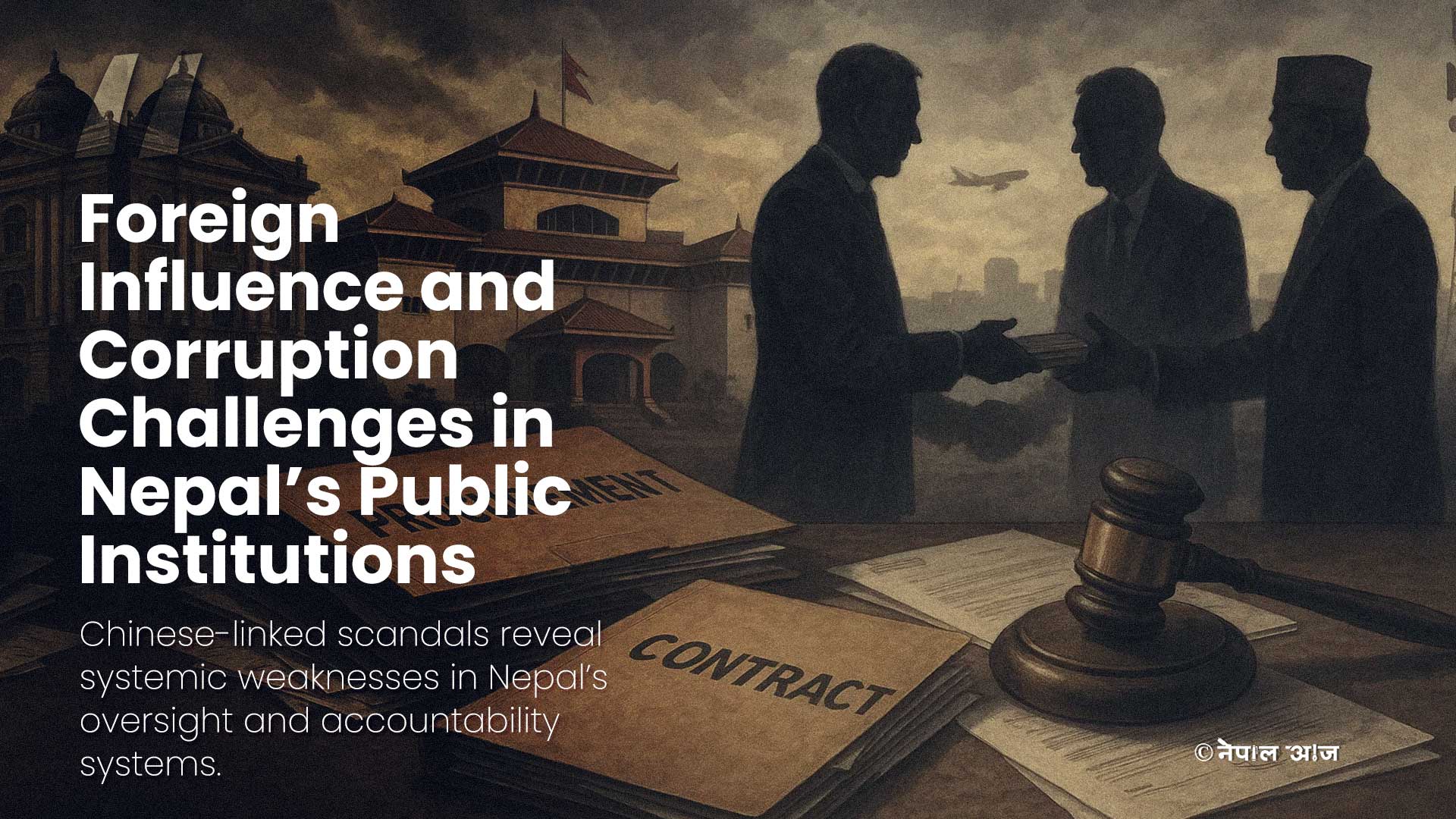
Corruption has long been a corrosive force in Nepal’s political and economic landscape, undermining public trust and hindering the nation’s development. But in recent years, a distinct pattern has emerged—one where several major scandals have involved Chinese nationals or Chinese companies operating in the country.
These cases have not only raised concerns about the integrity of foreign-funded projects but have also drawn attention to the vulnerabilities within Nepal’s own institutions, oversight mechanisms, and political networks.
The convergence of foreign influence and weak domestic accountability has created a fertile ground for corruption to thrive.
And as Nepal deepens its engagement with China through infrastructure, technology, and investment partnerships, the fallout from these scandals reveals deeper questions about sovereignty, transparency, and the true cost of large-scale foreign involvement.
A telecom scandal exposing deep roots
One of the most significant corruption cases to surface in 2025 came from within Nepal Telecom, the country’s largest public utility.
The Commission for the Investigation of Abuse of Authority (CIAA) filed charges against the company’s Managing Director, former executives, and several representatives of two Chinese firms—Asia Info Linkage Technologies (China) Inc. and Asia Info Yunghang Software (Beijing) Limited.
The allegations were stark. According to CIAA’s investigation, procurement for a critical billing system had been manipulated to favour the Chinese companies.
Contracts were inflated, maintenance agreements were unjustified, and procedures were bypassed to ensure the deal went through. The estimated loss to Nepal Telecom exceeded NRs 334 million.
Among those implicated were Chinese nationals Long Yong and Huang Wei, accused of colluding with Nepali officials to secure the deal through illicit means.
The billing system, which forms the backbone of Nepal Telecom’s revenue management, was allegedly chosen not on the basis of performance or value, but through a network of influence and kickbacks.
This case demonstrated something that has been a recurring theme: corruption thrives where oversight is weak, incentives are misaligned, and foreign partnerships are treated as untouchable. But it also showed that the anti-graft bodies are becoming more assertive in addressing wrongdoing involving foreign actors, not just domestic ones.
Pokhara International Airport: A national dream marred by scandal
If the Nepal Telecom case was alarming, the revelations surrounding the Pokhara International Airport project were seismic.
The project, built with Chinese financing and executed by China CAMC Engineering, was touted as one of Nepal’s flagship infrastructure ventures.
What was meant to symbolise Nepal’s modernisation and connectivity instead became a case study in inflated costs, poor accountability, and entrenched irregularities.
The parliamentary investigation found that China CAMC Engineering benefited from questionable payments, doctored estimates, and extensive cost overruns.
The project—funded through loans that Nepal must eventually repay—ended up costing far more than initially announced. The alleged embezzlement ran into NRs 14 billion.
But the scandal was not solely about foreign malpractice. Nepali officials were accused of facilitating, ignoring, or actively participating in the corruption.
Parliamentary committee members described an environment where Chinese contractors dictated terms, bypassed local guidelines, and pushed through exemptions—while Nepali oversight bodies looked the other way.
Construction quality issues also compounded concerns. Reports highlighted structural flaws, insufficient planning, and corner-cutting that compromised long-term sustainability.
In public discussions, many questioned whether Nepal’s political leadership had been too eager to accept Chinese financing without demanding transparency or accountability in return.
Together, these revelations dented not only the credibility of one of Nepal’s most prominent infrastructure projects but also the broader narrative around Chinese-funded development in the country.
Patterns behind the scandals
A look across these cases reveals recurring trends in how corruption involving Chinese entities plays out in Nepal’s governance ecosystem:
Chinese companies often negotiate from a position of overwhelming leverage.
With large-scale financing—often tied to political commitments—Chinese firms gain significant influence over contract terms, procurement decisions, and operational oversight.
Nepali oversight mechanisms remain underprepared and sometimes compromised.
Whether due to political pressure, administrative weakness, or collusion, regulatory agencies frequently fail to enforce safeguards, leaving space for irregularities.
Bribery and informal networks play a central role.
Multiple investigations have pointed to personal incentives for both foreign representatives and Nepali officials. Corruption is facilitated through the alignment of private interests on both sides.
Large infrastructure projects are particularly vulnerable.
Projects such as airports, highways, and hydropower plants involve massive budgets, complex contracts, and multi-layered implementation—making them ideal environments for financial misconduct.
Public institutions lack sufficient autonomy.
Interference—both domestic and foreign—can distort decision-making, reducing the ability of agencies to monitor, audit, and enforce standards.
Rather than isolated incidents, the scandals suggest a systemic weakness in how Nepal manages foreign-funded projects, especially when dealing with powerful international players.
Domestic fallout
The controversies have sparked heated debate within Nepal. Critics argue that the repeated involvement of Chinese companies in corruption scandals reflects an unhealthy dependency on one foreign partner, particularly at a time when geopolitical competition is intensifying in South Asia.
Opposition parties have accused governments—past and present—of shielding Chinese entities due to political alliances and strategic considerations.
Civil society groups have raised concerns that corruption in these projects ultimately burdens Nepali taxpayers, who will have to shoulder the repayment of inflated loans.
At a broader level, these scandals are eroding trust in public institutions. When high-profile projects repeatedly fall under the shadow of corruption, citizens begin to question whether development truly serves the people or simply enriches a few.
China’s expanding footprint meets Nepal’s accountability gap
China remains one of Nepal’s most influential economic partners, and its involvement in infrastructure, technology, and investment continues to grow. Many projects have been beneficial, helping Nepal expand its connectivity and capabilities.
But the corruption cases underscore a clear reality: foreign engagement, no matter how ambitious or well-financed, cannot succeed if domestic systems are unable to safeguard transparency.
These scandals tell a story not just of misconduct by foreign nationals, but of weaknesses within Nepal’s own governance structure—weaknesses that external actors can exploit when local institutions fail to enforce accountability.
Chinese-Linked Corruption Scandals


![From Kathmandu to the World: How Excel Students Are Winning Big [Admission Open]](https://nepalaaja.com/img/70194/medium/excel-college-info-eng-nep-2342.jpg)