India-Nepal Symbiotic Economic Relations: A Lesson on Economic Synergy
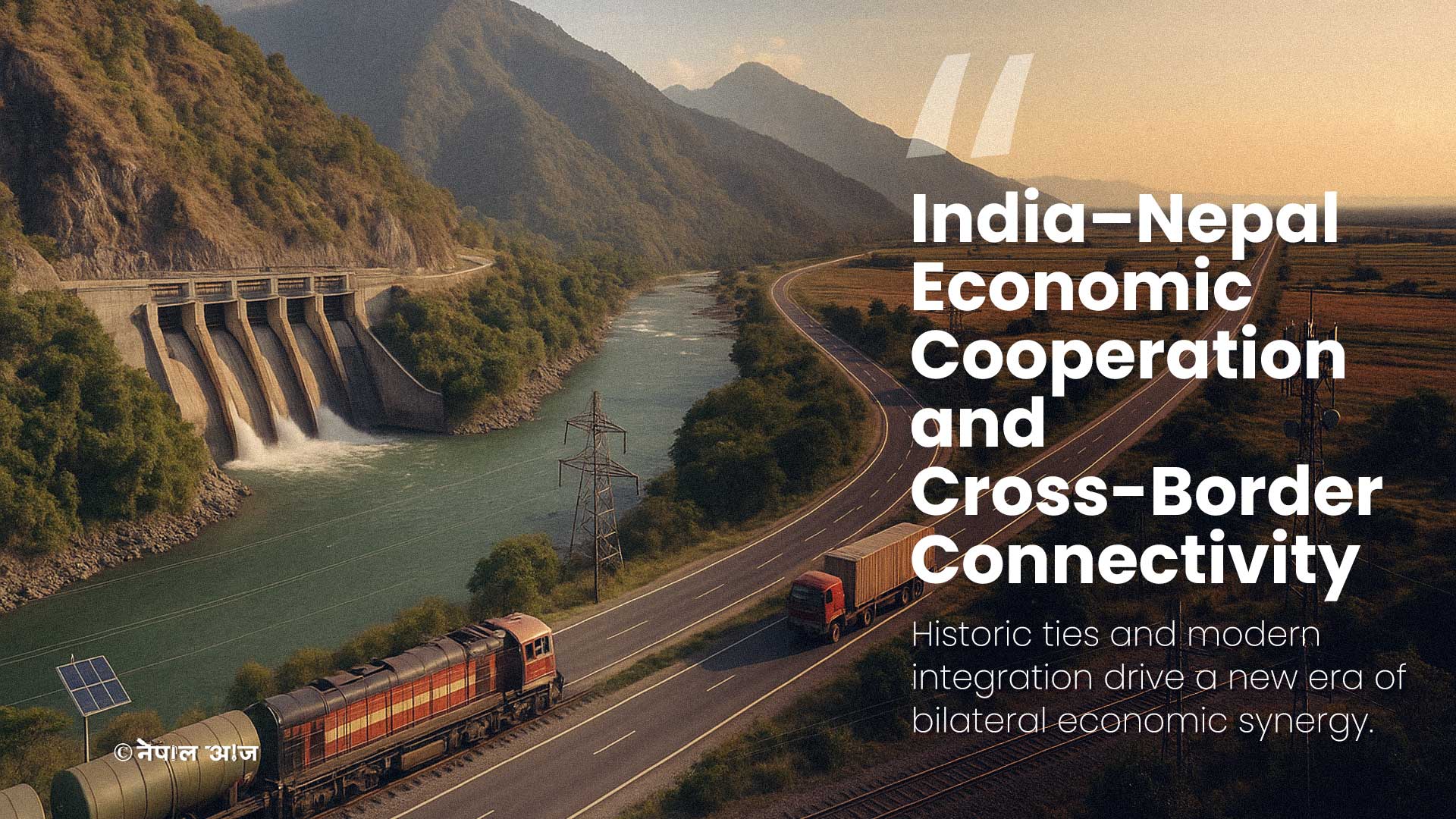
The current global geopolitical realities are defined by rising uncertainties, characterized by newly evolving geo-economic confrontations, frequently shifting alignments, geopolitical instabilities, and supply chain vulnerabilities. However, even in this environment of uncertainty, one factor that determines economic and diplomatic stability is the historicity of the bilateral economic ties. The current economic camaraderie(s) are often the function of deeply entrenched and cooperative economic exchanges formed over history (spanning centuries) and a shared sense of culture and belongingness. The current economic partnership between India and Nepal is testimony to this phenomenon.
India-Nepal economic synergies are the outcome of multi-dimensional bilateral factors, including but not limited to geography, culture, history, and trade and finance. Though India–Nepal relations are supported by a couple of official treaties, their ever-strengthening economic partnership is indeed the result of shared inheritance of civilization and culture. The natural buffer for defense provided by Nepal to India, and the sea channels accessed by Nepal via Indian territory, are already much celebrated aspects of their mutual strategic dependence. However, the mutual dependence between the two expands much beyond and is in a continuous state of evolution.
Areas where the economic synergies are being capitalized include tourism, hydroelectricity generation, organic farming, and connectivity projects, among others. Tourism is an important industry, with both nations possessing an excessively rich cultural heritage and scenic landscapes, acting as travel destinations for each other as well as the world. Thus, governments across borders are focusing on developing tourism on a significant scale, including in non-traditional areas. For India, Nepal provides economic opportunities that lead to the path of sustainability, as India explores pilot projects for developing Nepal as a major base for organic farm products. While there are considerations for Nepal’s plans for ensuring employment generation with New Delhi’s Skill India program.
In November 2025, the two nations amended the Treaty of Transit, a bilateral initiative to enhance cross-border connectivity and trade, to facilitate the movement of rail-based freight between Jogbani in India and Biratnagar in Nepal, including bulk cargo. Moreover, this liberalisation will extend to key transit corridors, which would not just help in strengthening multimodal trade connectivity between the two countries, but also Nepal’s trade with third countries. Such measures are a way to further consolidate economic and commercial linkages between the two countries.
On the financial development front, progressive measures have been taken with the establishment of interoperability of UPI (Unified Payments Interface) and FonePay QR in Nepal. Even during COVID-19, when borders around the world remained closed, India-Nepal trade routes continued to be open and robust, an example of resilient economic ties.
The two nations are writing new chapters of bilateral energy cooperation aimed at enhancing regional connectivity and sustainable power development. Progressing on their commitment to promote clean energy, New Delhi and Kathmandu reached a historic milestone with the Indian Oil Corporation Ltd. (IOCL)’s export of Liquefied Natural Gas (LNG) to Nepal. The transition was enabled with the development of cryogenic storage and regasification facilities at Simara, Nepal. This initiative highlights the synergies in achieving sustainability and efficiency with the development of a viable industrial energy alternative.
The much-celebrated Arun-3 Hydroelectric Project, being developed by SJVN Limited, an Indian public sector enterprise, is tapping into Nepal’s huge water wealth and hydropower potential, meeting energy-hungry India's increasing needs. The 900 MW run-of-the-river hydropower project stands as a symbol of robust India-Nepal partnership in the hydropower sector, with multi-pronged benefits like providing a share of free electricity to Nepal, meeting India’s incremental energy needs, as well as generating economic opportunities locally. Nepal is expected to receive energy royalty, along with rural electrification and rural infrastructural development. Thus, in their economic symbiosis, India provides a ‘ready and dynamic market to Nepal’s immense hydropower generating resources.’
Kathmandu and New Delhi are the South Asian siblings, uniquely enmeshed in unique cultural, historical, and economic ties, unparalleled in the world. They have been consistently involved, through different measures, dovetailing their economic path to progress. India and Nepal are progressing towards a fruitful era of bilateral engagement with increasing cooperation in the field of trade, infrastructural connectivity, and energy. The focus on trade diversification, mutual dependence on energy and resources, and diplomatic ties are fulcrums to economic development and regional prosperity. As mentioned, civilization ties and the shared sense of history and belongingness are the key to strengthening economic interdependence. Buttressed by the history, now the mutually beneficial bilateral economic relations are transcending into a shared economic future for the two.
India-Nepal Symbiotic Economic Relations


![From Kathmandu to the World: How Excel Students Are Winning Big [Admission Open]](https://nepalaaja.com/img/70194/medium/excel-college-info-eng-nep-2342.jpg)