China Expels Student for Anti-Marxist Views, Sparking Ideology Debate
China’s expulsion of a college student over anti-Marxist remarks signals intensifying ideological intolerance on campuses
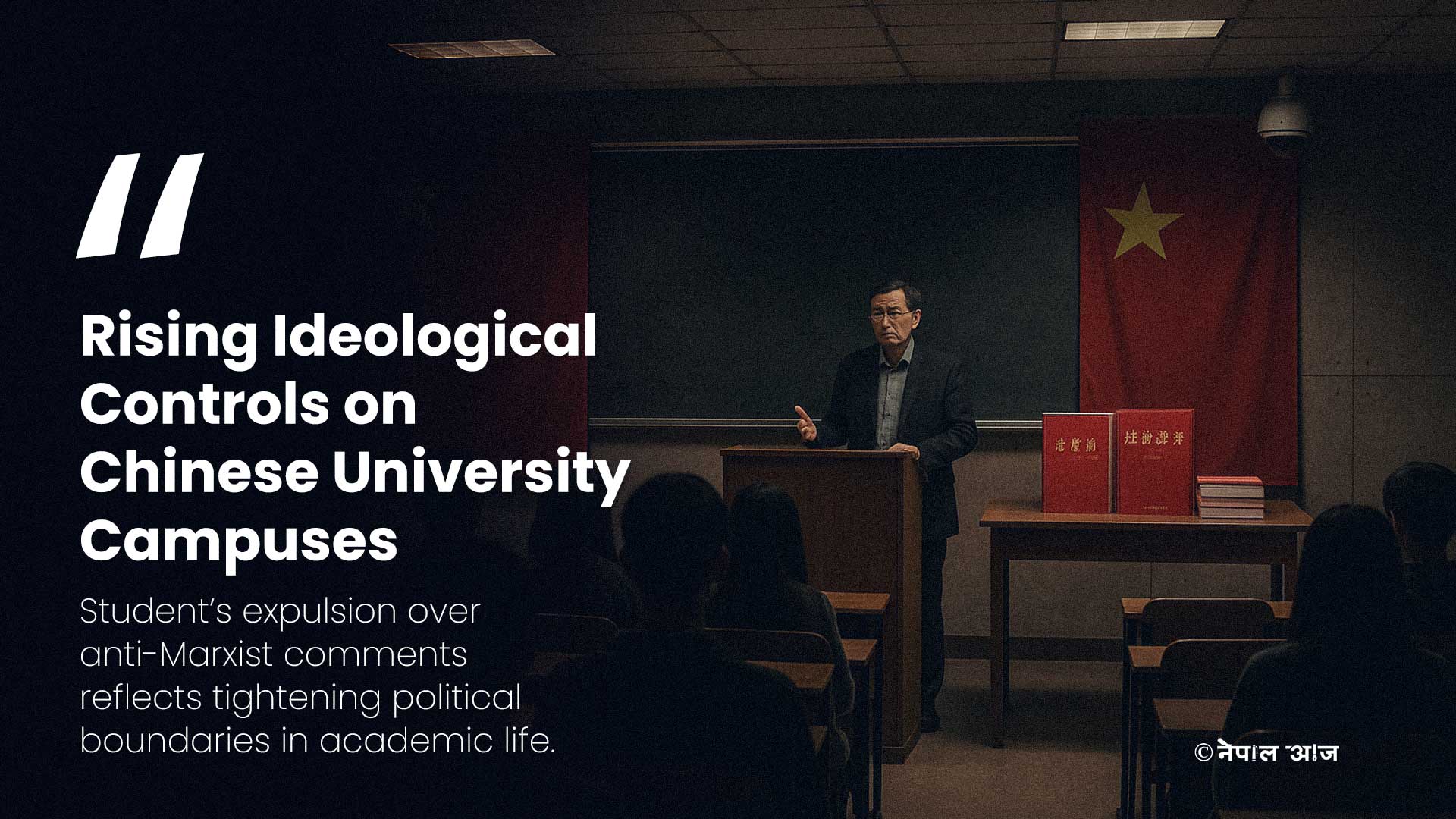
China’s decision to expel a university student for voicing opposition to Marxism and the Chinese Communist Party (CCP) has drawn renewed attention to the shrinking space for political discourse within the country’s academic institutions.
The incident, centred at Northwest University in Xi’an, reflects a campus climate in which dissenting opinions—especially those challenging official ideology—are increasingly treated as grounds for disciplinary action rather than debate.
As China strengthens its ideological education apparatus and embeds party doctrine more deeply into classroom instruction, episodes like this illustrate the narrowing boundaries of permissible speech.
The case began surfacing online after an internal disciplinary notice circulated on Chinese social media.
The document describes a physics major who enrolled in 2023 and repeatedly challenged Marxist and CCP-aligned perspectives during mandatory political theory courses.
According to the notice, four classmates reported him for rejecting the legitimacy of the Communist Party and disputing foundational ideological claims.
Such political theory courses are compulsory across Chinese universities, forming part of a curriculum designed to reinforce party narratives and cultivate alignment with official doctrine.
The student had reportedly already been disciplined in 2024 for what the university called “inappropriate remarks,” made during a Theoretical Marxism class in which he challenged key tenets of Marxist ideology.
While disagreements in political theory classes are common in many education systems, this disagreement escalated into a formal disciplinary matter, indicating the heightened sensitivity surrounding political expression on Chinese campuses.
The situation intensified during a September 16 class on “Xi Jinping Thought on Socialism with Chinese Characteristics for a New Era.”
When asked about the relationship between communist ideals and China’s national rejuvenation, the student is said to have replied that there was no direct connection and that a country could prosper without communism.
He then reportedly told the instructor that if the CCP were to collapse, Marxist professors would “have to set up street stalls” near the university to earn a living—a remark that appears to have further inflamed tensions in the classroom and among reporting students.
On November 21, Northwest University’s disciplinary committee concluded that the student had “seriously disrupted classroom teaching order” and violated university policies, according to the notice.
Although the university has not publicly announced the expulsion, nor responded to media inquiries about the decision, the leaked document has circulated widely enough to draw commentary from scholars and legal experts, many of whom have chosen to speak anonymously due to the political sensitivity of the case.
Several academics from Xi’an, Chongqing and other cities said the severity of the expulsion highlights a shift in how institutions handle ideological disputes.
A retired journalist from Shaanxi Television noted that discussions of Marxism, communism and CCP history have traditionally been part of normal classroom conversation.
In earlier years, disagreements—even emotionally charged ones—might have led to further discussion or quiet counselling rather than formal punishment.
Scholars said that exploring political theory requires space for challenging ideas, even if those ideas depart from the official line.
Legal experts also weighed in, noting that the student’s comments, while provocative, do not violate Chinese law.
One Chongqing-based lawyer pointed out that disbelief in an ideology is not criminal and that the remarks themselves constitute an expression of personal opinion, not an incitement or unlawful act.
However, the lawyer emphasised that universities operate within a political framework where ideological conformity is prioritised, particularly as campuses are increasingly relied upon to reinforce party narratives among young people.
He observed that many institutions have established Marxism institutes in recent years, signalling a system-wide emphasis on ideological education.
This tightening of ideological control on campuses is part of a broader push from the CCP to ensure political loyalty within educational environments.
Chinese state media have repeatedly highlighted the need for schools to “prevent and control ideological risks,” suggesting that universities are expected to take active measures in monitoring and guiding student thought.
In this environment, reports submitted by students about their peers or professors have become more common, contributing to an atmosphere that some faculty members compare to past political movements in China.
A professor at Chongqing Normal University described a previous case involving a colleague, Tang Yun, who was reported by students in 2019 after expressing personal views in class.
Tang later lost his teaching credentials and was demoted, and the professor said he heard that a surveillance camera was even placed at Tang’s residence after his retirement.
Although such measures are not widely documented, these anecdotes contribute to a narrative of expanding surveillance and ideological enforcement, underscoring the power dynamics that shape campus life.
While expulsions over political statements have occurred before, they remain relatively uncommon due to the reputational implications for universities and local authorities.
Most incidents are handled quietly through warnings, counselling, or internal evaluations. In this case, the decision to expel indicates that the remarks were deemed to cross an ideological boundary that the institution considered intolerable.
The future for the expelled student remains uncertain. It is unclear whether he intends to appeal the decision or seek readmission elsewhere.
Online discussion within China has been sparse, with many related posts on social media swiftly deleted—reflecting both censorship protocols and caution among users who fear being associated with politically sensitive topics.
The incident arrives at a time when universities across China are deepening their emphasis on “Xi Jinping Thought,” with curricula designed to ensure ideological alignment from early education through postgraduate studies.
Political education is viewed as integral to national security and social stability, resulting in an academic landscape where deviation from official positions is met with growing scrutiny.
As the disciplinary notice continues to circulate internationally, the case offers a glimpse into the evolving relationship between China’s higher education system and political orthodoxy.
The expulsion underscores the tightening boundaries of expression on campuses and highlights a shift toward stricter enforcement of ideological conformity in academic settings.
China Expels Student for Anti-Marxist Views


![From Kathmandu to the World: How Excel Students Are Winning Big [Admission Open]](https://nepalaaja.com/img/70194/medium/excel-college-info-eng-nep-2342.jpg)