


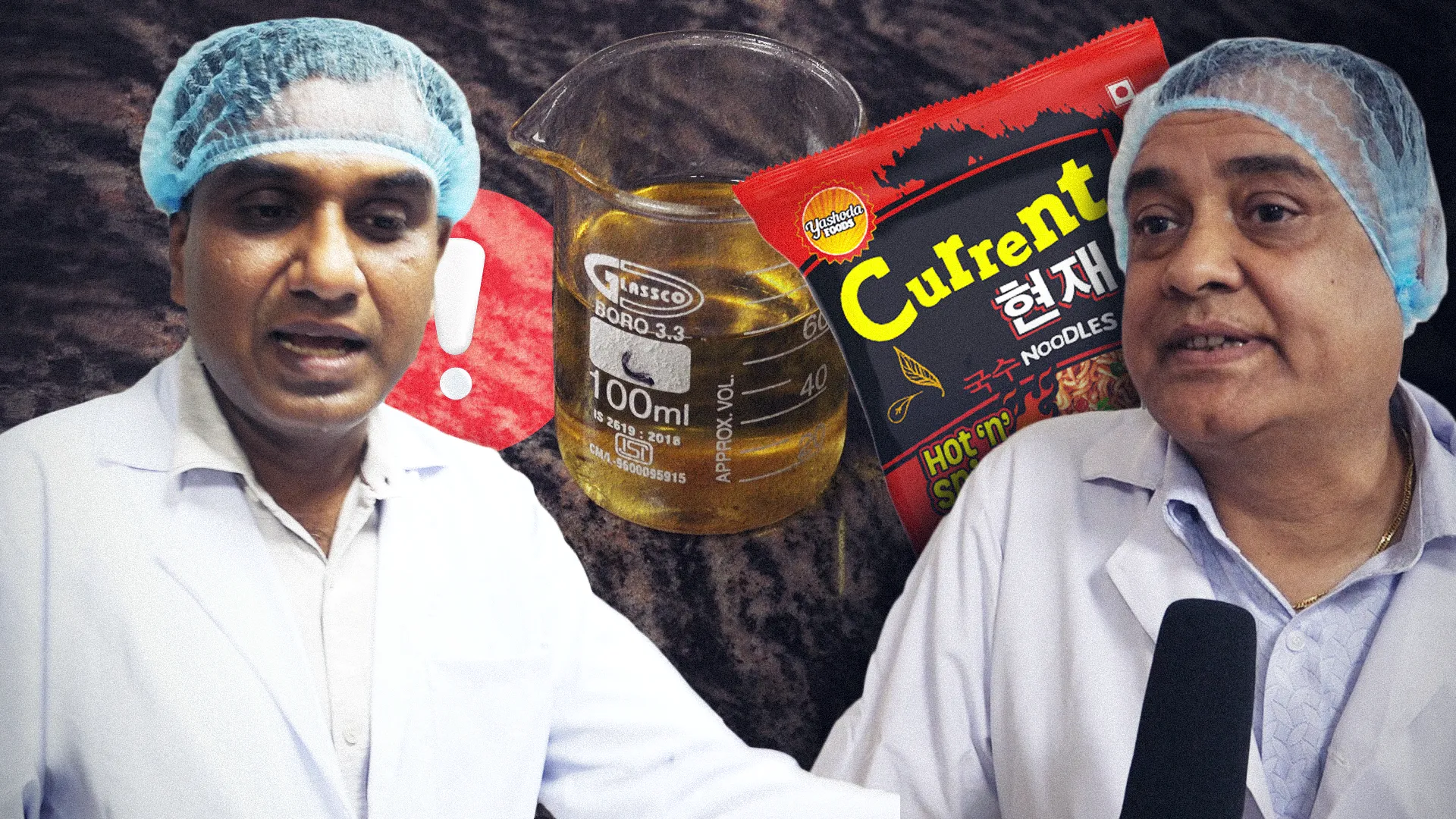
Kathmandu. On May 14, 2026 (Baishakh 31, 2083 BS), the Department of Food Technology and Quality Control issued a notice. It stated— 'Since the acid value of the extracted fat in Current Noodles batch number 04A was found to be higher than the standards set by the Government of Nepal, recall it from the market immediately.'
Following the release of this notice, a major stir was created on social media. While various suspicions were arising among general consumers regarding the quality of the noodles and public health, a special team from 'Nepal Aaja' reached directly to the factory of Yashoda Foods Private Limited, the industry producing Current Noodles, to understand the technical, scientific, and practical reality. Upon conducting a field study of the factory and conversing with the stakeholders there, the reality appears balanced and worthy of analysis.
Factory's Claim and Internal Laboratory Records
According to the industry's production manager, Parshuram Bhandari, three state-of-the-art laboratories operate round the clock inside the factory to ensure quality control:
Chemical Laboratory (Chemical Lab): To check the technical and chemical parameters of raw materials.
Microbiological Laboratory (Microbiological Lab): To test micro-organisms.
Research and Development Laboratory (R&D Lab): To continuously refine quality.
The factory rules are very strict. As soon as raw materials arrive, they are initially tested in the chemical laboratory, and goods are unloaded only if the chemical parameters are correct; otherwise, they are sent back right from the gate.
According to Bhandari, when prepared in the factory, the acid value of every food product ranges between 0.2 and 0.4. According to the company's internal laboratory records, when batch 04A, which the department pointed out flaws in, was produced, its acid value was only 0.26, which falls well within the government standard (less than 1). Therefore, since the industry sends only fully quality goods to the market, it claims there is no possibility of sub-standard finished noodles leaving the factory for the market.
Storage Discrepancies and Dhangadhi's Scorching Sun

Interested in this ad?
Would you like to continue to the link or provide your information for more details?
Please provide your information
To continue, please fill in your details
How did the acid value, which was within the standards (0.26) at the factory, increase in the market sample? Explaining the technical and scientific reasons for this, Production Manager Bhandari said:
"The department had collected this sample from the market in Dhangadhi. When goods are exposed to Dhangadhi's extreme heat and scorching sun for a long time or due to improper storage, there is a scientific possibility of chemical reactions occurring in the oil, thereby increasing the acid value."
A strong basis confirming this is that after the market recall order was issued, when goods of the same batch were brought back from various regions of the country and re-tested at the factory, the acid value was found to be within the specified limit (i.e., within limits).
International Standards and Scientific Debate
The argument of Quality Control Manager Anjani Kumar Karna on this matter is scientific. The Government of Nepal has set the limit for acid value at 1, but according to him, a food item does not become toxic or completely 'unedible' just because this limit exceeds 1. Standards vary across different countries of the world:
Nepal: Mandatory standard must be less than 1.
India: A safe limit up to 2 is considered normal and scientifically acceptable.
Japan: Up to level 3 is considered safe and edible.
USA (FDA): The 'Food and Drug Administration' of the United States has not set any specific limit for this. They only focus on 'Good Manufacturing Practices' (GMP).
After hearing all these technical details, at the time of leaving the factory, our team asked a purely personal question to Bhandari and Karna— "Do you eat these noodles yourselves?" Both of them replied that they and their families have been regularly and confidently consuming this product.
Balance Between Public Health and Domestic Industry
Remaining vigilant and implementing strict regulations by government bodies keeping the sensitivity of public health in mind is a welcome step. However, experts opine that it is not justified to blame only the industry for a small technical error caused by transportation, improper market storage processes, or the effects of the scorching sun while collecting a single sample. A situation where the same standard is acceptable abroad but considered unedible in Nepal demands a policy review.
Should a domestic industry that is providing employment to thousands of Nepalis, consuming raw materials from local farmers, and contributing significantly to the national economy by expanding domestically and internationally to bring foreign currency into Nepal, be discouraged based on social media rumors or encouraged on the basis of scientific facts? The ultimate decision and responsibility to exercise wisdom now lies in the hands of the general consumers.