


There was a time when measuring development largely meant counting economic output. Today, the conversation has shifted towards something more meaningful: whether people are healthier, better educated, financially secure, digitally connected and able to live with dignity.
It is within this broader understanding of progress that India's journey under the Sustainable Development Goals (SDGs) has drawn increasing global attention.
A decade after the United Nations adopted the 2030 Agenda for Sustainable Development, India has emerged as one of the world's largest examples of multidimensional poverty reduction.
Rather than focusing solely on income, the country's development strategy has increasingly targeted improvements across health, education and living standards, creating measurable gains that have touched millions of households.
The latest data from NITI Aayog, the United Nations Development Programme (UNDP) and the Oxford Poverty and Human Development Initiative (OPHI) indicates that India has recorded one of the fastest reductions in multidimensional poverty anywhere in the world since 2015.
Coupled with sweeping improvements in digital public infrastructure, financial inclusion, sanitation, healthcare, housing and social protection, the country's SDG journey presents a comprehensive picture of human development driven by multiple sectors working together.
Understanding poverty beyond income
The Sustainable Development Goals fundamentally changed the way governments evaluate development. SDG 1 seeks to end poverty in all its forms, recognising that deprivation extends far beyond household income.
The Multidimensional Poverty Index (MPI), jointly developed by UNDP and OPHI, measures poverty across three broad dimensions—health, education and standard of living—using indicators such as nutrition, child mortality, years of schooling, school attendance, sanitation, drinking water, housing, electricity, cooking fuel, bank accounts and asset ownership.
India adopted this framework through its National Multidimensional Poverty Index under the guidance of NITI Aayog, allowing policymakers to identify specific areas of deprivation and target interventions more precisely.
This approach reflects a broader shift in governance: improving everyday quality of life instead of focusing exclusively on economic statistics.
A historic decline in multidimensional poverty
The numbers illustrate the scale of India's transformation.
According to the National Multidimensional Poverty Index and UNDP estimates, multidimensional poverty declined from 24.85 percent in 2015-16 to 14.96 percent in 2019-21, meaning approximately 135 million people escaped multidimensional poverty within five years.
The progress has continued beyond this period.
NITI Aayog's second National MPI report, released in 2025, estimates that 24.82 crore (248.2 million) people moved out of multidimensional poverty between 2013-14 and 2022-23.
National multidimensional poverty declined further to 5.25 percent, indicating sustained progress across multiple development indicators.
This pace places India on track to achieve SDG Target 1.2, which seeks to reduce multidimensional poverty by at least half well before the 2030 deadline.
For a country with a population exceeding 1.4 billion, the scale of this achievement is significant not merely because of the numbers involved, but because improvements occurred simultaneously across rural and urban areas, multiple states and diverse socio-economic groups.
Health and education at the centre of progress
Much of India's multidimensional poverty reduction has been driven by improvements in basic public services.
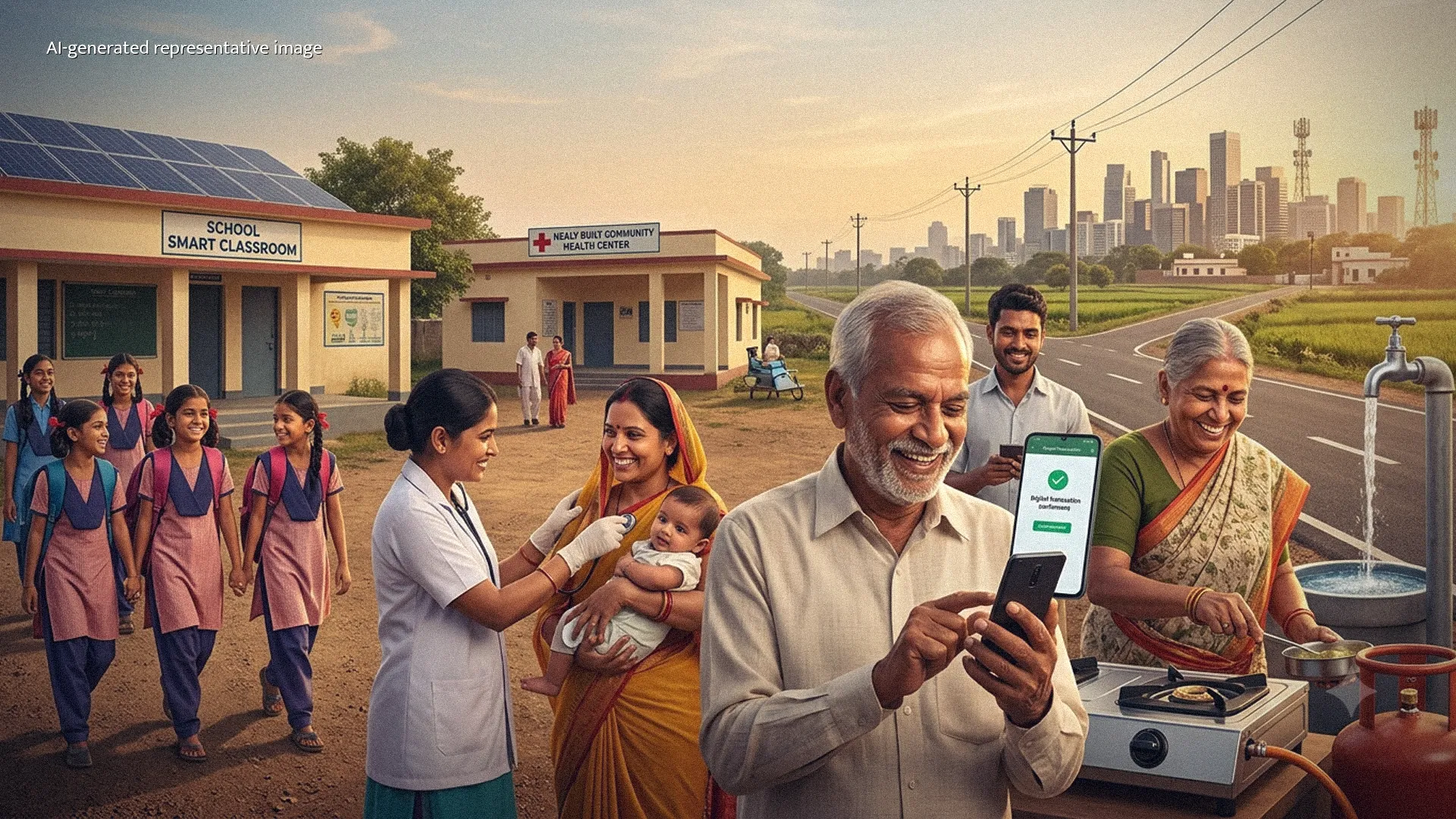
Expanded access to electricity, sanitation facilities, clean cooking fuel, drinking water, healthcare services and financial inclusion has significantly reduced household deprivation.
Health indicators have shown steady improvements through expanded immunisation, increased institutional deliveries, wider healthcare coverage and enhanced nutrition programmes.
Schemes such as Ayushman Bharat have expanded access to healthcare for economically vulnerable families, while improvements in primary healthcare infrastructure have strengthened service delivery across districts.
Education has followed a similar trajectory.
School enrolment, particularly among girls, has improved substantially over the past decade, supported by expanded school infrastructure, digital learning initiatives and scholarship programmes.
Greater educational attainment directly contributes to reductions in multidimensional poverty by improving employment opportunities and long-term household resilience.
The MPI framework recognises these improvements because education and health create lasting capabilities rather than temporary income gains.
Digital Public Infrastructure expands human development
One of the defining features of India's post-2015 development model has been the integration of Digital Public Infrastructure (DPI) into governance.
The combination of Aadhaar, Jan Dhan bank accounts and mobile connectivity—often referred to as the JAM Trinity—has fundamentally transformed the delivery of public services.
Digital platforms such as Unified Payments Interface (UPI), Direct Benefit Transfer (DBT), DigiLocker, Ayushman Bharat Digital Mission and e-Shram have created an interconnected ecosystem reaching virtually every part of the country.
This digital architecture has enhanced transparency while ensuring that welfare benefits reach intended beneficiaries directly.
According to official estimates, India's digital economy contributed approximately 12 percent of GDP in 2022-23, equivalent to about $395 billion (INR 31.64 lakh crore), and is projected to contribute almost one-fifth of national income by 2029-30.
Equally notable is India's leadership in digital payments.
The country now processes more than 200 billion digital transactions annually, with the Unified Payments Interface emerging as the world's largest real-time payment system.
UPI recorded over 22 billion transactions in March 2026 alone, demonstrating the rapid integration of digital finance into everyday life.
For millions of households, digital connectivity has become an enabling factor for financial inclusion, entrepreneurship and access to government services, reinforcing several SDGs simultaneously.
Financial inclusion changes household economics
Banking access has become one of India's most transformative development stories.
The Pradhan Mantri Jan DhanYojana dramatically expanded financial inclusion, bringing hundreds of millions of citizens into the formal banking system.
Combined with Aadhaar-based authentication and mobile technology, this has enabled direct transfers of welfare benefits, pensions, scholarships and subsidies without intermediary leakages.
Financial inclusion has also encouraged greater participation in savings, insurance, credit access and digital commerce, strengthening household economic resilience.
For rural entrepreneurs, women-led self-help groups and small businesses, digital financial systems have opened new opportunities for formal economic participation.
The integration of banking with digital payments has therefore become an important contributor to broader human development outcomes.
Housing, sanitation and living standards improve together
India's multidimensional poverty decline has also been closely linked with improvements in basic living conditions.
Access to electricity has become nearly universal across much of the country.
Sanitation coverage expanded rapidly through nationwide initiatives promoting household toilets and behavioural change.
Housing programmes have improved access to permanent homes for economically weaker sections, while drinking water initiatives have expanded piped water connectivity across rural communities.

Interested in this ad?
Would you like to continue to the link or provide your information for more details?
Please provide your information
To continue, please fill in your details
Clean cooking fuel programmes have reduced dependence on traditional biomass, improving household health and indoor air quality.
These interventions address multiple MPI indicators simultaneously, demonstrating how integrated public policy can accelerate reductions in multidimensional poverty rather than tackling individual sectors in isolation.
India’s post-2015 progress under SDG
India's rapid expansion of Digital Public Infrastructure (DPI) has emerged as one of the defining features of its development journey after 2015.
Rather than functioning merely as a technology platform, the country's digital ecosystem has increasingly become an instrument for delivering welfare, expanding financial inclusion and strengthening human development outcomes.
Built around the JAM Trinity—Jan Dhan bank accounts, Aadhaar digital identity and widespread mobile connectivity—the architecture enables citizens to access public services with greater speed and transparency.
The ecosystem integrates platforms such as Unified Payments Interface (UPI), Direct Benefit Transfer (DBT), DigiLocker, Ayushman Bharat Digital Mission, Ayushman Bharat health insurance and e-Shram, creating a seamless framework that links identity, finance and public service delivery.
According to official estimates, India now serves more than 1.4 billion people through one of the world's largest digital public infrastructures. The system has substantially improved access to banking, healthcare, education and welfare services, particularly for populations that previously remained outside the formal economy.
The impact extends well beyond administrative efficiency. By reducing transaction costs, improving transparency and ensuring that benefits reach intended beneficiaries directly, digital infrastructure has strengthened the implementation of several Sustainable Development Goals simultaneously, including poverty reduction, financial inclusion, health and institutional effectiveness.
A digital economy driving human development
The rise of India's digital economy has added another important dimension to the country's development story.
According to government estimates, the digital economy contributed around 12 percent of India's GDP in 2022-23, generating economic output worth approximately $395 billion (INR 31.64 lakh crore).
It is projected to account for nearly one-fifth of national income by 2029-30 while expanding at almost twice the pace of the broader economy.
This growth has translated into substantial employment generation, with the sector supporting more than 15 million jobs. Its productivity is estimated to be nearly five times higher than the rest of the economy, while digital adoption continues to transform banking, retail, education, healthcare and logistics.
India has simultaneously become the world's largest real-time digital payments market through UPI. More than 200 billion digital transactions are now processed annually, overtaking several advanced economies.
During the first quarter of 2026 alone, monthly UPI transactions consistently crossed 20 billion, with transaction values reaching record levels.
The International Monetary Fund has recognised India's digital payments ecosystem among the most advanced globally, highlighting its scalability, interoperability and inclusiveness.
Such achievements contribute directly to SDG targets relating to innovation, financial inclusion, economic growth and reduced inequalities.
Human development gains extend beyond income
The multidimensional poverty framework emphasises that development is measured not merely by rising incomes but by improvements across education, healthcare, sanitation, nutrition and living standards.
India's recent progress reflects this broader understanding.
The National Family Health Surveys indicate steady improvements in household access to electricity, sanitation facilities, clean cooking fuel, drinking water, housing quality and asset ownership.
Expansion of healthcare coverage through Ayushman Bharat, wider immunisation programmes, improved maternal healthcare and greater institutional deliveries have strengthened several health indicators that directly influence multidimensional poverty calculations.
Education indicators have also shown consistent progress through expanded school enrolment, improved access to educational facilities and greater emphasis on foundational learning.
These multiple interventions have produced cumulative benefits. Rather than isolated improvements in individual indicators, India's poverty reduction reflects simultaneous progress across several dimensions of human development.
This integrated approach closely mirrors the philosophy of the Sustainable Development Goals, where improvements in one sector reinforce outcomes in others.
Global recognition for India's development trajectory
India's achievements in multidimensional poverty reduction have increasingly attracted international recognition.
The United Nations Development Programme has highlighted India's unprecedented pace of poverty reduction, describing it as one of the largest reductions recorded globally within such a short period.
The Multidimensional Poverty Peer Network has also recognised India's National Multidimensional Poverty Index as an important example of how countries can use domestic data systems to monitor progress more effectively while aligning national priorities with global Sustainable Development Goals.
International institutions increasingly point to India's ability to combine economic growth with targeted social interventions.
Unlike income-based poverty measurements alone, India's multidimensional approach provides policymakers with detailed evidence about where deprivations continue to exist and which interventions produce the strongest outcomes.
This evidence-based policy framework has become an important feature of India's development planning.
SDGs as an integrated development framework
The Sustainable Development Goals, adopted unanimously by United Nations member states in 2015, were designed as an interconnected framework rather than a collection of isolated objectives.
India's development experience since 2015 illustrates this integrated philosophy.
Progress towards SDG 1 (No Poverty) has been reinforced through improvements in SDG 2 (Zero Hunger), SDG 3 (Good Health and Well-being), SDG 4 (Quality Education), SDG 6 (Clean Water and Sanitation), SDG 8 (Decent Work and Economic Growth), SDG 9 (Industry, Innovation and Infrastructure) and SDG 10 (Reduced Inequalities).
Digital Public Infrastructure has further accelerated implementation by creating common platforms through which multiple programmes can operate simultaneously.
Financial inclusion enables direct benefit transfers, digital identity facilitates healthcare access, mobile connectivity expands educational opportunities, and digital payments improve economic participation.
Together, these interconnected systems demonstrate how progress in one domain strengthens outcomes across several Sustainable Development Goals.
Towards SDG Target 1.2 ahead of schedule
Perhaps the most significant aspect of India's multidimensional poverty story is the pace at which progress has occurred.
According to NITI Aayog and UNDP assessments, nearly 24.82 crore people exited multidimensional poverty over a nine-year period, placing India on course to achieve SDG Target 1.2—reducing multidimensional poverty by at least half—well before the 2030 deadline.
The decline from 24.85 percent multidimensional poverty in 2015-16 to 14.96 percent in 2019-21 represents one of the fastest improvements recorded anywhere in the developing world for a country of comparable population size.
Equally significant is the fact that the progress has been measured through internationally recognised methodologies jointly developed by national institutions and the United Nations Development Programme.
As India continues expanding digital governance, strengthening healthcare systems, improving educational access and broadening financial inclusion, the country's post-2015 experience increasingly demonstrates how coordinated public policy, technological innovation and sustained institutional reforms can collectively accelerate human development.
Rather than viewing poverty solely through the lens of income, India's multidimensional approach captures a broader transformation in the quality of life experienced by millions of citizens.
It reflects an evolving development model in which improved access to health, education, sanitation, financial services and digital connectivity becomes central to measuring national progress.
With the Sustainable Development Goals entering their final stretch towards 2030, India's experience has emerged as one of the most closely watched examples of how large-scale policy coordination, data-driven governance and inclusive development strategies can reshape human development outcomes while advancing multiple global goals simultaneously.