

A hospital employee fills out a form about religious beliefs. A school compiles information about a child's family. Details about Christianity, Islam or other faiths are collected not in a place of worship, but through the everyday machinery of public administration.
In Chengdu, southwestern China, reports of such checks have raised questions about how far the state’s scrutiny of religious life now extends.
According to leaked internal documents and sources who spoke anonymously to The Epoch Times in August 2026, a public hospital in Chengdu required all employees, including permanent staff, contracted workers and temporary personnel, to disclose their religious affiliations.
Education officials in the city were also reportedly collecting information about students’ religious backgrounds and those of their parents.
The allegations have not been independently verified across the wider public sector, and the available evidence does not establish that every institution in China follows the same procedures.
However, the reported measures fit into a broader regulatory environment in which the Chinese Communist Party (CCP) has intensified its supervision of religious organisations, worshippers and religious expression.
The issue extends beyond the collection of personal information. When religious affiliation becomes part of workplace records and school-related checks, questions arise over privacy, freedom of belief and the extent to which the state can scrutinise people who have committed no offence.
Every employee 'must declare their faith'
The internal notice attributed to the Chengdu hospital described a comprehensive survey of employees’ religious beliefs as part of the “regular investigation of ideological, ethnic, and religious work”.
It reportedly instructed the institution to cover every employee without exception and required staff to provide accurate information without concealing or omitting details.
Workers who did not follow any religion were also required to register and select “no religious belief”.
The notice said designated personnel would collect the information and keep it confidential. It also prohibited the dissemination of the information online.
The document reportedly stated that CCP members could not practise religion and required employees with religious affiliations to report their status to their Party branch.
Religious proselytising and religious activities were prohibited in the workplace.
The notice did not specify that employees would automatically face dismissal or disciplinary action simply because they identified as religious. Nor did the available reporting establish how the hospital ultimately used the information.
Nevertheless, the requirement to disclose religious affiliation placed the personal beliefs of permanent, contractual and temporary workers within an institutional reporting process.
The inclusion of employees with no religious affiliation suggests that the exercise sought a complete register rather than information about a limited group already suspected of religious activity.
Schools extend the checks to parents
The reported scrutiny does not stop at the workplace. An administrative employee at a university in Sichuan, identified by the surname Chen, told The Epoch Times that schools were investigating the religious affiliations of students’ family members and compiling statistics for higher authorities.
“They are now investigating religious beliefs, [and] the schools have to compile the statistics and report them upward,” she said.
A separate employee of Chengdu’s education authorities reportedly said schools conducted family background checks every year before admitting new students, with religious affiliation included among the information collected.
The employee also described contact between the education system and religious authorities.
These accounts suggest that the reported checks may form part of recurring administrative procedures rather than a one-off exercise.
However, the available information does not establish the precise scope of the data collection, the number of students affected or how authorities use the records.
The inclusion of parents nevertheless raises a distinct concern. A child’s educational circumstances may become linked to the religious identity of family members, even when the child has no religious affiliation of their own.
The reported procedures also leave unanswered whether families can refuse to disclose such information and what consequences, if any, follow from their responses.
Religious belief under political supervision
China’s Constitution formally states that citizens enjoy freedom of religious belief.
Article 36 also prohibits state organs, social organisations and individuals from compelling citizens to believe in or not believe in a religion, or discriminating against them on that basis.
In practice, the authorities maintain a tightly regulated system covering five officially recognised religions: Buddhism, Taoism, Islam, Catholicism and Protestantism.
Religious organisations face controls over their management, personnel, publications, finances and activities. Groups that operate outside the approved framework can face police intervention and prosecution.
The Chengdu hospital notice’s reference to ideological, ethnic and religious work reflects this wider administrative approach. Religious affiliation is treated not only as a personal matter but also as information relevant to the state’s management of society.
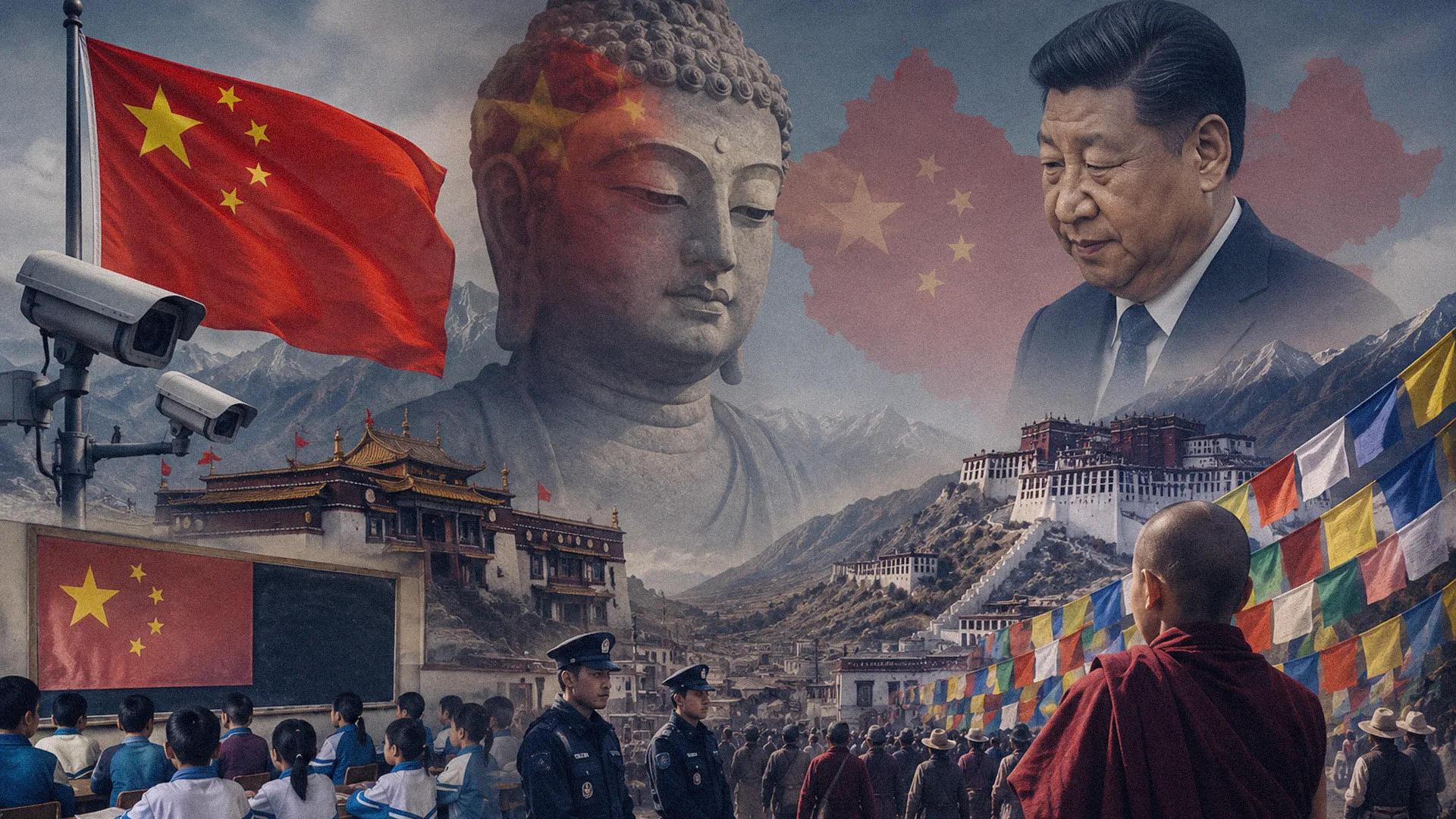
Under President Xi Jinping, the CCP has promoted the “Sinicisation of religion”, a policy requiring religious life to conform to Chinese political and cultural priorities.
In its May 2026 assessment, the US Commission on International Religious Freedom said the policy had intensified through laws and regulations that expand state control over religious communities.
It also reported continuing pressure on Uyghur Muslims, Tibetan Buddhists, underground Catholics, house-church Protestants and Falun Gong practitioners.
Reporting rules reach into communities
A September 2026 report by Human Rights Watch documented another development: local authorities encouraging residents to report religious activities considered illegal.
The organisation said that, during the first half of the year, more than a dozen Chinese cities introduced such measures.
In February, authorities in Honghe prefecture in Yunnan province reportedly listed 35 categories of reportable activity.
These included collective worship in private homes or unapproved venues, religious livestreams by clergy, distributing religious material in public and organising religious education without official permission.
Human Rights Watch also reported that authorities in Haidong, Qinghai province, had extended reporting obligations to businesses, including hotels and travel agencies, requiring them to report suspicious activity.
In Chengdu, verified tips about prohibited religious conduct could reportedly attract rewards of up to 800 yuan. The organisation said the rules could encourage surveillance of religious activity within ordinary communities.
These measures do not prove that the hospital and school checks are directly connected to local reporting schemes. Taken together, however, the reports describe a regulatory environment in which religious activity is increasingly subject to scrutiny beyond places of worship.
Crackdown on unregistered churches
Recent cases involving Protestant congregations provide further context. In January 2026, Human Rights Watch reported that police had detained several members of Chengdu-based Early Rain Covenant Church, an unregistered Protestant congregation.
Police reportedly took away church leader Li Yingqiang and other members in a series of actions that renewed concerns about the treatment of house churches.
In June, the Congressional-Executive Commission on China reported that at least 50 local government officials had raided an Early Rain Covenant Church service in Jiangyou, Sichuan province.
More than 30 worshippers were detained and taken to a detention centre, while others were reportedly prevented from leaving and pressured to provide personal information.
Some received administrative detention penalties for organising or participating in what authorities described as illegal gatherings.
The cases involve alleged enforcement against unregistered religious activity, rather than the collection of religious information from public-sector employees or students’ parents.
They nevertheless demonstrate the consequences that can follow when religious practices fall outside the state-approved system.
Human Rights Watch’s 2026 assessment also described tighter controls over online religious expression, including a code of conduct introduced in September 2025 that restricts religious professionals from circulating unauthorised content online.
The regulatory framework increasingly reaches both physical gatherings and digital communication.
The limits of confidentiality
The Chengdu hospital notice reportedly promised to keep employees’ declarations confidential. But the available document and testimony do not clarify who would have access to the information, how long records would be retained or whether other government departments could obtain them.
The same uncertainty surrounds the reported school checks. One source said the information was compiled and passed to higher authorities but did not know how officials ultimately used it.
Those gaps matter because collecting religious information can have consequences even when authorities do not publicly announce punitive action.
Employees may question whether disclosure could affect their professional standing, while parents may be uncertain about how their family’s beliefs could influence administrative decisions involving their children.
A scholar identified only by the surname Lu told The Epoch Times that restrictions on religious belief among public employees were not confined to Chengdu.
He cited alleged cases in Shandong and Zhejiang, including the reported dismissal of a Christian civil servant in Wenzhou. These claims were not independently established by the reporting and should not be treated as verified evidence of a nationwide policy.
A wider system of religious control
The reported surveys in Chengdu remain limited in what they establish. They do not prove that all Chinese hospitals and schools collect religious information, nor do they demonstrate that every employee or family identified as religious faces punishment.
Yet the allegations have emerged amid documented cases of religious leaders being detained, unregistered congregations being raided and local authorities expanding mechanisms to report activities classified as illegal.
The broader pattern places the collection of personal religious information within a system of extensive state supervision.
For hospital workers, the reported requirement means disclosing beliefs as part of employment-related administration.
For students’ families, it raises the possibility that religious identity is being recorded before a child even begins school.
In both settings, the central question is how information about private belief becomes part of the state’s institutional records—and what those records may mean for the people required to provide it.