


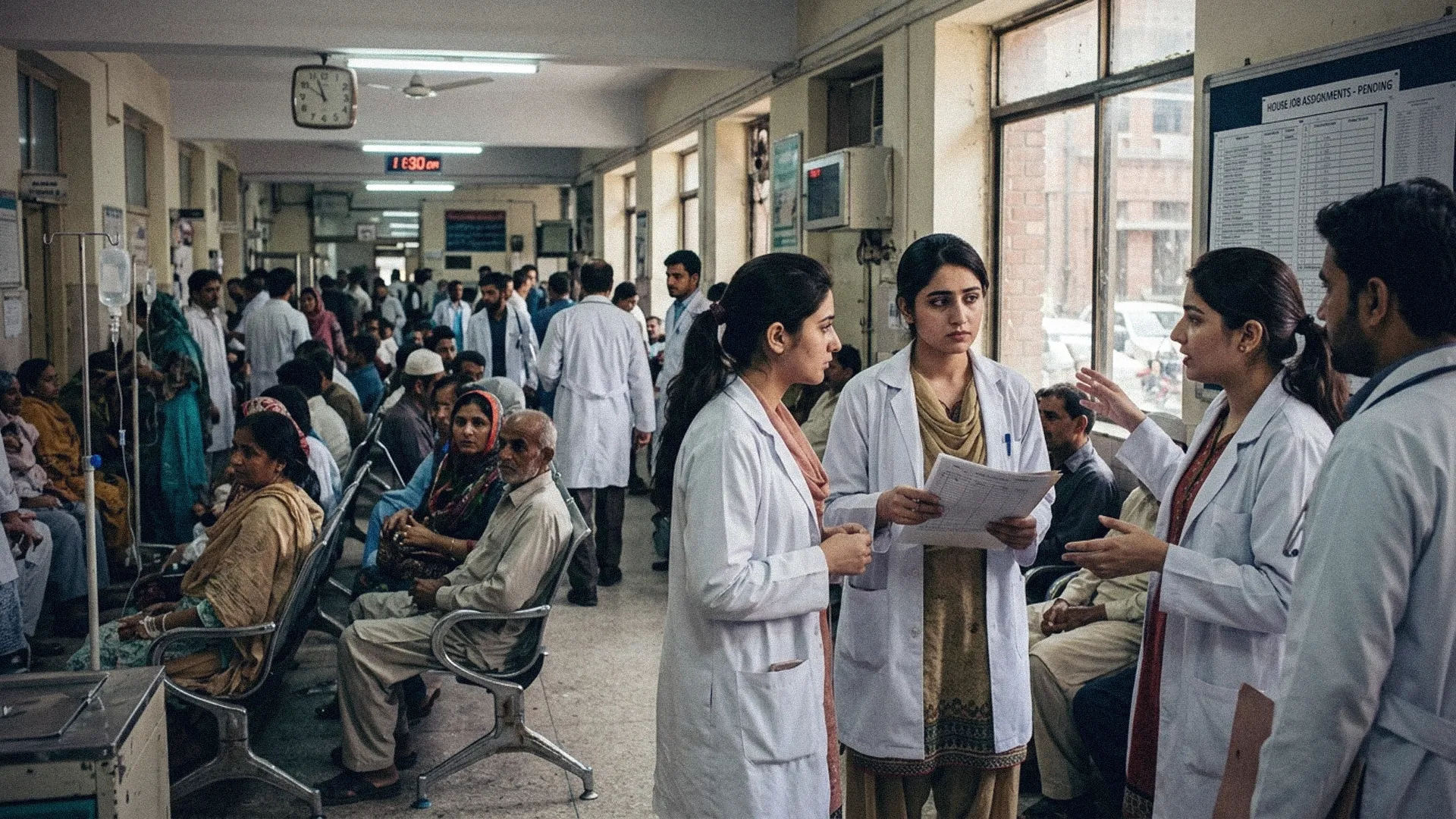
Every year, lecture halls across Pakistan produce thousands of newly minted doctors—graduates who have endured years of rigorous study, clinical rotations and high-stakes examinations.
White coats are worn with pride, degrees are conferred with ceremony, and families celebrate the culmination of long academic journeys. Yet, for a growing number of these young professionals, the moment of achievement quickly gives way to an uncertain reality.
Behind the façade of academic success lies a system unable to absorb its own output.
Thousands of qualified doctors find themselves navigating a narrowing corridor of opportunity, where the absence of postgraduate training slots effectively halts their professional progression.
The result is a widening disconnect between education and employment—one that is increasingly defining Pakistan’s healthcare landscape.
A widening gap between graduates and training
At the centre of the crisis is a structural imbalance.
The Pakistan Medical and Dental Council has repeatedly highlighted the growing mismatch between the number of medical graduates entering the system and the limited availability of postgraduate training positions required for specialisation.
Pakistan produces approximately 16,000 to 20,000 MBBS graduates each year from more than 120 medical colleges.
However, the number of training slots has not expanded at a comparable pace. This imbalance creates a bottleneck at a critical stage in a doctor’s career, leaving many unable to advance beyond basic qualifications.
Without access to structured postgraduate training, medical graduates remain professionally incomplete. Specialisation is not merely an optional step; it is an essential component of modern medical practice.
The absence of this pathway effectively sidelines thousands of doctors, despite the country’s acknowledged healthcare shortages.
The paradox of shortage amid surplus
The crisis presents a striking contradiction. Pakistan faces a persistent shortage of healthcare professionals, yet a significant proportion of its trained doctors remain unemployed or underemployed.
The doctor-to-patient ratio stands at approximately 1:1,300, falling short of international benchmarks, while rural areas experience even more severe disparities.
Despite this evident need, the system fails to integrate its own workforce.
The imbalance is particularly visible in underserved regions, where healthcare infrastructure remains limited, and access to qualified practitioners is constrained.
At the same time, urban centres witness a concentration of medical graduates competing for a finite number of positions.
This paradox underscores a deeper issue within the country’s planning framework.
The expansion of medical education has not been matched by corresponding investments in training infrastructure or healthcare delivery systems. As a result, the production of doctors continues without a clear pathway for their utilisation.
Unemployment and underutilisation
The consequences of this imbalance are reflected in employment data. Studies indicate that a substantial proportion of medical graduates, particularly women, remain outside the workforce.
Approximately 35 percent of female doctors are not actively practising, highlighting both structural and social barriers within the system.
For those who do enter the workforce, opportunities are often limited. Entry-level positions in private hospitals may offer modest remuneration, while public sector hiring has been constrained by fiscal pressures and recruitment freezes.
The gap between expectations and reality leaves many graduates in a state of professional uncertainty.
The issue extends beyond unemployment to underutilisation. Doctors who are unable to secure postgraduate training or stable employment may take on roles that do not fully utilise their skills.
This represents a significant loss of human capital, particularly in a country where healthcare needs remain acute.
Brain drain accelerates the crisis
Faced with limited domestic opportunities, many Pakistani doctors are seeking careers abroad.
Data from the Bureau of Emigration and Overseas Employment indicates that nearly 5,000 doctors left the country between 2024 and 2025 alone. This figure is widely considered an underestimate, as it does not account for those who migrate through alternative pathways.
Pakistani medical graduates are often able to secure positions in international healthcare systems, including those in the United Kingdom, North America and the Gulf region. Their success abroad contrasts sharply with the constraints they face at home.
This outward migration has significant implications for Pakistan’s healthcare system.

Interested in this ad?
Would you like to continue to the link or provide your information for more details?
Please provide your information
To continue, please fill in your details
The loss of trained professionals further exacerbates existing shortages, particularly in specialised fields. At the same time, the investment made in their education yields returns in foreign healthcare systems rather than within the country.
Infrastructure and funding constraints
The training crisis is closely linked to broader deficiencies in healthcare infrastructure.
Pakistan’s healthcare expenditure remains significantly below global recommendations, limiting the capacity of public institutions to expand training programmes and facilities.
Teaching hospitals, which play a central role in postgraduate training, often operate under considerable strain. Bed shortages, high patient loads and limited resources affect both patient care and the quality of training provided to junior doctors.
In many cases, hospitals lack the capacity to accommodate the growing number of graduates seeking clinical experience.
The imbalance is further compounded by the uneven distribution of healthcare facilities.
Rural areas, where the need for medical professionals is most acute, have fewer training institutions and limited infrastructure. This geographic disparity reinforces the concentration of opportunities in urban centres.
Policy disconnect and systemic inertia
The persistence of the training gap reflects a broader disconnect between policy formulation and implementation. While regulatory bodies and experts have repeatedly highlighted the issue, tangible progress remains limited.
The expansion of private medical colleges over the past two decades has significantly increased the number of graduates entering the system.
However, this growth has not been accompanied by a corresponding increase in training capacity. The result is a system that prioritises educational output without ensuring professional integration.
This disconnect raises questions about the effectiveness of long-term planning within the healthcare sector. The absence of coordination between educational institutions, regulatory bodies and healthcare providers has contributed to the current imbalance.
Economic pressures and limited hiring
Pakistan’s broader economic challenges have also influenced the employment landscape for medical graduates.
The economic crisis of recent years, characterised by high inflation, currency depreciation and fiscal constraints, has affected both public and private sector hiring.
Government institutions have implemented cost-cutting measures, including recruitment freezes, while private healthcare providers have adopted cautious hiring strategies.
These factors have further reduced the availability of positions for newly qualified doctors.
The financial burden on graduates adds another dimension to the crisis. Many students, particularly those from private institutions, complete their education with significant expenses.
Entering a job market with limited opportunities intensifies the pressure on these individuals.
A system under strain
The cumulative effect of these factors is a healthcare system that struggles to align its resources with its needs. The training shortage not only affects individual careers but also undermines the overall efficiency of the sector.
Doctors without access to specialisation represent an underutilised resource, while patients in many parts of the country continue to face limited access to qualified healthcare providers.
This disconnect highlights the systemic nature of the problem.
The situation also raises concerns about the long-term sustainability of medical education in Pakistan. Without a clear pathway from graduation to professional practice, the value of medical degrees is increasingly called into question.
An unresolved structural crisis
The growing number of medical graduates without adequate training opportunities reflects a structural challenge that extends beyond individual institutions.
It is rooted in the interplay between education, infrastructure, policy and economic conditions.
As Pakistan continues to produce thousands of doctors each year, the gap between qualification and employment remains a defining feature of the system.
The figures associated with graduate output, unemployment and migration point to a crisis that is both persistent and multifaceted.
In a country where healthcare needs remain significant, the inability to effectively utilise trained professionals underscores the depth of the challenge.
The training shortage has transformed medical degrees into incomplete credentials for many, leaving a generation of doctors suspended between aspiration and opportunity.