
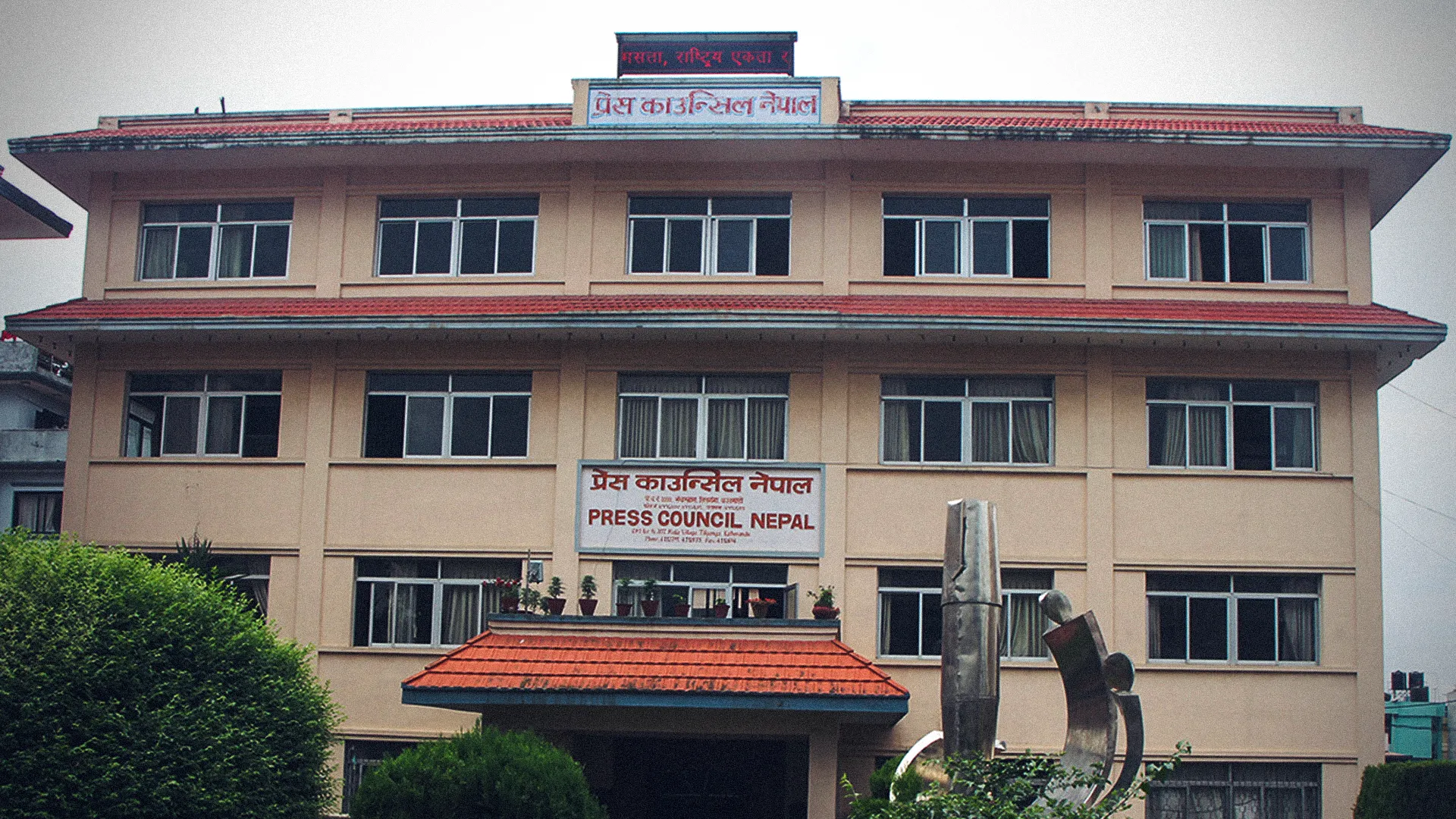
KATHMANDU — The Government of Nepal has forwarded an ordinance amending existing laws to President Ram Chandra Poudel for authentication, seeking to significantly expand the regulatory authority of Press Council Nepal. Through this ordinance, efforts are being made to bring digital content creators and social media influencers under the scope of the code of journalistic ethics, alongside journalists and traditional media outlets.
According to the proposed ordinance, regardless of whether individuals identify as media personnel, content creators, presenters, or influencers, if they engage in journalistic work, the code of conduct will apply to them. In addition, journalists working in Nepal for online outlets, mobile applications, digital media, as well as domestic and foreign media organizations will fall under its scope.
The ordinance stipulates that media organizations will bear responsibility for content published or broadcast through social media accounts under their editorial control. Provisions for punitive measures against code-of-conduct violators include directing them to correct errors, issue public apologies, recommending the suspension of government subsidies and facilities for media outlets or journalists who repeatedly violate the code, and publishing a list of offenders. However, personal views expressed through private social media accounts, political commentary, satire, art, and literature are excluded from this scope.
Meanwhile, the Federation of Nepali Journalists (FNJ) has voiced strong objections, stating that the ordinance, brought by bypassing the parliamentary process, will curb freedom of the press and expression. The Federation has urged President Poudel not to authenticate the ordinance.
Fundamental Principle of Media
The fundamental principle of press freedom dictates that the media must operate independently, publishing and broadcasting news without fear of state interference, police action, legal harassment, or regulatory intimidation. In a democratic society, true media accountability relies on public trust rather than state enforcement: if a media organization disseminates incorrect, unbalanced, or misleading information, the ultimate consequence is exacted by the audience itself through the withdrawal of readership, trust, and business viability.
Elucidating the core essence of media freedom in a democratic society, the fundamental principle of media on this matter is highlighted as follows:
"Media must be able to freely broadcast and publish news content without the continuous fear of potential legal hassles, police action, or punitive measures from the Press Council or courts. In a true democratic system, if a media organization disseminates wrong, unbalanced, or misleading news, the ultimate punishment is rendered by the readers and the public themselves. The public withdraws its trust from the media, causing the media organization to lose its credibility, readership, and ultimately its business itself. This natural public trial is the largest and most effective regulator of the press."
Editor's Satirical Take on Expanding Press Council's Authority
Mocking the government's efforts and growing demands to empower the Press Council, a senior editor expressed their views in a satirical tone.
The editor sarcastically remarked, "The Press Council should be made so strong that it has the right to conduct legal trials like a court, arrest journalists, and investigate criminal matters directly. After all, the Press Council has been continuously requesting the Nepal Police to investigate various affairs. Therefore, it should simply be given powers equal to a High Court."
Emphasizing that the media should be completely free in a democratic system, the editor stated that the Press Council should not regulate social media. According to the editor, the Council's primary duty should solely be to maintain professional ethics, uphold journalistic integrity, and advocate for press freedom. Furthermore, the editor leveled a serious charge, alleging that the current Press Council is heavily influenced by the North (China).