


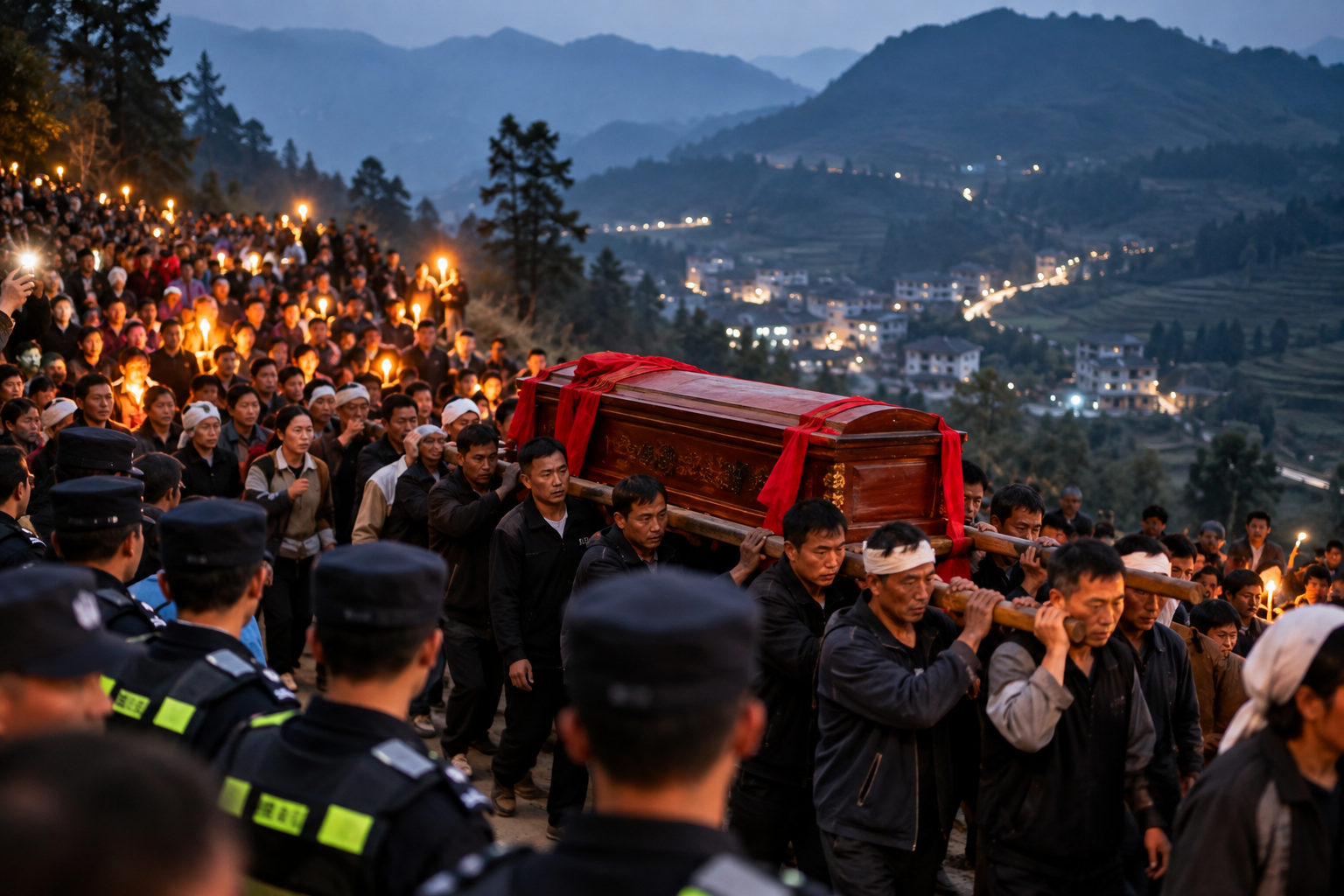
The mountains of China's Yunnan, a funeral has become the setting for an unusually intense confrontation between rural communities and local authorities. Coffins carried through the night, thousands of villagers gathering around burial processions and residents keeping watch over fresh graves have brought an old dispute over cremation back into public view.
The latest confrontation unfolded in Zhenxiong County, where residents say authorities have been enforcing cremation requirements across 14 townships.
On the night of September 14, thousands gathered to escort the coffins of two elderly residents to burial sites despite a large police presence, according to residents quoted by The Epoch Times.
One resident estimated that about 20,000 people took part.
The figure has not been independently verified, but the reported mobilisation illustrates the depth of local resistance to a policy that touches one of the most sensitive areas of rural Chinese life: how families bury their dead.
Coffins become symbols of resistance
Residents told The Epoch Times that people from 14 townships joined the funeral processions. They said hundreds of police officers were present but did not directly prevent the coffins from being taken to burial sites.
The confrontation did not end once the graves were filled. Residents reportedly remained overnight to guard the burial sites, fearing that authorities could later exhume the bodies and send them for cremation.
A woman identified by The Epoch Times by her surname, Zhang, said hundreds of villagers stayed awake through the night to protect the graves.
Such accounts could not be independently verified, and no publicly available official account has confirmed the scale of the deployment or the alleged threat of exhumation.
The reported mobilisation nevertheless points to something larger than a dispute over funeral administration. In Zhenxiong, burial remains closely connected with family identity, ancestry and the idea of returning the dead to the earth.
That cultural dimension helps explain why an administrative policy has produced collective resistance rather than simply individual complaints.
A teenager’s funeral triggers another standoff
The September 14 gathering followed another confrontation two days earlier involving the burial of a 16-year-old boy, He Guoqiang, according to the reports cited by The Epoch Times.
He died on September 6 after reportedly undergoing treatment for leukaemia for two years. His family planned to bury him on September 12.
Residents said they believed local authorities intended to prevent the burial and arrange cremation. Thousands subsequently gathered from surrounding villages and townships, according to accounts given to The Epoch Times.
The crowd escorted the coffin up a mountain and the boy was buried. Residents later organised watches around the grave, reportedly using tents and remaining overnight.
Claims that authorities intended to remove the body, or that the burial was being treated as a test case for enforcing the cremation policy, remain allegations from local residents and have not been independently verified.
The incident nevertheless became another focal point in a dispute that has now repeatedly brought large numbers of villagers into confrontation with local authorities.
China’s cremation policy has deep roots
The dispute cannot be separated from China’s decades-long effort to change funeral practices.
The country's 1997 Regulations on Funeral and Interment Administration established a national policy of promoting cremation in designated areas while permitting burial in areas where conditions for cremation were not available.
The regulations cited conserving funeral land and reforming traditional funeral practices as objectives.
China revised those regulations in 2025, with the new framework taking effect on March 30, 2026.
The revised rules retain the policy of steadily expanding areas where cremation is implemented, while also recognising designated areas where burial is permitted. They promote land-saving and ecological forms of interment and prohibit burying bodies or constructing graves outside legally designated areas.
The revised framework came into force only months before the latest Zhenxiong confrontations.
For authorities, funeral administration sits within a broader regulatory system involving land use, public services, environmental considerations and local administration. For many rural families, however, the issue is experienced at a much more personal level.
Mountains and tradition complicate enforcement
Zhenxiong's geography has long been an important part of the burial debate. The mountainous county has traditionally relied heavily on burial, and residents have said that transportation difficulties and limited access to cremation infrastructure helped sustain the practice.
The national rules themselves acknowledge that burial can remain permitted in designated areas. The revised regulation requires provincial authorities to consider population, transport and land resources when determining and expanding cremation areas.
That distinction matters because the national policy is not simply a blanket requirement that every person in China must be cremated. Its implementation depends on the areas designated for cremation and burial.

Interested in this ad?
Would you like to continue to the link or provide your information for more details?
Please provide your information
To continue, please fill in your details
The current dispute concerns allegations that local authorities in Zhenxiong have extended cremation requirements in ways that residents regard as incompatible with longstanding local practices.
The precise scope and legal basis of the county's current enforcement measures have not been independently established through publicly available official documentation.
Zhenxiong has seen resistance before
The current confrontation is also not the first time cremation has generated unrest in Zhenxiong.
In January 2013, following a landslide in the county that killed dozens of people, relatives protested after victims' bodies were reportedly cremated without family approval.
Contemporary reporting described anger among families who wanted greater control over the treatment of the remains of their relatives.
More than a decade later, the same fundamental dispute resurfaced.
In November 2025, videos circulated showing more than 1,000 villagers in Zhenxiong confronting government personnel during an attempt to take away a deceased person's body, according to footage and accounts cited by The Epoch Times.
Separate accounts published by the Yesterday protest-monitoring outlet described villagers gathering in QingshanVillage and resisting attempts to prevent a traditional burial.
The footage and accounts provide evidence of a confrontation, but claims surrounding individual actions and alleged body exhumations remain difficult to independently verify.
The recurrence of such incidents suggests that the policy has not disappeared from rural tensions even as China's national regulations have evolved.
The dispute crosses provincial borders
The same pattern appeared in neighbouring Guizhou in November 2025.
Residents of Xifeng County protested against a local cremation policy, with videos showing villagers confronting officials over attempts to enforce the policy and alleged efforts to interfere with existing graves.
The Guardian reported that the protests were linked to a local directive requiring cremation and that traditional burial practices remained particularly significant in the region.
Other footage and reports from the period showed confrontations between villagers and officials in Guizhou. Because much of the material circulated through social-media accounts rather than official records, individual claims about what happened remain subject to verification.
The geographic spread is significant. Zhenxiong sits in Yunnan near the Guizhou border, while several other counties across the Yunnan-Guizhou region have experienced disputes over cremation. The pattern indicates that the conflict is not confined to one isolated funeral.
Social media adds another layer
The latest Zhenxiong confrontations have also unfolded alongside attempts to document them online.
Residents told The Epoch Times that livestreamers seeking to broadcast the gatherings had their accounts shut down. Those claims could not be independently verified.
Nevertheless, the circulation of videos and reports from rural protests has become an important feature of China's local disputes.
Events that once remained largely confined to villages can now reach audiences outside the immediate area before authorities have publicly explained what happened.
That creates another point of tension: a funeral that begins as a private family event can quickly become a collective confrontation and, through social media, a national or international story.
A conflict over who controls the final farewell
The Zhenxiong dispute ultimately centres on a question that is both administrative and deeply personal: who decides how a person's remains should be treated?
China's revised funeral regulations place greater emphasis on public administration, ecological burial, land conservation and standardised funeral services.
They also formally recognise burial in designated areas and require provincial governments to consider local conditions when expanding cremation zones.
Yet in parts of rural Yunnan and Guizhou, burial remains intertwined with family tradition and ancestral identity. The repeated appearance of large crowds at funerals shows how quickly enforcement of a regulatory policy can become a matter of collective resistance.
In Zhenxiong, the images described in recent reports are striking precisely because they involve ordinary rural residents gathering around coffins and graves.
The confrontation is not over an abstract regulation. It concerns the final physical connection between families, their ancestors and the places where they expect their dead to remain.