


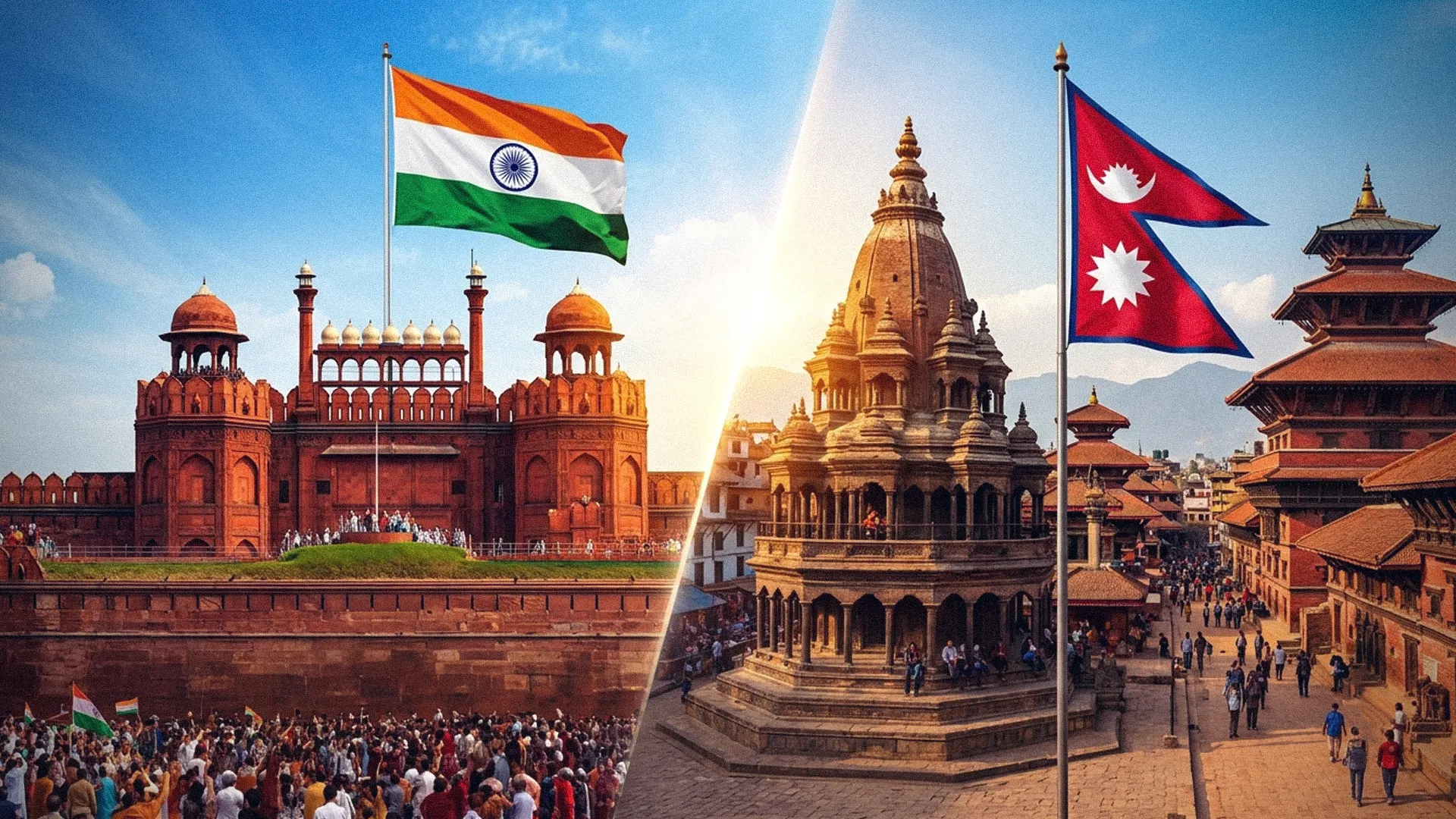
August 15 stands as a watershed moment in the geopolitical history of the Indian subcontinent. The date commemorates the enactment of the Indian Independence Act on August 15, 1947, which formally ended nearly 200 years of British colonial rule and birthed India as a free and sovereign nation. While this day is historically deeply associated with India's first Prime Minister, Jawaharlal Nehru, and his iconic "Tryst with Destiny" speech, its profound impact reverberated across the border into Nepal.
Today, as Indian citizens celebrate their freedom by flying kites, singing the national anthem ("Jana Gana Mana"), and watching the Prime Minister hoist the national flag at the historic Red Fort in Delhi, it is equally important to recognize the symmetrical struggle that intertwined the destinies of India and Nepal.
The Sociopolitical Dichotomy: Autocracy vs. Democracy
During the early to mid-20th century, the relationship between Nepal and British India was defined by a stark geopolitical and ideological dichotomy.
The Rana-British Alliance
The autocratic Rana regime, which had ruled Nepal since 1846, operated with the primary objective of regime survival. Recognizing the immense power of the neighboring British Empire, the Ranas cultivated a deeply symbiotic relationship with the British Crown. In exchange for financial support, diplomatic recognition (cemented by the 1923 Treaty of Friendship), and non-interference in internal affairs, the Ranas provided vital military assistance to the British. This notably included deploying Gurkha troops during the 1857 Sepoy Mutiny, World War I, and World War II. Consequently, the Rana government acted as an informal buffer for British colonial interests, actively suppressing any anti-British sentiment within Nepal.
The Democratic Resistance
Conversely, the underground Nepali democratic resistance recognized a pragmatic and ideological truth: overthrowing the deeply entrenched, 104-year Rana oligarchy would be virtually impossible as long as the regime enjoyed British backing. Concluding that India's liberation was a necessary prerequisite for Nepal's own democratic awakening, Nepali intellectuals, students, and political exiles crossed the porous border. They plunged directly into the Indian anti-colonial struggle, forging a shared destiny with the Indian National Congress and the Congress Socialist Party.
Architects of Freedom: Nepali Leaders in the Indian Struggle
The participation of Nepali leaders in Mahatma Gandhi's 1942 "Quit India" movement stands as a testament to the cross-border solidarity between the two nations. British colonial authorities did not distinguish between Indian and Nepali dissenters, leading to the imprisonment of several individuals who would later shape modern Nepal:

Interested in this ad?
Would you like to continue to the link or provide your information for more details?
Please provide your information
To continue, please fill in your details
-
Bishweshwar Prasad (B.P.) Koirala: A staunch socialist and the future first democratically elected Prime Minister of Nepal, B.P. Koirala was deeply integrated into the Indian freedom struggle. Having studied at Banaras Hindu University, he worked closely with Indian socialist leaders like Jayaprakash Narayan. Arrested by British authorities during the 1942 "Quit India" movement at the age of 27, he spent nearly three years in Hazaribagh Central Jail alongside prominent Indian leaders.
-
Girija Prasad (G.P.) Koirala: Introduced to political resistance at a young age, the younger brother of B.P. Koirala followed into the anti-colonial movement. At exactly 18 years old, he participated in the 1942 protests and faced arrest by the British colonial police, marking the beginning of a lifelong career in labor rights and democratic politics.
-
Man Mohan Adhikari: While studying for his science degree in Varanasi, Adhikari was heavily influenced by Marxist ideologies. He abandoned his studies to join the 1942 "Quit India" protests and was arrested by British authorities at exactly 22 years old. He served time in colonial prisons before returning to Nepal to become a founding member of the Communist Party of Nepal and, eventually, the country's Prime Minister.
-
Krishna Prasad Bhattarai: Mobilized during his student years in Banaras, he organized student wings to support the Indian National Congress. He is also a former Prime Minister of Nepal who played a pivotal role in the nation's democratic evolution.
Networks of Resistance: The Cross-Border Hubs
The ideological and logistical networks connecting the two movements were vast and heavily reliant on Indian border towns. Because political organization was strictly banned in Nepal, cities like Varanasi (Banaras), Patna, and Calcutta served as the intellectual nerve centers for the Nepali resistance.
These Indian cities provided safe havens where Nepali dissidents could publish anti-Rana literature, hold clandestine meetings, and procure arms. The ideological exchange was entirely reciprocal:
-
Indian socialists provided organizational training to Nepali youths.
-
Nepali activists provided manpower and cross-border safehouses for Indian freedom fighters evading British arrest.
-
Crucial intellectuals like Dilli Raman Regmi and Surya Prasad Upadhyay utilized Indian platforms to write against both British colonialism and Rana autocracy.
-
Pushpa Lal Shrestha, influenced by Indian communist leaders in Calcutta, utilized the anti-colonial momentum to lay the groundwork for Nepal's own communist movement.
Historical Synthesis: Post-Independence Relations
The mutual catalysis of the 1920s–1940s fundamentally shaped the modern political landscape of South Asia. The successful culmination of the Indian Independence Movement in 1947 successfully removed the external pillar of support for the Rana regime. Just three years later, utilizing the logistical networks and political capital built during the Indian struggle, Nepali democratic forces—backed by a newly independent India—launched the 1950–51 revolution, successfully ending the Rana autocracy.
Following India's independence, formal state-to-state military ties were swiftly established to replace colonial dynamics, formalizing a lasting brotherhood:
-
The 1947 Tripartite Agreement: Signed between the UK, India, and Nepal, this agreement transferred six of the ten Gurkha regiments from the British Indian Army to the newly sovereign Indian Army, institutionalizing a military bond that remains active today.
-
The Honorary General Tradition (1950): Initiated during a visit by Indian Army Chief General K.M. Cariappa to Nepal, this tradition confers the honorary rank of General upon the respective military chiefs of both nations, symbolizing mutual trust and a shared military heritage.
Ultimately, the story of August 15 is not just a narrative of Indian sovereignty; it is a symmetrical history of cross-border resilience, where the fight for a free India simultaneously sowed the seeds for a democratic Nepal.