


A growing push for institutional integrity has taken center stage as youth activists demand an unfettered, cross-branch probe into the high-profile Inam Sapkota case. Warning against selective investigations and institutional bias, Gen-Z Movement Nepal has called for the immediate creation of a powerful, autonomous citizen ombudsman (Lokpal) to uncover potential corruption bridging the judiciary and executive branches.
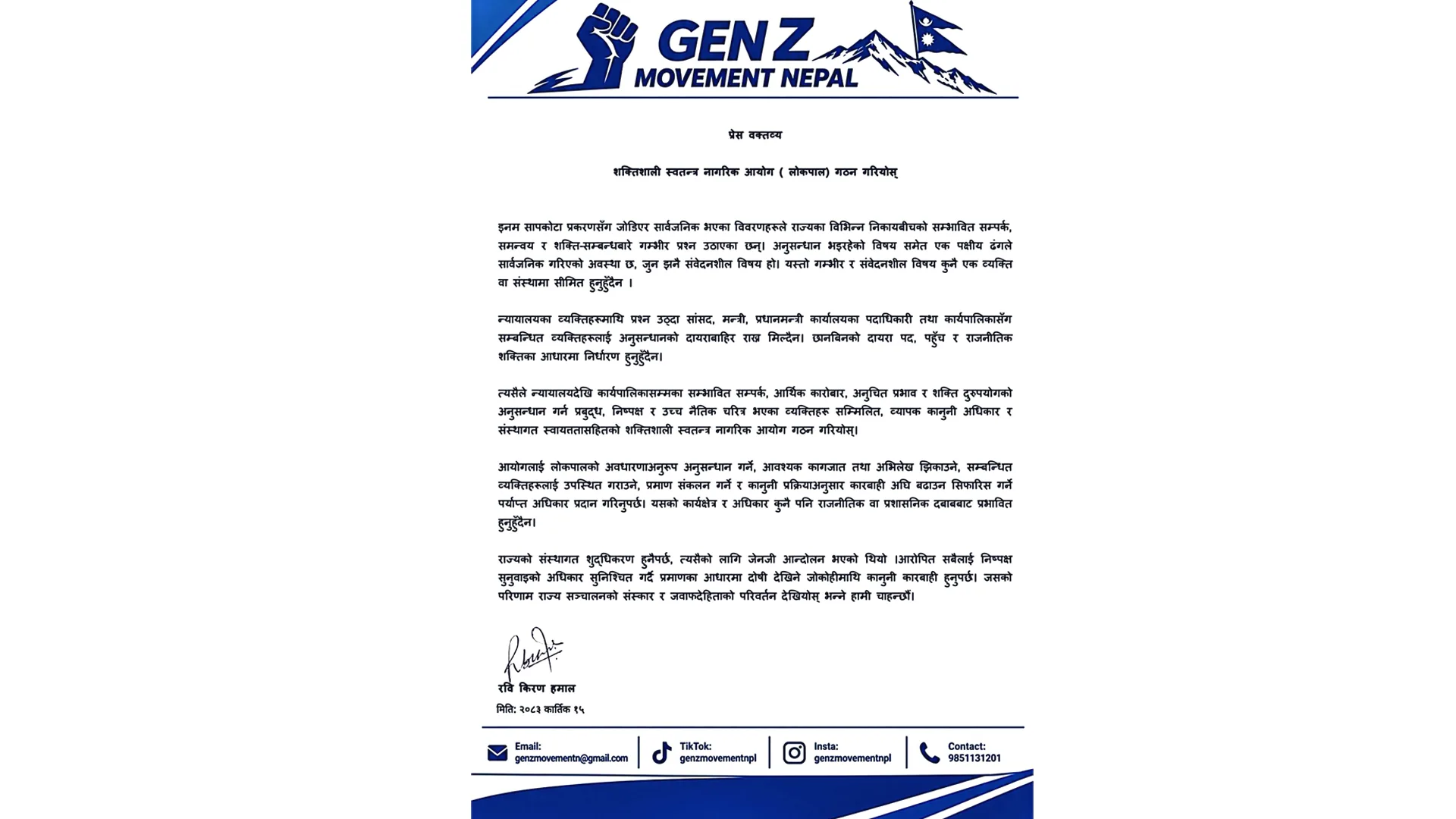
In an official statement released on Sunday (Kartik 14), Gen-Z leader Ravi Kiran Hamal emphasized that any meaningful inquiry into the scandal must transcend individual figures and look into systemic complicity. According to the movement, the proposed independent body must examine potential financial transactions, behind-the-scenes coordination, undue influence, and abuse of authority across all tiers of governance—including judges, parliamentarians, cabinet ministers, and officials within the Prime Minister's Office.
Expressing deep concern over the current trend of unilateral information leaks, Hamal argued that selective disclosures threaten public trust and risk shielding key decision-makers. He maintained that no individual should enjoy immunity based on official stature, political leverage, or institutional access, insisting that high-level officials across the executive branch must remain fully accountable alongside judicial personnel.
To ensure credibility, the movement outlined a blueprint for the citizen commission, insisting it be composed of impartial, highly respected public figures equipped with complete legal autonomy. As envisioned, this independent body would possess full statutory powers to subpoena confidential records, compel testimony from high-ranking officials, collect forensic evidence, and recommend formal prosecution—completely isolated from political or administrative interference.
Reflecting on the broader motivation behind recent youth-led mobilizations, Hamal underscored that genuine change requires a total overhaul of governance culture rather than a simple turnover of political leadership. He affirmed that while every accused party deserves a fair hearing, any individual implicated by concrete evidence must face legal consequences, framing this systemic purification as the foundational goal of the Gen-Z movement.