


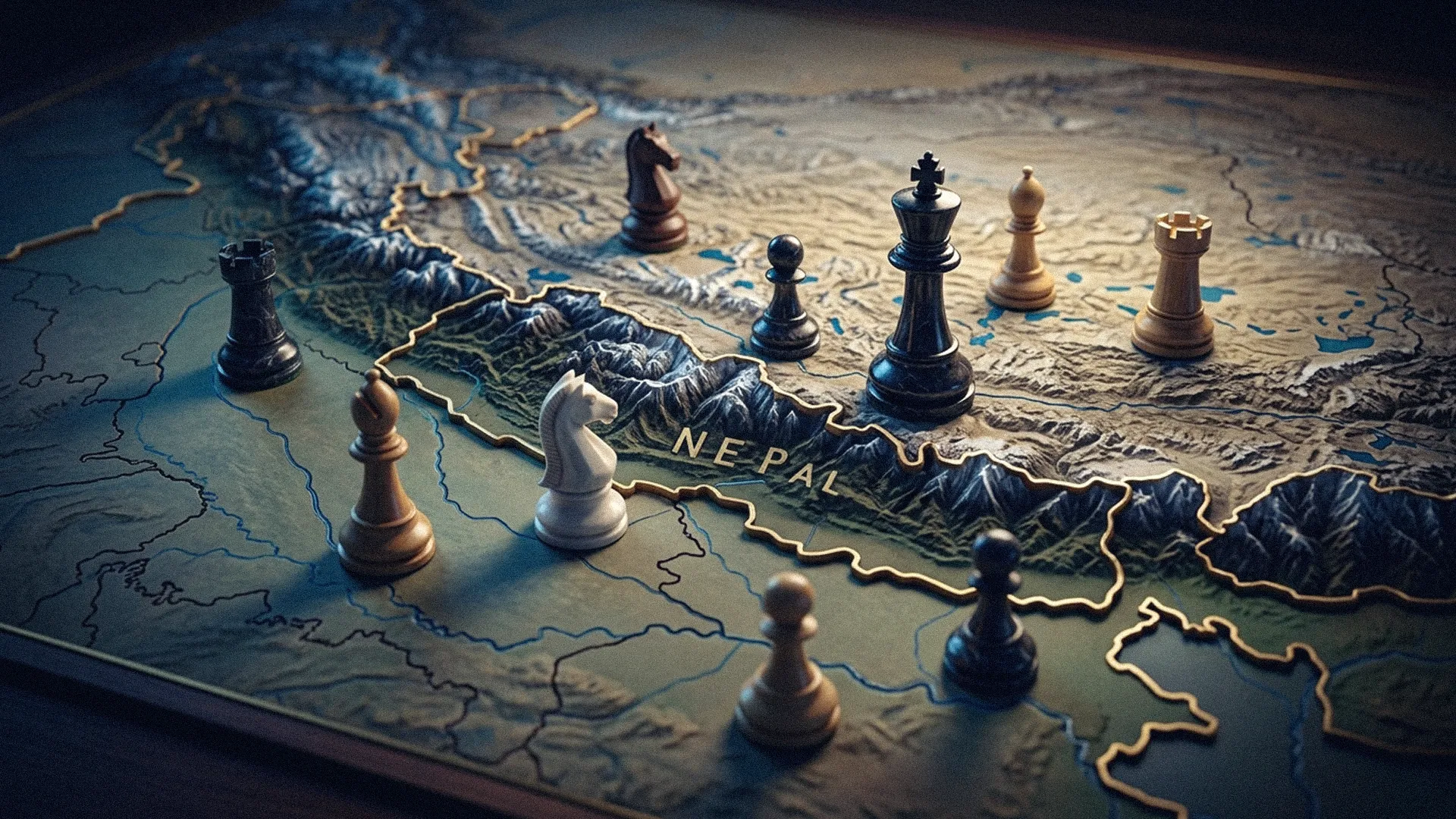
S.B. Shah - Situated in the middle of the Himalayas, this landlocked nation lies between two rising superpowers, establishing Nepal as a geopolitical buffer, and its internal stability directly affects the broader balance between India and China.
Nepal has emerged as a crucial strategic front for the Inter-Services Intelligence (ISI) for years. Taking advantage of the 1,751-kilometer-long open border with India, lenient visa policies, and border security, the ISI has systematically transformed the Himalayan nation into an operational hub, a safe haven, and a transit route for conducting illegal activities. US cables released by WikiLeaks in 2011 contained detailed accounts of how Nepali soil was used in the 1999 aircraft hijacking incident, which severely damaged Nepal's global reputation and systemic vulnerabilities. In addition, a June 2000 report by the global intelligence company Stratfor and the 2001 arrest of a Pakistani diplomat with 16 kg of RDX confirmed that international cartels have exploited Nepal's vulnerabilities.
Recent Security Incidents and Continuous ISI Activity
Recent incidents such as the Prabhat Kumar Chaurasiya espionage and SIM card infiltration module (September 2025), the Ansurul Miyan Ansari module (Mid 2025), the Sheikh Sakim pistol arrest (June 2026), and the Kapilvastu border arrests in the case of high-value gold jewelry theft (April 2026) indicate that ISI-backed operatives have continued their continuous modus operandi. As the newly elected Government of Nepal determines the direction of future bilateral relations with neighboring countries, the continuous use of Nepali soil by foreign intelligence agencies and their agents will create immense pressure on Kathmandu. Stopping foreign intelligence agencies from undermining national sovereignty and internal stability must be viewed as an urgent security necessity for Nepal.
Religious-Demographic Shift and the Growth of Madrasas
A concerning aspect is the gradual change in the religious-demographic structure of our Hindu-majority sovereign state. A thematic study of the official census showed a rapid increase of 55.5% in the Muslim population between 2001 and 2021, of which about 75% reside in the Terai region. According to available data, there are 911 registered and an estimated 2,500-3,000 unregistered madrasas in Nepal, where the average density is one madrasa per 07 to 08 children.
This leads us to the most relevant question:
Where is the funding for the construction of these mosques and madrasas coming from?
Broadly, these funds are received from Zakat/Sadaqah, charitable organizations/trusts, foreign donors, and primarily Islamic charitable organizations from Saudi Arabia, Qatar, the United Arab Emirates, and Kuwait. These numbers are unregulated and alarming!
Is the government planning to form any regulatory body to ensure checks and balances, or will the uncontrolled growth of these religious infrastructures continue unabated?

Interested in this ad?
Would you like to continue to the link or provide your information for more details?
Please provide your information
To continue, please fill in your details
Continuous Influx of Tablighi Jamaat and Local Facilitators
Even though the Government of Nepal repeatedly denies permission for large religious gatherings (Tablighi Jamaat), Tablighi Jamaats from Pakistan and Bangladesh continue to arrive for long periods of three to four months. According to sources, Mufti Abu Bakar Qasmi of the Nepali Jame Masjid in Kathmandu and other elements associated with such organizations are actively involved in welcoming and operating foreign Jamaats, which includes their travel to Terai regions like Nepalgunj, Rautahat, Birgunj, Parsa, and Biratnagar.
Communal Violence and the Role of Foreign Radicals
The Terai recently faced an unfortunate violent communal clash. The government has formed an inquiry commission to investigate the matter. However, what has not been deemed a coincidence is that Turkey-based Pakistani cleric Muhammad Ilyas Ghuman paid a five-day visit to Nepal's border areas, including Kathmandu and Rautahat, in July 2026. According to available information, Ghuman is a radical involved in the targeted killing of security personnel in Pakistan and is associated with terrorist organizations like Hizbul Mujahideen, Harkat-ul-Ansar, and Harkat-ul-Mujahideen, which are banned in the USA, UK, India, and other countries. Is it not ironic that shortly after his visit, on 26 July 2026, Koshi and Madhesh in Sunsari faced a brutal communal clash resulting in the death of five people? Is this a coincidence or connected? What is happening within our borders must be introspected, and security agencies must be alerted. As confirmed by internal sources, Ghuman had directed his confidants in Nepal to construct new mosques in Kathmandu, Rautahat, and Nepalgunj to facilitate the visits of foreign Jamaats.
Does this mean the frequency of Pakistan-based Jamaats will increase in the future?
The government must identify who and why there is an interest in disproportionately investing in religious structures in Nepal, where the Muslim population is only 6%.
Irregular Immigrants and the Entry of Rohingya
Current security dynamics have also drawn attention towards irregular undocumented immigrants, especially Rohingyas. This concern was recently raised by Inspector General of Nepal Police Dan Bahadur Karki. Later, on 07 August 2026, news of 526 Rohingyas residing illegally in Nepal gained prominence. This influx from the border to the hinterland and the capital did not happen overnight. Inspector General of Police (IGP) Dan Bahadur Karki has repeatedly warned about the presence of undocumented foreign nationals, which poses not only a severe threat to Nepal's internal security and law enforcement but could also deteriorate diplomatic relations in the future.
Conclusion and Security Challenges
In the name of Muslim fundamentalist organizations, infrastructure development, and religious discourse, the ISI is exploiting Nepal as a low-cost, high-yield proxy. This is like a pest at the roots of the country and is challenging the nation's security apparatus. The uncontrolled growth of religious infrastructures along with historical precedents, radicalization, demographic modification, and irregular fund flows, as well as radical content in the digital space, is a threat that must be neutralized through regular and digital security mechanisms to dismantle the ISI's underground presence in the country. The government must acknowledge the developments, ban the visits of radical elements, and develop a strategy to mitigate the growing challenges, otherwise, another Sunsari will not be far away.