


Tibet and Tibetans have faced continuous political, cultural, and religious repression since the military takeover by the Communist Party of China (CPC) in 1950. Historical accounts and Tibetan sources describe the destruction of thousands of monasteries, the persecution of monks, and the erosion of traditional institutions that once formed the backbone of Tibetan society. Over decades, Tibetans have been subjected to strict political control, curbs on religious expression, and policies widely interpreted as an attempt to reshape identity and social life. These policies force assimilation, marriages between mainland Chinese and Tibetans, surveillance, bans on the use of the native language, and ideological re-education to erase distinct Tibetan cultural and spiritual traditions in favour of a homogenised state identity aligned with Party doctrine.

Interested in this ad?
Would you like to continue to the link or provide your information for more details?
Please provide your information
To continue, please fill in your details
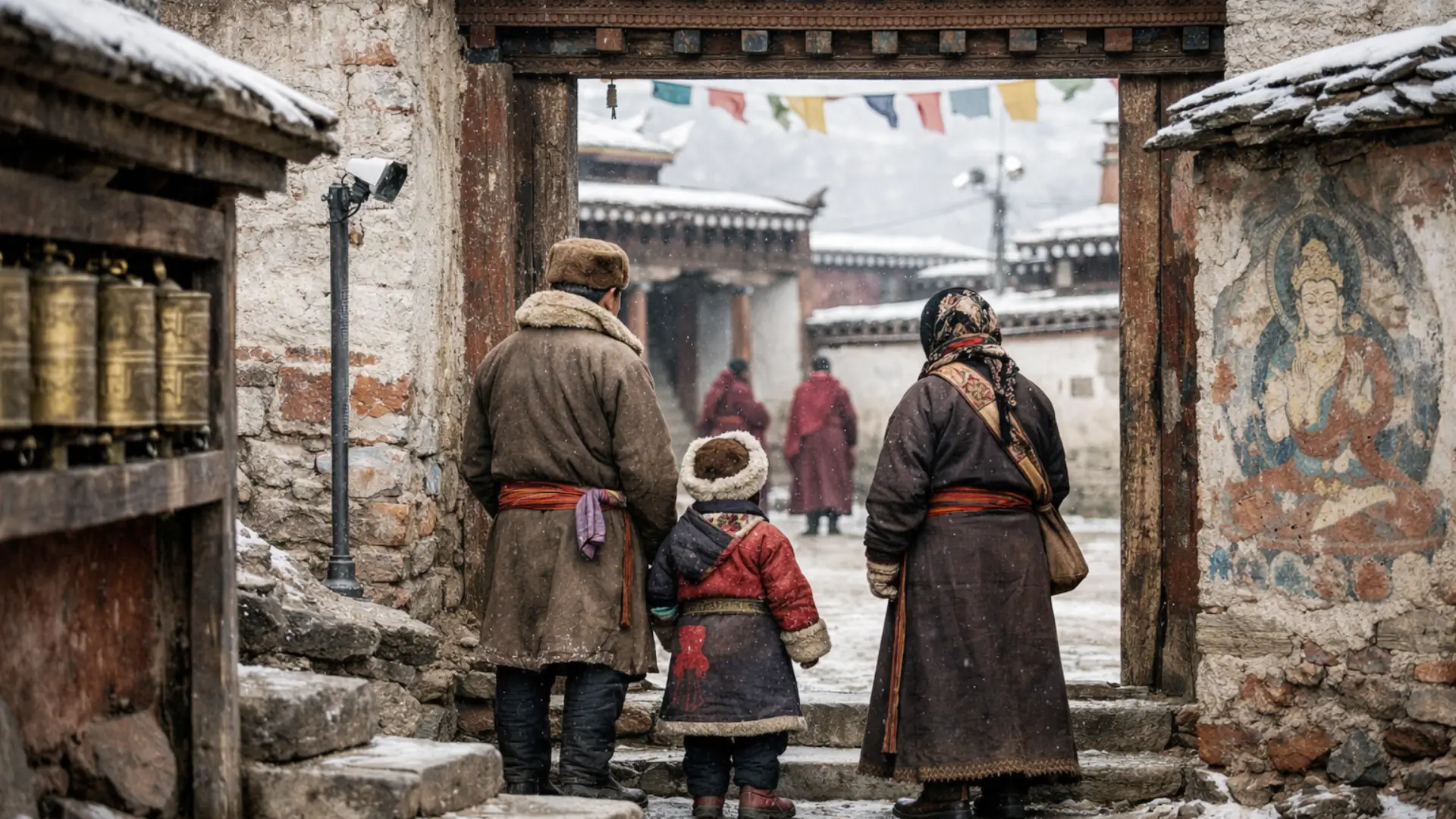
At the core of Beijing’s approach has been a drive to integrate Tibet into a centralised national framework. Policies aimed at “sinicisation” have sought to align local culture, religion, and language more closely with dominant Chinese norms, while discouraging or marginalising expressions of distinct Tibetan identity. Observers often draw parallels with developments in Xinjiang, where similar assimilation-oriented strategies have been documented. People have been banned from speaking their languages or celebrating festivals to discourage the dissemination of their culture to younger generations. Recent developments have intensified these concerns. A video reportedly circulated on the Chinese messaging platform WeChat showed notices posted at the entrance of a monastery in Kham restricting entry to children under 18, during the winter school holidays, a time when families traditionally visit monasteries together. Reports suggest that even children accompanied by parents were denied access, raising fresh questions about the curtailment of religious and cultural participation.
Tibetan scholars are identifying this new policy as a measure to “erase Tibetan cultural imprints from the everyday lives of young Tibetans”. In the recent year the Party has clamped down on Tibetan culture systematically using state policies such as ‘compulsory pre-nursery boarding schools for Tibetan children, the prohibition of Tibetan language instruction in monasteries during holidays’ to eliminate and deprive the the young children of their cultural roots in their formative years, making it easy for the CPC to sell propaganda when these children attain adulthood and join the workforce. This is another step towards creating a homogenous society, where children are forced to leave their native language and traditions to assimilate with the larger Chinese population.
The underlying logic appears calculated: if fewer young Tibetans are exposed to monastic life, fewer will become monks, and the influence of Tibetan Buddhism, language, and cultural traditions will gradually diminish. Education structures reinforce this objective. Schools serving Tibetan children are increasingly administered by the United Front Work Department, the Party organ tasked with managing ethnic and religious minorities. This institutional arrangement prioritises political loyalty and ideological conformity over cultural preservation.
The pressure has intensified in recent years. Authorities have continued to demolish monasteries, religious structures, and sacred symbols across the Tibetan regions. Large Buddha statues and hundreds of stupas have reportedly been razed under administrative justifications—“illegal construction,” “government land use,” or development initiatives such as hydropower projects. These actions not only remove physical symbols of Tibetan spirituality but also weaken community cohesion and collective memory.
A recurring pattern accompanies such actions: once such policies are implemented, communication within and from the region is tightly controlled. Information flows are restricted, digital surveillance is intensified, and Tibetans attempting to share news with the outside world risk detention under charges such as “leaking state secrets.” The result is an enforced silence that obscures the scale of cultural and religious erosion and isolates Tibetan communities from international attention.
The trajectory of policies in Tibet reflects a sustained attempt by the Chinese state to transform a distinct civilisation into a politically compliant and culturally diluted population. What is unfolding is not merely administrative governance or economic modernisation—it is a systematic effort to reshape identity, belief, and memory. Restrictions on monastic access, language, and education are not isolated policies; they are components of a broader strategy to weaken Tibetan cultural continuity and absorb it into a centralised national narrative.
Despite these pressures, Tibetan resilience remains evident in the continued practice of faith, preservation of language, and global advocacy for cultural rights. The struggle of Tibetans today is not only about political autonomy but about the survival of a civilizational heritage rooted in spirituality, community, and historical continuity. International awareness and scrutiny, therefore, remain essential. Without sustained attention, the incremental erosion of Tibetan identity risks becoming normalised—an outcome that would represent not just a regional tragedy, but a profound loss to humanity’s cultural and spiritual diversity.