


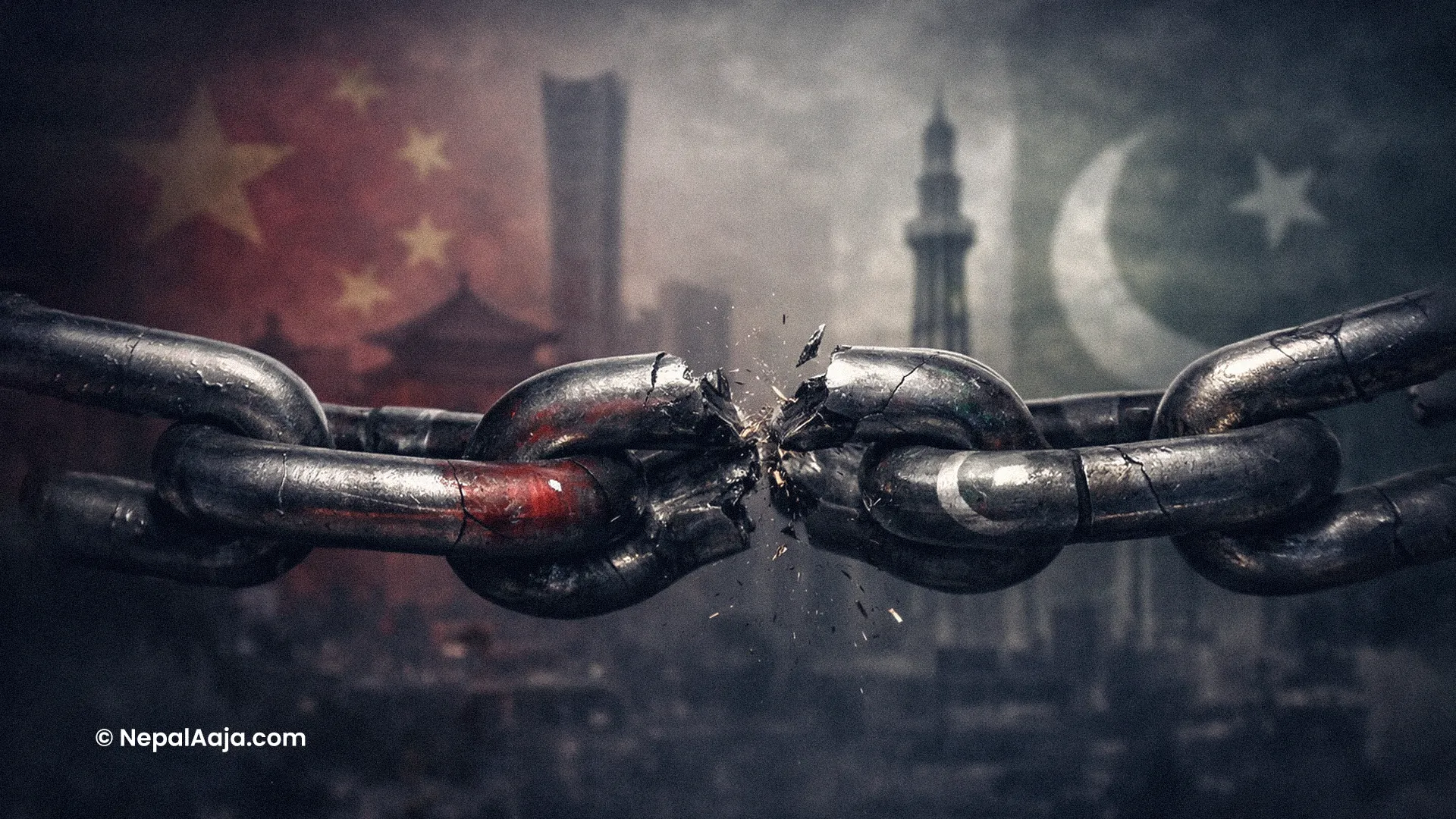
The strategic bond long described as an “iron brotherhood” between China and Pakistan is increasingly under pressure, as Pakistan’s internal instability begins to outpace Beijing’s ability to manage or offset the risks.
Security conditions inside Pakistan have emerged as a critical stress point. Militant groups such as Islamic State Khorasan Province (ISKP) and Tehreek-e-Taliban Pakistan (TTP) have intensified actions that directly threaten Chinese interests. Projects connected to Afghanistan and key infrastructure under the China–Pakistan Economic Corridor (CPEC) have faced repeated attacks and security warnings, raising concerns about the most vulnerable segment of China’s Belt and Road Initiative.
In Balochistan, armed insurgency has escalated further. Incidents including railway explosions, assaults on security installations, and rising cases of enforced disappearances have turned Chinese-backed projects into focal points of local resentment. Baloch groups increasingly frame China as a backer of Pakistan’s military-dominated state, using this narrative to justify attacks on Chinese assets.
At the same time, China’s own economic pressures are narrowing its room for maneuver. Ongoing stress in the property sector, rising domestic debt, and slowing growth have constrained Beijing’s capacity to provide large-scale financial relief to Pakistan as it did in earlier years, according to analysts.

Interested in this ad?
Would you like to continue to the link or provide your information for more details?
Please provide your information
To continue, please fill in your details
This shift is also visible in China’s policy posture. Where economic investment once dominated the relationship, security considerations now take precedence. The expansion of private security deployments and closer military coordination to protect Chinese nationals suggests Pakistan is being treated less as an equal partner and more as a high-risk strategic zone.
International relations analysts argue that the relationship is evolving into one of asymmetric dependence. Pakistan’s reliance on Chinese loans, diplomatic backing, and military technology has deepened, while China increasingly views Pakistan as an unstable yet strategically useful state rather than a balanced ally.
Against this backdrop, the durability of the China–Pakistan axis is being openly questioned. With terrorism, ethnic insurgency, and institutional erosion intensifying inside Pakistan, analysts conclude that external support alone can no longer guarantee stability—revealing the structural limits of Beijing’s influence.