


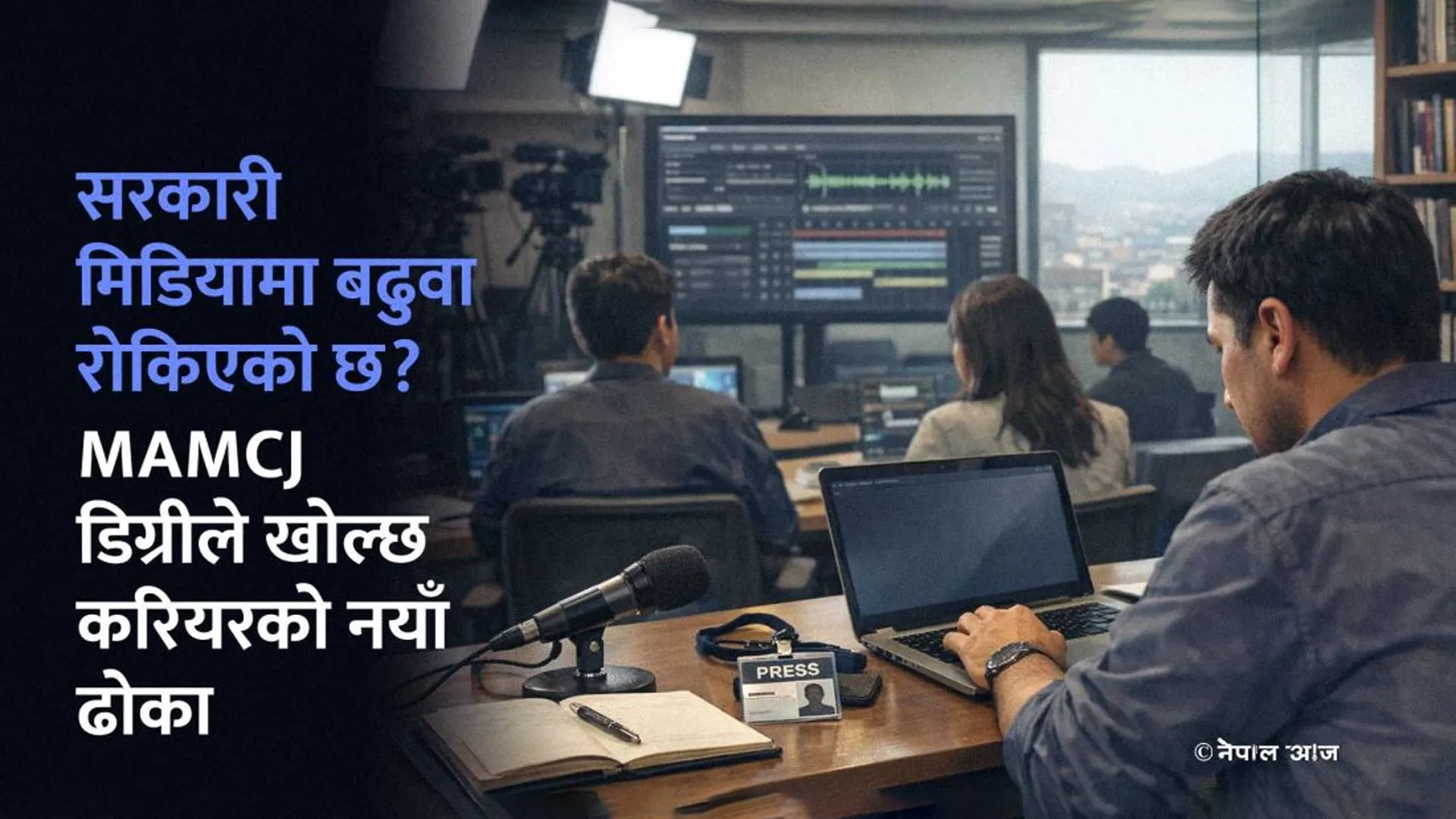
Kathmandu. There was a time when field experience was considered paramount to enter and establish oneself in journalism. Once a person had a good writing style and access to information, academic qualifications were deemed secondary. But times have changed. The Nepali media sector has transitioned from its traditional form into the digital age, and media houses have begun prioritizing the efficiency and academic qualifications of their employees.
Especially for media persons who have been active in journalism for a long time but lack a degree in the subject (Mass Communication & Journalism), this current period could become a career 'turning point'. To reach leadership roles in both government and private sectors, a Master's Degree in Mass Communication, alongside experience, is becoming a mandatory condition.
Why is a Degree Becoming Indispensable in Nepali Journalism?
Journalism is no longer just a passion or a 'hobby'; it has become a specialized profession. Those who entered journalism in the past with Bachelor’s or Master’s degrees in other subjects have now begun to realize the necessity of obtaining a degree in journalism itself to make their careers secure and dignified.
Formal education has become indispensable for understanding the corporate culture entering the media, and for gaining the theoretical knowledge, media laws, ethics, and managerial skills required for editorial leadership. To prove oneself excellent in a fiercely competitive market and to provide 'Academic Validation' to field experience, the importance of a journalism degree has increased.
Rising Academic Standards in Government Media
For hundreds of journalists working in state-owned media—Nepal Television, Gorkhapatra Corporation, Rastriya Samachar Samiti (RSS), and Radio Nepal—academic qualification has become a major hurdle for career development.
Whether entering permanent service or seeking promotion to higher levels, the criterion of having passed the Master's level in the relevant subject (Mass Communication) is being strictly implemented. Many media persons face the compulsion of being unable to reach leadership levels and shrinking into the same post due to a lack of academic qualifications, despite long years of service.
The Public Service Commission (Lok Sewa Aayog) syllabus and promotion criteria have also started giving special preference to degrees in 'Mass Communication'. Therefore, for those seeing their future in government media, studying this subject can prove to be a career 'lifeline'.
The Challenge for Journalists from Non-Journalism Backgrounds
A large section of Nepali journalism comprises journalists from Science, Management, Humanities, or Education backgrounds. While they possess news writing skills, the lack of theoretical knowledge regarding mass communication principles, the sociology of media, and global practices is often felt.
For those with non-journalism academic backgrounds who have made journalism their life's goal, the 'Mass Communication and Journalism' (MAMCJ) degree serves two purposes: first, it legitimizes their profession, and second, it establishes them as fully professional journalists.
Information Technology and the Changing Face of Media
Sponsored Offer
Interested in this ad?
Please provide your information
To continue, please fill in your details
Journalism today is not just about writing or reading news. AI, social media, data journalism, and multimedia storytelling have changed the very shape of the newsroom.
Traditional skills are not enough to cope with this Digital Transformation. The MAMCJ program run at Kantipur City College (KCC) has addressed this need. Subjects included in the curriculum here, such as 'Fundamentals of Information Systems', 'Multimedia Applications', and 'Cyber Publishing', make students proficient in digital journalism and information technology. This helps keep journalists relevant and employable in the changing market.
MAMCJ: A Practical Option for Career Journalists (Running since 2001)
Affiliated with Purbanchal University, the two-year (four-semester) Master of Arts in Mass Communication & Journalism (MAMCJ) program, run continuously by Kantipur City College (KCC) since 2001, is established as an excellent option for working journalists.
The main feature of this program is the "Newsroom + Classroom Approach". Here, not only book lessons are taught, but skills required in a real newsroom are imparted. Considering the busy schedules of working journalists, the college has arranged for hybrid classes (both online and physical).
-
Experienced Faculty: Senior journalists, editors, and experts of Nepal teach here. Faculty members include Janardan Bist, Ekraj Pathak, Laxman Humagain, Binod Dhungel, Rudra Khadka, Awas Raj Upadhyay, Hemant Joshi, Rajiv Timilsina, and Engineer Bhavana Bam for technical subjects. Their presence allows students to exchange lived experiences alongside bookish knowledge.
-
Emphasis on Research: Thesis and project work on subjects like media law, gender issues, and community radio inspire students to become future media researchers.
-
Infrastructure: The college has its own audio-visual lab, photography lab, and recording studio available.
Why is Now the Right Time?
Time waits for no one. In a situation where media houses are cutting staff (Layoffs) and technology is replacing human work, the only way to keep oneself safe is—'Upskilling'.
If you are in government media awaiting promotion, or in private media aspiring to handle editorial leadership, Kantipur City College's MAMCJ program can become a milestone in your career. Scholarships have also been arranged for working journalists here.
Admission and Contact:
Interested journalists and students wishing to take their careers to new heights can contact the KCC office at Putalisadak or inquire online.
Contact: 9851137877 Website: www.kcc.edu.np
Interested in this ad?
Would you like to continue to the link or provide your information for more details?
Please provide your information
To continue, please fill in your details
Sponsored Offer
Interested in this ad?
Please provide your information
To continue, please fill in your details