


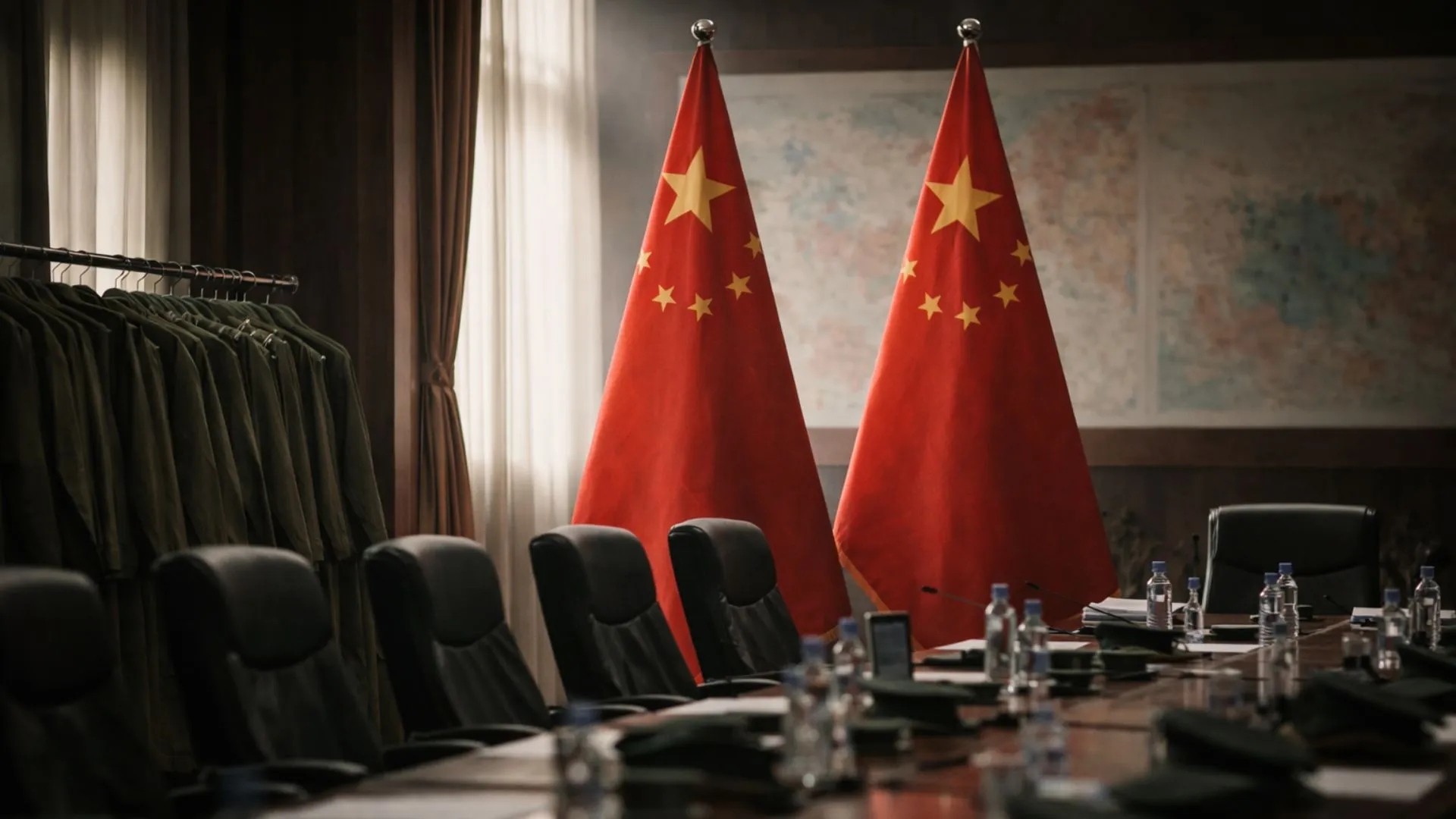
A sweeping purge of senior Chinese military leaders has sharply narrowed the top command structure of the People’s Liberation Army, raising concerns among analysts about operational continuity, internal morale, and crisis decision-making capacity.
Recent removals from China’s Central Military Commission (CMC) — including Vice Chair Zhang Youxia and senior officer Liu Zhenli — have reduced the commission to Chairman Xi Jinping and one remaining member, Zhang Shengmin. According to New York–based political risk consultancy SinoInsider, the contraction of the CMC marks the most politically disruptive phase for the PLA during Xi’s tenure and risks weakening institutional stability at the core command level.
Multiple defence analysts say the shakeup strips the PLA of experienced battlefield leadership at a sensitive time. Evan Sankey of the Cato Institute noted that the commission, typically composed of seven members, is now operating with only two, and none with prior combat experience. He described the situation as both a short-term consolidation of Xi’s authority and a reputational setback for military governance.
SinoInsider assessed that the dismissals — along with parallel anti-corruption and rectification campaigns in equipment and political departments — are likely to interrupt planning cycles and slow operational readiness. The firm warned that repeated leadership changes at theatre command level and the removal of senior figures could temporarily dull the PLA’s ability to coordinate complex missions. The assessment links these disruptions to broader restructuring and discipline drives inside the force.

Interested in this ad?
Would you like to continue to the link or provide your information for more details?
Please provide your information
To continue, please fill in your details
Researchers focusing on Chinese defence policy say the psychological effect inside the system may be as significant as the structural one. Shanshan Mei of RAND Corporation said the climate created by successive removals is likely to increase fear and risk-avoidant behavior not only within military ranks but across government institutions, as uncertainty grows over who might be targeted next.
Zi Yang of the S. Rajaratnam School of International Studies in Singapore described the fall of Zhang and Liu — including one regarded as a decorated combat veteran — as an unusual break in the PLA’s professional core. According to his assessment, cited in the source text, the scale of leadership turnover is comparable to periods of historic political upheaval and could trigger extended instability through 2026 if internal factions are further implicated.
Former Pentagon Asia strategist Drew Thompson argued that a thinner advisory circle around Xi increases the danger of flawed judgments in a crisis. He stressed that effective deterrence depends on leaders receiving competent and independent military advice, adding that the reduced size of the CMC raises questions about who participates in top-level wartime consultations.
Policy specialist Lyle Morris of the Asia Society Policy Institute said, as reported in the source material, that removing seasoned commanders may produce lasting consequences for cohesion and combat effectiveness. With command continuity weakened and morale under strain, analysts broadly expect turbulence inside the PLA’s upper ranks to persist in the near term.