


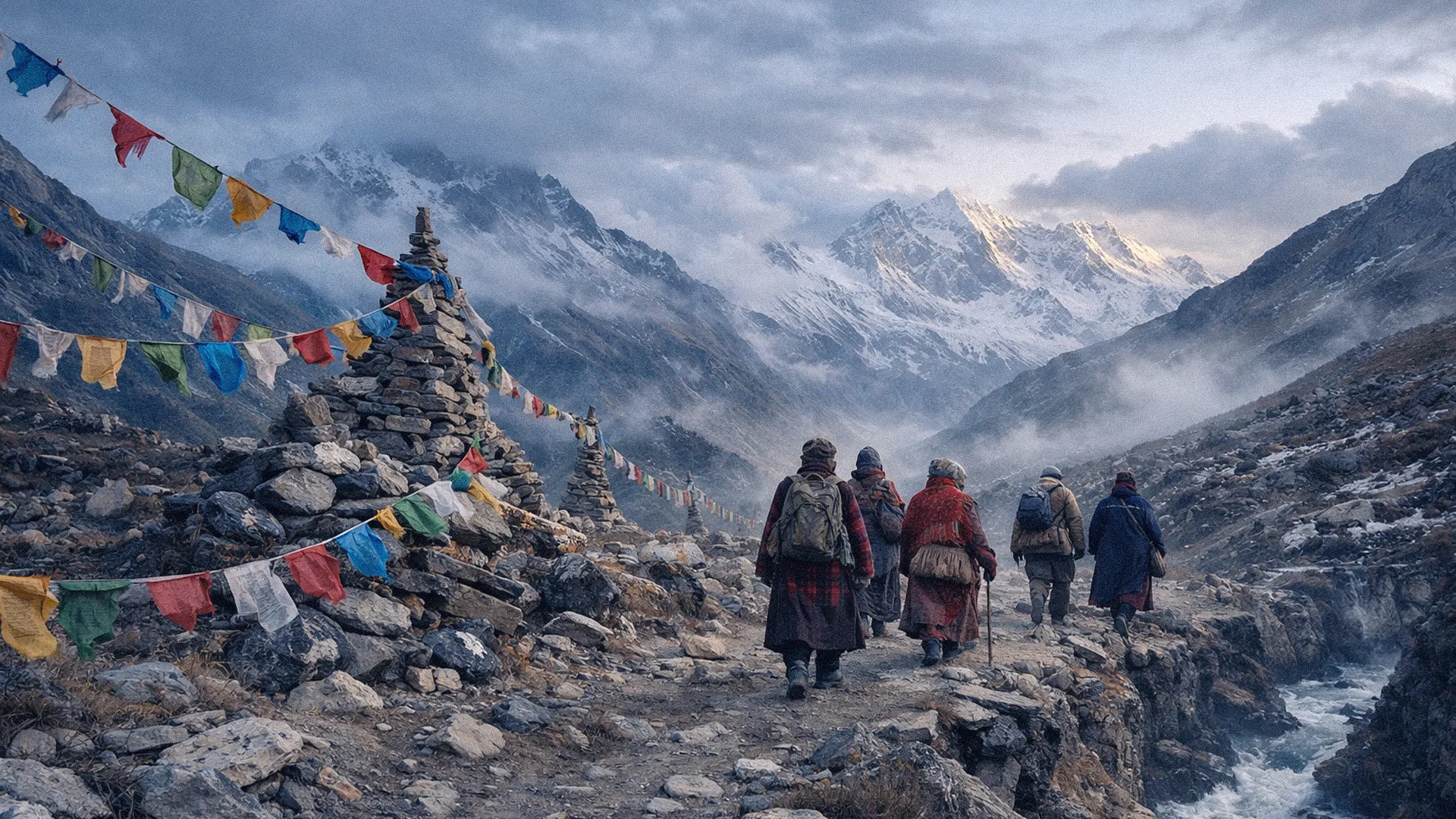
Magh 2082 - In the first week of last Bhadra, Bhakta Singh from Jayaprithvi Municipality Ward No. 1, Pimik, along with four of his relatives, walked for five days to reach the Nepal-China border area of Urai Bhanjyang. Leaving Urai at 2:00 AM, his team reached Kathan in Tibet, China, by 6:00 AM. Kathan is the area where the Karnali River (known as Mapja Tsangpo in Tibetan), which originates near Lake Mansarovar, flows.
They had gone there to immerse the hair of the deceased Dhami (spiritual healer/shaman) of their ancestral deity, Masto. In Bajhang, when a Dhami passes away, their hair (Lada) cannot be cremated with the body. Before the Dhami breathes their last, the hair is cut and kept safely. After another person assumes the avatar of the Dhami, the new Dhami, while in a trance, designates the specific place where the hair must be immersed. These designated places of immersion become pilgrimage sites. Usually, the hair of deceased Dhamis is taken to Mansarovar in Tibet for immersion.
It had been eight years since Bhakta's family was unable to immerse the Dhami's hair. Citing the COVID-19 pandemic, China closed the Urai pass in 2019, which prevented the family from immersing the hair of the Dhami who had died two years prior to that. When his family went to immerse the hair at Mansarovar in Shrawan 2081 BS, Chinese security personnel turned them back before they reached the designated spot. After walking for seven days to get near Taklakot, they were denied entry to Mansarovar. Instead, they were mistreated, and the photos on their mobile phones were deleted.
Having faced harassment from Chinese security personnel the previous year, they came up with a new plan this year. After consulting the new Dhami—who advised that it would be acceptable to immerse the hair in the Karnali River flowing through Kathan, slightly further from Urai—they reached there overnight. "We hurriedly immersed the Lada there," Bhakta said. He explained that they quickly returned to the Nepali border before there was any movement of people, fearing they might be spotted by security personnel like the previous year.
"Actually, it was supposed to be immersed in Mansarovar. But they don't let us go there," he said. "Since we couldn't go to Mansarovar, we immersed it in the Karnali on the advice of the new Dhami. Keeping a dead person's hair for years felt uncomfortable, but we hadn't been able to dispose of it because we couldn't go to Mansarovar."
Just like Bhakta's family, people from every village in Bajhang are currently facing various hardships at the border. The Chinese government has banned entry to Mansarovar, a place where people had been traveling unhindered for hundreds of years. This has put the religious and cultural practices of Bajhang's locals in crisis. Not only the immersion of the deceased Dhamis' hair and offerings to ancestors (Pitru Tarpan), but even the ancestral worship (Kul Puja) in almost all villages of the district has been stalled for years.
It has been an age-old tradition that the worship in most temples of Bajhang begins only after offering water from Mansarovar. Moreover, due to the lack of Mansarovar water, the appointment of new Dhamis in the temples has also been halted. According to local culture, once a new Dhami goes into a trance, they must travel to Mansarovar and Kailash, bring holy water from there, and offer it at the temple before officially taking their seat (getting official recognition as a Dhami). In some temples, the annual worship begins only after offering Mansarovar water. The inability to fetch this water has even affected the annual pujas.
Under the Masto culture, bringing and offering Mansarovar water once a year during the worship of deities is a mandatory cultural ritual. For the Dhamis of most deities, they are considered true Dhamis only after they bathe in Mansarovar and get a darshan (glimpse) of Mount Kailash once the deity incarnates in them. Even after being recognized as a Dhami, it is a mandatory rule to bathe in Mansarovar and circumambulate Kailash every two to three years. People travel on foot from Bajhang to fetch Mansarovar water. Devotees from Bajhang, along with Dhamis and priests, walk the specific path believed to have been designated by the deity, with fixed resting places along the way.
Walking from Taklakot via Bajhang's Urai, they must follow the path previously taken by the Laga deity (a deity associated with the Masto culture) and stay overnight at Gauri Odar (a cave). The rule is to bathe in Mansarovar, fetch the water, stay again at Gauri Odar, perform puja, and then return. Shyam Khadka, author of the book Masto Culture and Tradition, said, "Some return to Bajhang from there. Others bury the water vessel nearby on the banks of the Gauri stream, go to circumambulate Mount Kailash, and bring back the buried water on their way back."
Before the COVID pandemic, based on temporary entry permits issued by the Bajhang District Administration Office, locals could easily enter Tibet through the Urai pass. However, although the Chinese government opened the border for commercial purposes post-pandemic, it has not permitted entry for the Mansarovar pilgrimage.
Dhamis of various shrines and temples in Bajhang, local residents, local governments, and provincial and federal representatives have submitted memorandums ranging from the Prime Minister of Nepal to the Chinese Ambassador to open the Mansarovar pilgrimage, but there has been no hearing on this matter.

Interested in this ad?
Would you like to continue to the link or provide your information for more details?
Please provide your information
To continue, please fill in your details
"They treat those who go to fetch holy water like criminals, but allow those carrying herbs from here to enter directly," said Chandra Singh of Jayaprithvi Municipality, who had set out for Mansarovar in Shrawan 2081 but was turned back halfway by Chinese security. "Their treatment of traders and pilgrims is completely different," Singh added. "For instance, at the Chinese border, there are no restrictions not only for legal traders but even for illegal ones."
As Singh mentioned, the Urai Bhanjyang border pass—located in Saipal Rural Municipality of Bajhang, which is geographically Nepal's largest and perhaps its most remote in terms of facilities—lacks both a customs office and a security post. Taking advantage of this weakness, large quantities of herbs are illegally exported through this route every year. Due to the smuggling of wildlife parts to Tibet via this pass, poaching is increasing in Bajhang. Consequently, the existence of wildlife listed as rare and endangered by the Nepal government is at risk.
Eyewitnesses say that in recent years, after strictness increased at eastern borders like Tatopani, smugglers who bring red sandalwood from India to smuggle into China have also started using this route, taking advantage of the absence of security posts to send red sandalwood to Tibet.
Until 2059 BS (2002), a temporary Nepal Police security camp was stationed at a place called Kanalga, 2 kilometers from the border. This camp was removed during the state of emergency. Currently, Nepal's border security post is located in Dhuli village of Saipal Rural Municipality, about 30 km away from the border. Saipal Rural Municipality Chairman Manvir Bohara says, "Smugglers rule the border area."
In the absence of security personnel, smugglers openly conduct their business around the border with no one to stop them. Bohara said, "The Chinese security post is only in Kathan. Since pilgrims take that route, Chinese security personnel turn them back. But smugglers have thousands of routes." He mentioned that smugglers use alternative paths within Tibetan territory to deliver goods near Taklakot.
Former Chairman of Saipal Rural Municipality, Rajendra Dhami, states that contraband items—including herbs, wildlife parts, and red sandalwood—are stockpiled at a place called Thadodhunga near the Urai Bhanjyang border pillar, and transported to the Tibetan border town of Taklakot from Chaitra to Kartik. He noted that herbs, mostly red mushroom, Panchaule, Katuki, Satuwa, Jatamasi, and wild garlic, go to Tibet through this route. "We submitted memorandums from the province to the center demanding a security post and customs office at the border. But the government didn't listen," Dhami said. "When there is no state presence, arbitrariness is bound to happen."
In Chaitra 2068 BS (2012), Bajhang police arrested 86 porters with about 35 quintals of red sandalwood from Baril in Rithapata while it was being taken towards Tibet. All the porters were from Bajura. In Asoj of the same year, it was revealed that about 50 quintals of red sandalwood were transported to Tibet using over 150 porters from Achham and Bajhang. In that red sandalwood smuggling scandal exposed by the Bajhang porters, there were strong suspicions of collusion by the Bajhang police administration.
Since then, no red sandalwood destined for Tibet through this pass has been seized. However, locals and hotel businessmen along this route say that red sandalwood passes through this border to Tibet every year. Due to the closure of the Tatopani border in Sindhupalchok and tightening at other borders like Rasuwa, smugglers have changed routes and started using the Bajhang border.
Voices have been raised repeatedly, not just in Saipal Rural Municipality but throughout the district, demanding that a customs office be opened at this border and Armed Police Force personnel with special facilities be deployed for border security. This border, which often becomes an election agenda for candidates, had seen the then Bajhang District Council make repeated decisions and send them to the center to manage the customs office and security. However, Bajhang officials say that due to a lack of response, the Urai pass has become increasingly easy for smugglers.
Credit: Basant Pratap Singh, Centre for Social Innovation and Foreign Policy (CESIF)