


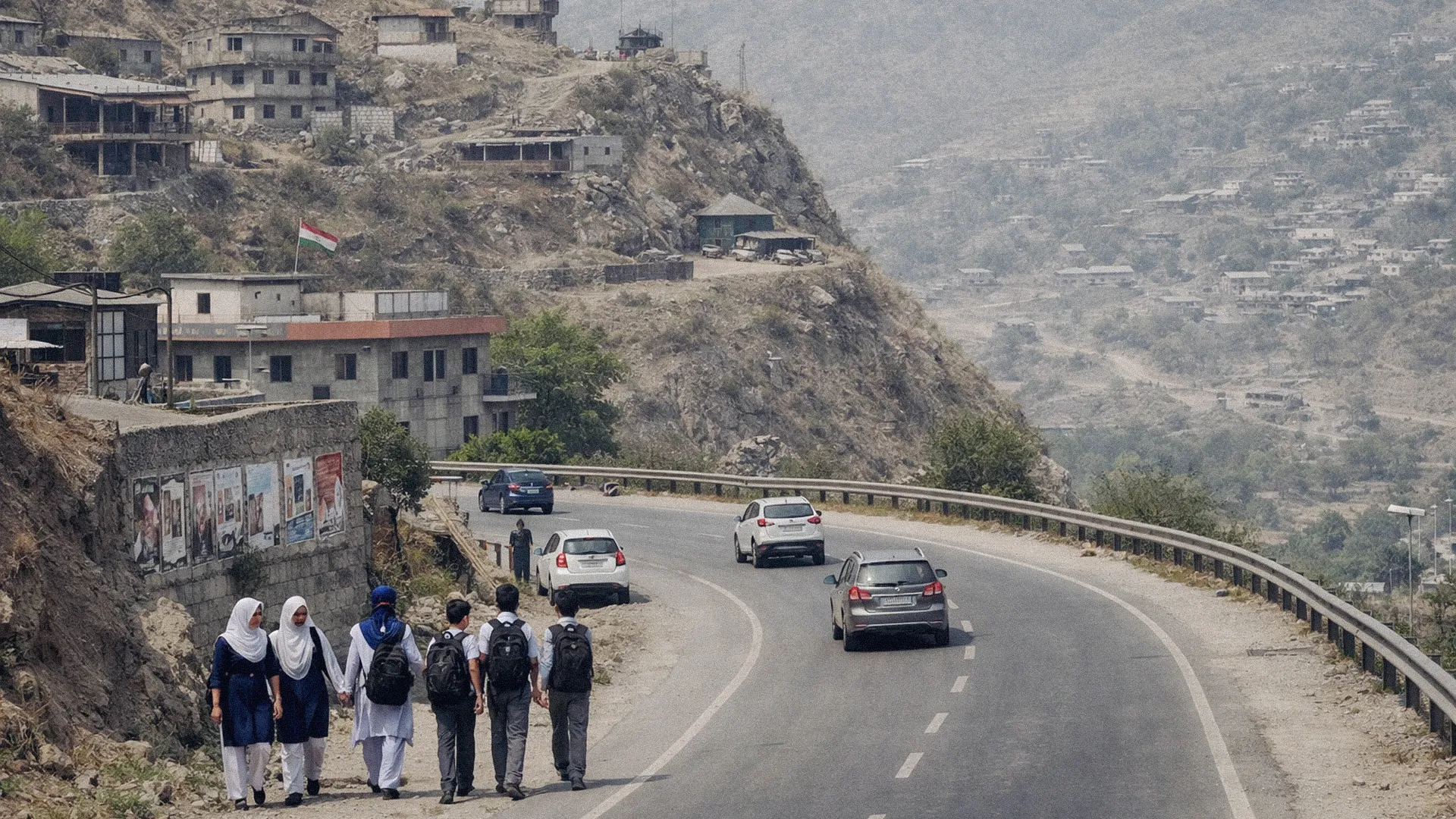
Jammu & Kashmir (J&K) stands today as one of the most relevant examples of democratic empowerment and institutional integration in South Asia. The abrogation of Article 370 in August 2019, though controversial in international debates, has undeniably enhanced the governance, rights, and economic progress in the region. In contrast, Pakistan-occupied Kashmir (PoK) continues to languish under Islamabad’s tight administrative grip, marked by political manipulation, curbed civil freedoms, and the absence of genuine local representation. This contrast underscores how democratic inclusion and infrastructural modernization in J&K have empowered people, while PoK remains administratively marginalized.
Post-2019, J&K’s administrative framework was aligned with the Indian Constitution, extending national welfare schemes, electoral processes, and judicial oversight directly to its citizens. The Election Commission of India’s preparations for the 2024 assembly elections symbolized a restored democratic rhythm, ensuring uniform enfranchisement. According to the UNDP Democracy Index Report (2024), India’s governance framework in J&K follows constitutional norms ensuring citizens’ voting rights and participation, contrary to PoK, where local elections remain largely symbolic. Human Rights Watch (HRW) and Amnesty International have long noted systematic constraints on freedom of association, the press, and political dissent in PoK, with federal intelligence and military agencies closely supervising administrative decisions (Human Rights Watch, 2023).
Pakistan’s control over PoK is largely mediated through the Azad Jammu & Kashmir Council, based in Islamabad, which retains overriding powers over finance and policy, effectively negating local autonomy. The International Crisis Group (ICG) has documented that budgetary decisions for PoK are made by Pakistan’s Ministry of Kashmir Affairs, limiting local government initiative (ICG Report, 2022). J&K’s assembly awaits full operational restoration under the Indian Election Commission’s supervision, while PoK’s governance remains unclear under Pakistan’s bureaucratic hierarchy.
Democratic empowerment also translates through tangible development. Over the past five years, J&K has undergone transformational infrastructure expansion, blending national security imperatives with civilian benefits. Projects like the Chenab Railway Bridge, the Zojila Tunnel, and the Udhampur-Srinagar-Baramulla Rail Link have connected remote border belts with the national economic grid, facilitating both troop mobility and tourism.
Official Indian government figures show nearly ₹2 lakh crore (≈US$23.3 billion) worth of highway and tunnel projects are underway in the Union Territory. Combined with the PMGSY-IV programme (approved ₹4,224 crore) and the New Industrial Policy 2021, J&K’s Gross State Domestic Product has risen to ₹2.62 trillion (US$30.35 billion) in FY 2024–25, an 8.55% CAGR since 2018–19. The World Bank’s 2024 South Asia Economic Focus Report attributes part of this growth to India’s improved subnational investments in connectivity corridors through J&K, which reduced logistical isolation and expanded employment access (World Bank, 2024).
Tourism has emerged as a crucial democratic dividend. With over 23 million tourist visits in 2024 (up from 21 million in 2023), the sector now contributes close to 7% of the UT’s GDP, demonstrating how peace dividends can directly translate into livelihoods. Complementing these efforts, central schemes like Ujjwala, PM-KISAN, and Jal Jeevan Mission have penetrated rural belts, ensuring welfare delivery without administrative distortions—a key indicator of the shift from the earlier semi-autonomous arrangement.

Interested in this ad?
Would you like to continue to the link or provide your information for more details?
Please provide your information
To continue, please fill in your details
Infrastructure and governance reforms in J&K have focused not merely on roads and tunnels but on bridging social divides. Initiatives under the Smart City Mission have modernized Srinagar and Jammu, while 4G and 5G expansion have reached previously disconnected villages. According to the Telecom Regulatory Authority of India (TRAI), by March 2025, the region had a wireless tele-density of over 90%, significantly reducing the digital divide and enabling e-governance outreach.
In contrast, Freedom House’s 2024 Report on Internet Freedom ranks Pakistan among the “not free” countries in digital access, citing frequent network blackouts in Gilgit-Baltistan and PoK during protests (Freedom House, 2024). Pakistan’s use of restrictive telecommunications policies and enforced disappearances of local journalists has choked civic discourse. The absence of decentralized digital infrastructure in PoK represents an extension of Islamabad’s authoritarian model, where even constitutional amendments, such as the 13th Amendment (2018), failed to restore genuine fiscal or political autonomy.
By comparison, PoK remains dependent on Pakistan’s politically controlled economy. Islamabad restricts cross-LoC trade and imposes indirect taxation through federal decrees. The Asian Development Bank (ADB) notes that PoK’s fiscal dependence on Pakistan’s federal transfers exceeds 80%, leaving its local administration financially incapacitated (ADB Country Report, 2023). Employment remains precarious, and youth participation in governance or entrepreneurship is constrained by bureaucratic-military collusion.
The most defining divergence lies in political pluralism. J&K’s political parties, ranging from the National Conference to the People’s Democratic Party, work within a constitutionally protected multiparty framework under the Election Commission’s scrutiny. Meanwhile, PoK’s political laws outright bar parties or candidates that question accession to Pakistan. The International Commission of Jurists (ICJ) has criticized these restrictions, noting that such exclusion violates Article 25 of the International Covenant on Civil and Political Rights (ICCPR), which guarantees free political participation (ICJ, 2024).
True democratic empowerment goes beyond voting; it manifests through freedom of speech, equal economic access, and institutional accountability. In J&K, the convergence of infrastructural development, economic liberalization, and electoral readiness represents a calibrated integration of democracy with regional aspirations. On the other side of the Line of Control, PoK’s constrained polity and media silencing underscore a systemic denial of that same empowerment. While J&K’s journey may still face challenges, it is marked by transparency, institutional participation, and measurable progress—qualities absent in Islamabad’s administered territory. In the long run of democratic evolution, J&K’s reintegration into India’s electoral and rights frameworks signals a region moving from uncertainty to empowerment, while PoK continues to echo the silence of suppressed voices awaiting genuine autonomy.